
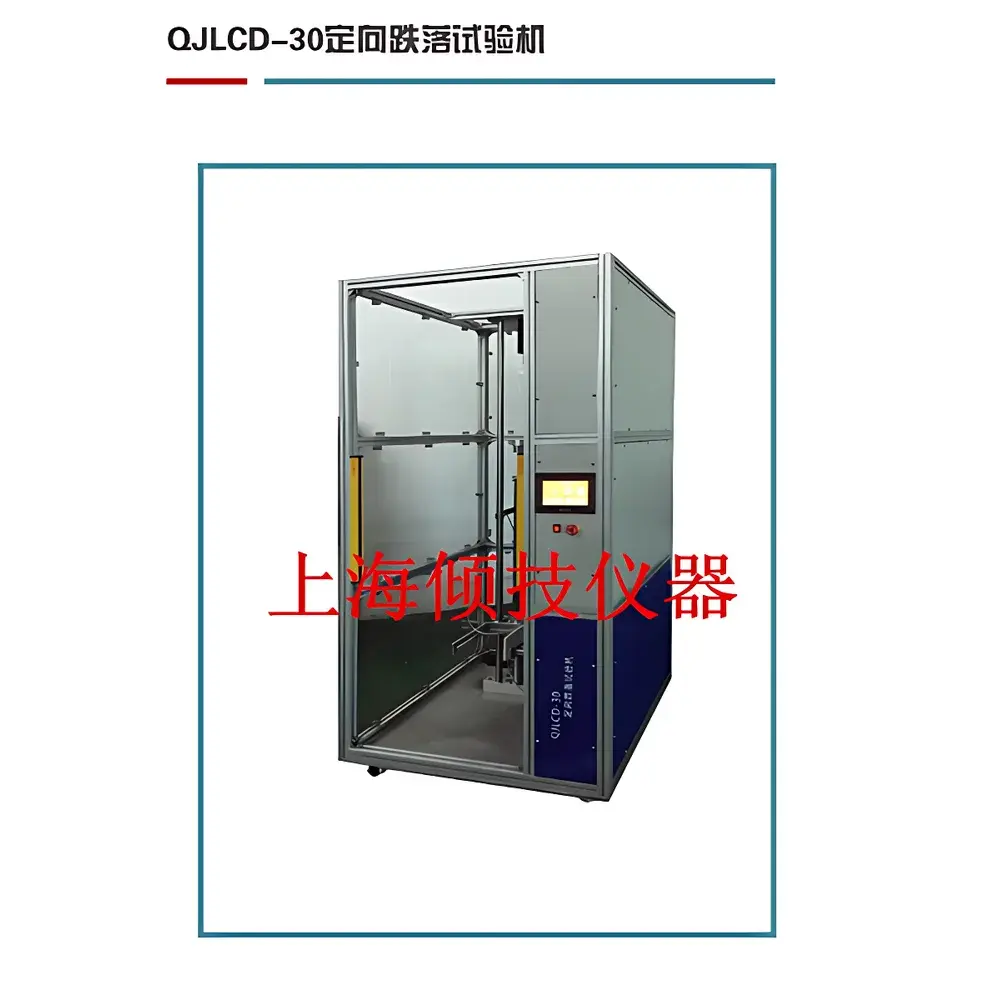
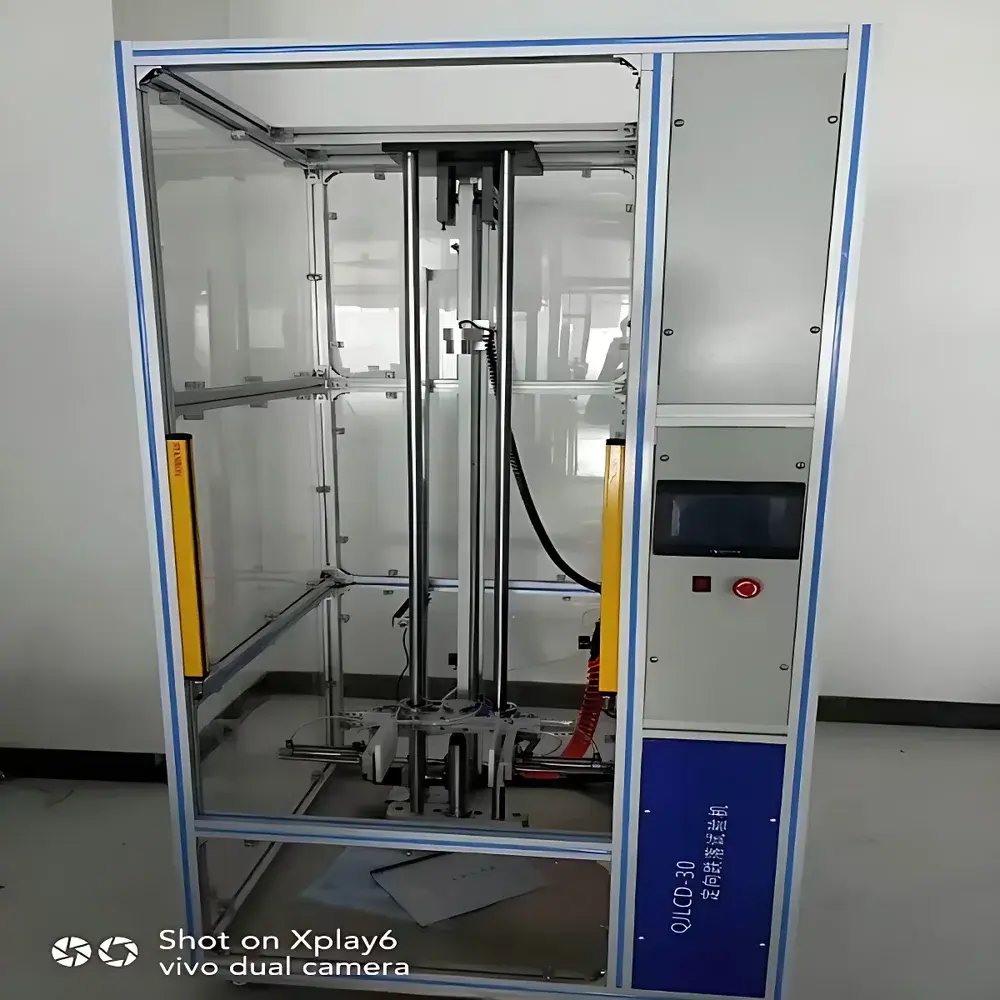
Qinji LCD-30 Directional Drop Tester
| Brand | Qinji |
|---|---|
| Origin | Shanghai, China |
| Model | LCD-30 |
| Drop Height Range | 400–1800 mm (±0.5 mm positioning accuracy) |
| Max. Specimen Weight | 700 g |
| Max. Specimen Dimensions | 350 × 350 × 50 mm |
| Drop Surface Dimensions | 350 × 350 × 50 mm |
| Drop Angles | 0°, 45°, 90° |
| Suction Cup | Six Ø16 mm vacuum cups |
| Compliance | IEC 60068-2-32 |
| Drive System | Servo motor + synchronous timing belt |
| Control System | Touchscreen HMI + PLC |
| Air Supply | ≥0.6 MPa clean compressed air |
| Power Supply | AC 220 V ±10%, 50 Hz |
| Rated Power | 400 W |
| Overall Dimensions | 800 × 900 × 2400 mm |
| Net Weight | 270 kg |
| Drop Surface Material | Granite or concrete (customizable) |
| Surface Roughness | Ra 0.59 µm (granite), Ra 1.29 µm (concrete) |
Overview
The Qinji LCD-30 Directional Drop Tester is an electromechanically controlled impact testing system engineered for precise, repeatable evaluation of product robustness under controlled free-fall conditions. It operates on the principle of gravity-driven acceleration, where specimens are securely held by vacuum suction cups and released from programmable heights onto standardized rigid impact surfaces. Unlike generic vertical drop testers, the LCD-30 enables directional orientation control—supporting impact tests on flat faces, edges, and corners of rectangular packages or electronic enclosures in accordance with IEC 60068-2-32 (Environmental testing – Part 2-32: Tests – Test Ed: Free fall). Its servo-driven vertical lift mechanism ensures sub-millimeter positional repeatability (±0.5 mm), critical for comparative analysis across multiple test cycles and compliance validation.
Key Features
- Six independently controllable Ø16 mm vacuum suction cups allow secure gripping and orientation of specimens up to 700 g and 350 × 350 × 50 mm in volume.
- Three-axis directional capability supports standardized impact configurations: two large faces, four small faces, eight edges, and four corners—fully aligned with IEC 60068-2-32 test matrix requirements.
- Precision servo motor coupled with a synchronous timing belt drive delivers smooth, vibration-damped vertical motion and accurate height positioning across the 400–1800 mm range.
- Integrated touchscreen HMI communicates directly with industrial-grade PLC firmware, enabling intuitive test setup, real-time status monitoring, and parameter logging without external PCs.
- Modular impact surface assembly accepts interchangeable granite or concrete plates—both characterized for surface roughness (Ra 0.59 µm and Ra 1.29 µm respectively)—ensuring consistency across laboratories and audit-ready traceability.
- Compressed air interface (≥0.6 MPa) powers vacuum generation and mechanical release actuation, eliminating reliance on pneumatic compressors with oil contamination risk.
Sample Compatibility & Compliance
The LCD-30 accommodates consumer electronics housings, handheld medical devices, retail packaging, and small industrial components requiring mechanical shock validation prior to distribution. Its dimensional envelope and weight limit (max. 700 g, 350 × 350 × 50 mm) align with common portable device categories subject to ISTA 2A, ASTM D5276, and MIL-STD-810H Method 516.6 (Drop Test). The system complies with IEC 60068-2-32 as a primary reference standard, and its mechanical design permits adaptation to ISO 2247, GB/T 4857.5, and JIS Z 0202-1 when paired with calibrated instrumentation and documented SOPs. All hardware interfaces—including electrical grounding, air supply filtration, and structural rigidity—meet CE machinery directive (2006/42/EC) baseline safety requirements.
Software & Data Management
Test parameters—including drop height, release angle, cycle count, elapsed time, and vacuum status—are stored locally in non-volatile memory via the embedded PLC. The HMI interface logs each test event with timestamp, operator ID (via optional login module), and pass/fail flags based on user-defined criteria (e.g., visual inspection post-drop). While the base system does not include network connectivity or FDA 21 CFR Part 11-compliant electronic signatures, it supports export of CSV-formatted test records via USB port for integration into LIMS or quality management systems. Audit trails can be maintained manually per GLP/GMP guidelines using printed reports generated from the HMI’s built-in thermal printer interface.
Applications
- Pre-shipment validation of smartphone, tablet, and wearable device housings against corner/edge impact failure modes.
- Package integrity assessment for e-commerce fulfillment centers, including corrugated boxes, blister packs, and molded trays.
- Design verification of medical diagnostic handheld units subjected to accidental drops in clinical environments.
- Quality assurance screening for automotive infotainment modules, sensors, and control panels during incoming inspection.
- Teaching and research applications in materials science labs evaluating polymer toughness, adhesive bond strength, and housing fracture thresholds.
FAQ
What standards does the LCD-30 explicitly support?
It is designed and verified to meet the procedural and dimensional requirements of IEC 60068-2-32. Additional alignment with ASTM D5276, ISTA 2A, and MIL-STD-810H Method 516.6 is achievable through documented test protocols and calibrated ancillary instrumentation.
Can the drop surface be customized beyond granite and concrete?
Yes—custom impact surfaces (e.g., steel, rubber-coated steel, or composite laminates) can be integrated provided they conform to the 350 × 350 × 50 mm mounting footprint and maintain structural rigidity under repeated 700 g impacts.
Is remote diagnostics or firmware update capability available?
Firmware updates require local USB-based loading via service mode; remote access is not implemented to preserve system integrity and minimize cybersecurity exposure in regulated environments.
What maintenance intervals are recommended for vacuum cup longevity?
Vacuum cups should be inspected visually before each test series and replaced every 6 months under continuous operation or after 5,000 drop cycles—whichever occurs first—to ensure consistent clamping force and leak-free release.
Does the system include calibration certification?
Factory calibration data for height positioning accuracy (±0.5 mm) and vacuum pressure response is supplied with each unit. Third-party ISO/IEC 17025 calibration services are available upon request but are not included in standard delivery.
Related Products



