
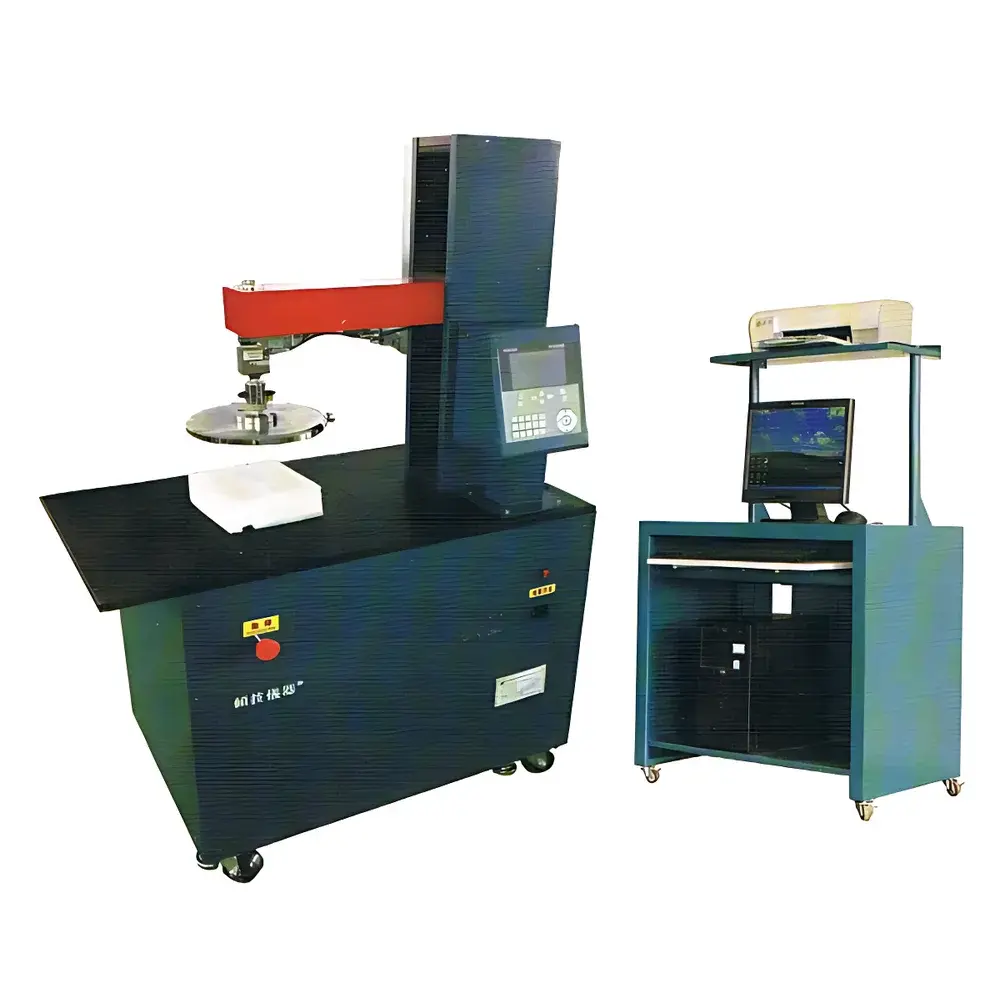
Qinji QJ-2000 Series Foam Elongation at Break Tester
| Brand | Qinji |
|---|---|
| Origin | Shanghai, China |
| Model | QJ-2000 Series |
| Max Load Capacity | 2000 N |
| Force Sensor Accuracy | 0.01% FS |
| Test Accuracy | Class 0.5 |
| Repeatability | ≤0.5% |
| Displacement Accuracy | ≤0.2% |
| Strain Measurement Accuracy | ≤0.2% |
| Test Speed Range | 0.01–300 mm/min |
| Compliance | GB/T 6344–1996, GB/T 10807–2006, GB/T 20467–2006 |
| Instrument Type | Electromechanical Universal Testing Machine |
Overview
The Qinji QJ-2000 Series Foam Elongation at Break Tester is an electromechanical universal testing machine engineered for precise mechanical characterization of flexible polymeric foam materials. It operates on the principle of controlled uniaxial tensile loading, measuring force response and axial deformation in real time to determine elongation at break, tensile strength, compressive modulus, indentation hardness (via indentation deflection methods), and cyclic fatigue behavior under low-frequency loading. Designed specifically for soft cellular polymers—including polyurethane, latex, and ethylene-vinyl acetate (EVA) foams—the system complies with internationally referenced test standards including GB/T 6344–1996 (equivalent to ISO 1798 for tensile properties of flexible cellular plastics), GB/T 10807–2006 (aligned with ISO 2439 for indentation hardness), and GB/T 20467–2006 (harmonized with ASTM D3574 for compression set and load-deflection behavior of sponge rubber and foam products). Its dual-control architecture supports both microprocessor-based local operation via integrated LCD interface and PC-driven closed-loop control through proprietary software, enabling seamless transition between routine QC checks and R&D-grade protocol execution.
Key Features
- Electromechanical drive system with high-resolution servo motor and precision ball-screw transmission, delivering stable speed control across the full range of 0.01–300 mm/min
- High-fidelity 2000 N load cell with 0.01% full-scale accuracy and thermal drift compensation, certified per ISO 7500-1 Class 0.5 requirements
- Integrated displacement transducer and optional extensometer support for direct strain measurement, achieving ≤0.2% linearity error over full stroke
- Dual-mode control architecture: standalone LCD panel for rapid setup and operator-guided tests; PC-based software for programmable multi-step profiles, data logging, and statistical reporting
- Modular fixture system compatible with standard tensile grips, compression platens, indentation probes (for IFD/ILD testing), and custom fixtures for tear, peel, and puncture configurations
- Rigid four-column frame with reinforced crosshead and self-aligning load train, minimizing parasitic bending moments during off-center loading
Sample Compatibility & Compliance
The QJ-2000 Series is validated for testing specimens conforming to standardized geometries defined in GB/T 6344–1996 (dumbbell-shaped tensile bars, 100 mm gauge length), GB/T 10807–2006 (150 mm × 150 mm × 50 mm blocks for indentation hardness), and GB/T 20467–2006 (cylindrical or rectangular compression samples). It accommodates foam densities from 15–120 kg/m³ and thicknesses up to 100 mm. All test routines are traceable to national metrological standards maintained by the Shanghai Institute of Measurement and Testing Technology (SIMT). The system supports audit-ready documentation workflows aligned with GLP principles, including user-defined test templates, electronic signature fields, and configurable pass/fail criteria per test parameter.
Software & Data Management
The included Windows-based testing software provides ISO/IEC 17025-compliant data acquisition, real-time curve visualization (stress–strain, load–displacement, force–time), and automated calculation of key metrics: elongation at break (%), tensile strength (kPa), yield point, secant modulus, indentation load deflection (ILD), and compression set after recovery. Raw data export is supported in CSV, XLSX, and XML formats; PDF reports include embedded calibration certificates, environmental conditions (temperature/humidity logs), operator ID, and timestamped test metadata. Audit trail functionality records all user actions—including method edits, result overrides, and calibration events—satisfying basic FDA 21 CFR Part 11 requirements for electronic records in non-GMP environments.
Applications
- Quality assurance of automotive seat cushions, mattress cores, and packaging foams against batch-to-batch consistency in elongation and resilience
- R&D evaluation of novel bio-based foams and flame-retardant formulations under static and dynamic loading
- Validation of manufacturing process parameters (e.g., blowing agent ratios, curing time) via correlation of mechanical outputs with formulation variables
- Regulatory submission support for medical device cushioning components requiring mechanical stability per ISO 10993-10 biocompatibility assessments
- Failure analysis of aged or UV-exposed foam samples through comparative fatigue life mapping and hysteresis loop analysis
FAQ
What standards does this tester directly support?
It is configured to execute test protocols specified in GB/T 6344–1996, GB/T 10807–2006, and GB/T 20467–2006, with method templates preloaded in software.
Is third-party calibration certification available?
Yes—factory calibration is performed using NIST-traceable reference loads; optional ISO/IEC 17025-accredited calibration certificates can be provided upon request.
Can the system integrate with LIMS or MES platforms?
Via OPC UA or TCP/IP API, raw data streams and summary results can be exported to external laboratory information management systems.
What maintenance is required for long-term accuracy?
Annual verification of load cell linearity and displacement encoder resolution is recommended; routine cleaning of guide rails and lubrication of ball screws every 6 months ensures mechanical integrity.
Does the software support multi-user role-based access control?
Yes—administrator, technician, and viewer roles can be assigned with granular permissions for method editing, test execution, and report generation.



