
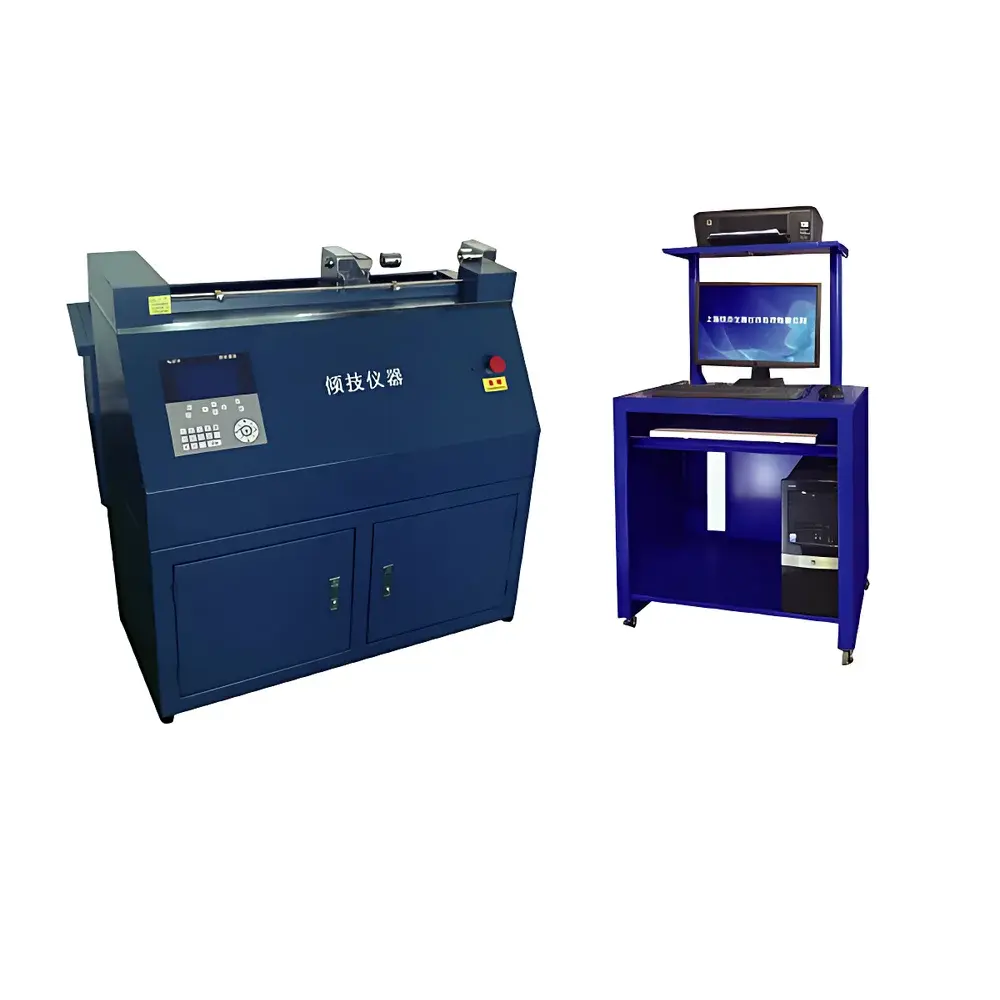
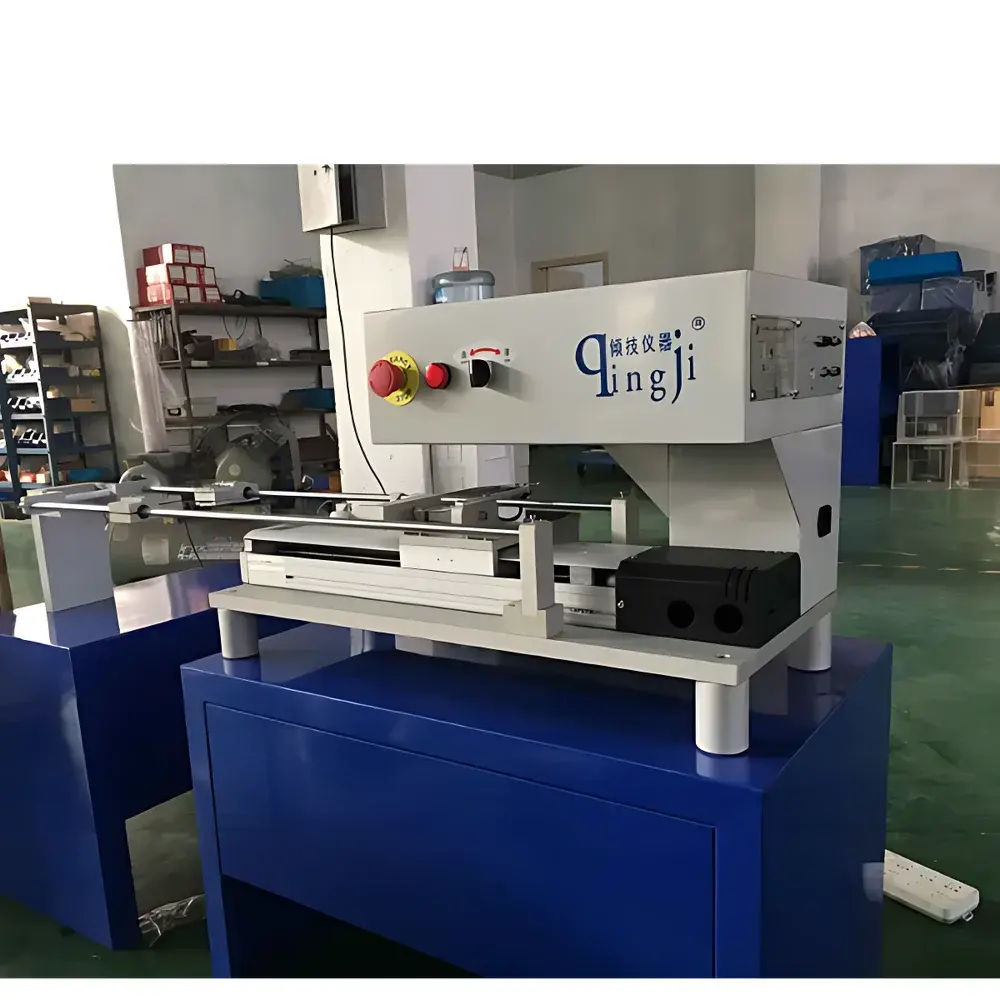
Qinji QJ-310 Horizontal Plug-and-Socket Pull-Off Tester
| Brand | Qinji |
|---|---|
| Origin | Shanghai, China |
| Manufacturer Type | Authorized Distributor |
| Country of Origin | China |
| Model | QJ-310 |
| Price Range | USD 3,500 – 4,900 |
| Load Capacity | 2500 N or 5000 N (selectable) |
| Load Cell Accuracy | 0.01% FS |
| Test Accuracy | ±0.5% |
| Speed Range | 0.001–300 mm/min (standard) |
| Effective Test Stroke | ≥200 mm |
| Power Supply | AC 220 V, 50/60 Hz |
| Dimensions (W×D×H) | 600 × 300 × 300 mm |
| Net Weight | ~40 kg |
Overview
The Qinji QJ-310 Horizontal Plug-and-Socket Pull-Off Tester is an electromechanical tensile testing system engineered specifically for evaluating mechanical retention strength in electrical interconnect components. Designed in accordance with fundamental principles of axial force measurement and displacement-controlled static loading, the instrument applies calibrated uniaxial tension to assess pull-out resistance, crimp integrity, terminal retention force, and adhesive bond strength under controlled rate conditions. Its horizontal configuration accommodates elongated specimens—such as cable harnesses, molded plugs, IEC 60320-compliant sockets, LED lamp holders, PCB-mounted connectors, and wire-to-terminal assemblies—without requiring vertical overhead clearance. The system operates on a precision ball-screw actuation mechanism coupled with a high-stiffness load frame, enabling stable force application across its full rated capacity (2500 N or 5000 N variants). Real-time load-displacement data acquisition is synchronized at up to 1 kHz sampling rate, ensuring fidelity in capturing peak detachment forces and post-yield behavior typical of plastic deformation in insulating housings or metallurgical interfacial failure.
Key Features
- High-resolution digital control interface with backlit LCD display showing real-time load (N), displacement (mm), and test curve visualization
- Adjustable crosshead speed ranging from ultra-low 0.001 mm/min (for creep-sensitive adhesives) to 300 mm/min (for rapid qualification screening)
- Modular load cell options: 2500 N or 5000 N capacity, each certified to 0.01% full-scale accuracy per ISO 376 Class 0.5
- Rigid structural frame fabricated from CNC-machined steel plates with electrostatic powder-coated finish for long-term dimensional stability
- RS-232 and USB interfaces for bidirectional communication with Windows-based PC software supporting ASTM D903, IEC 60884-1, and GB/T 2099.1 test protocols
- Integrated safety limit switches and emergency stop circuit compliant with EN ISO 13850
Sample Compatibility & Compliance
The QJ-310 accommodates a broad spectrum of low-voltage electrical interface geometries, including but not limited to: standard household plugs (Type A/B/C/E/F), industrial connectors (IEC 60309), automotive blade terminals, ribbon cable IDCs, surface-mount USB/HDMI receptacles, and encapsulated LED driver modules. Fixture adaptability is ensured via standardized T-slot base plate (M6 threaded holes on 50 mm grid) and optional custom jaw sets (e.g., flat-faced clamps, serrated grip inserts, and spring-loaded socket retention fixtures). Regulatory alignment includes design conformance to IEC 61000-4-2 (ESD immunity), CE marking requirements under Machinery Directive 2006/42/EC, and mechanical testing traceability to ISO/IEC 17025-accredited calibration practices. All firmware and embedded control logic are validated for GLP-compliant operation where audit trails and user access levels are required.
Software & Data Management
The included PC software suite supports automated test sequence programming, multi-curve overlay analysis, statistical batch reporting (mean, SD, CV%), and export to CSV, PDF, or XML formats compatible with LIMS integration. Raw data files retain timestamped metadata—including operator ID, environmental temperature/humidity (if external sensor connected), and calibration certificate reference numbers. Audit trail functionality records all parameter modifications, test start/stop events, and report generation actions in tamper-evident log format. Software complies with FDA 21 CFR Part 11 requirements when configured with electronic signatures and role-based permissions (administrator, technician, reviewer).
Applications
- Verification of plug retention force per IEC 60884-1 Clause 10.4 and GB/T 2099.1 Section 10.4
- Quantification of crimp joint strength for AWG 24–10 wire terminations under UL 486A-B criteria
- Evaluation of adhesive bond durability between thermoplastic housings and metal contacts after thermal cycling (IEC 60068-2-14)
- Comparative assessment of terminal insertion/extraction forces during design validation
- Quality assurance testing for automotive wiring harness subassemblies prior to OEM delivery
- Failure mode analysis of brittle fracture in polycarbonate socket bodies under sustained load
FAQ
What standards does the QJ-310 support out-of-the-box?
The system ships pre-configured with test templates for IEC 60884-1, GB/T 2099.1, UL 498, and ASTM D903. Custom protocol development is available upon request.
Is third-party calibration certification provided with delivery?
Yes—a factory-issued calibration certificate traceable to NIM (National Institute of Metrology, China) is included. Optional UKAS or DAkkS accredited calibration is available at additional cost.
Can the tester be integrated into an automated production line?
Via optional digital I/O module (PN: QJ-IO-01), the QJ-310 supports PLC-triggered start/stop, pass/fail signal output, and real-time analog voltage feedback (0–10 V) proportional to applied load.
What maintenance is required during routine operation?
Monthly inspection of ball-screw lubrication, biannual verification of load cell zero drift, and annual recalibration are recommended. No consumables are required beyond standard M6 fasteners and replacement jaw inserts.
Does the software support multi-language UI?
English and Simplified Chinese interfaces are standard; German, French, and Japanese language packs can be licensed separately.



