
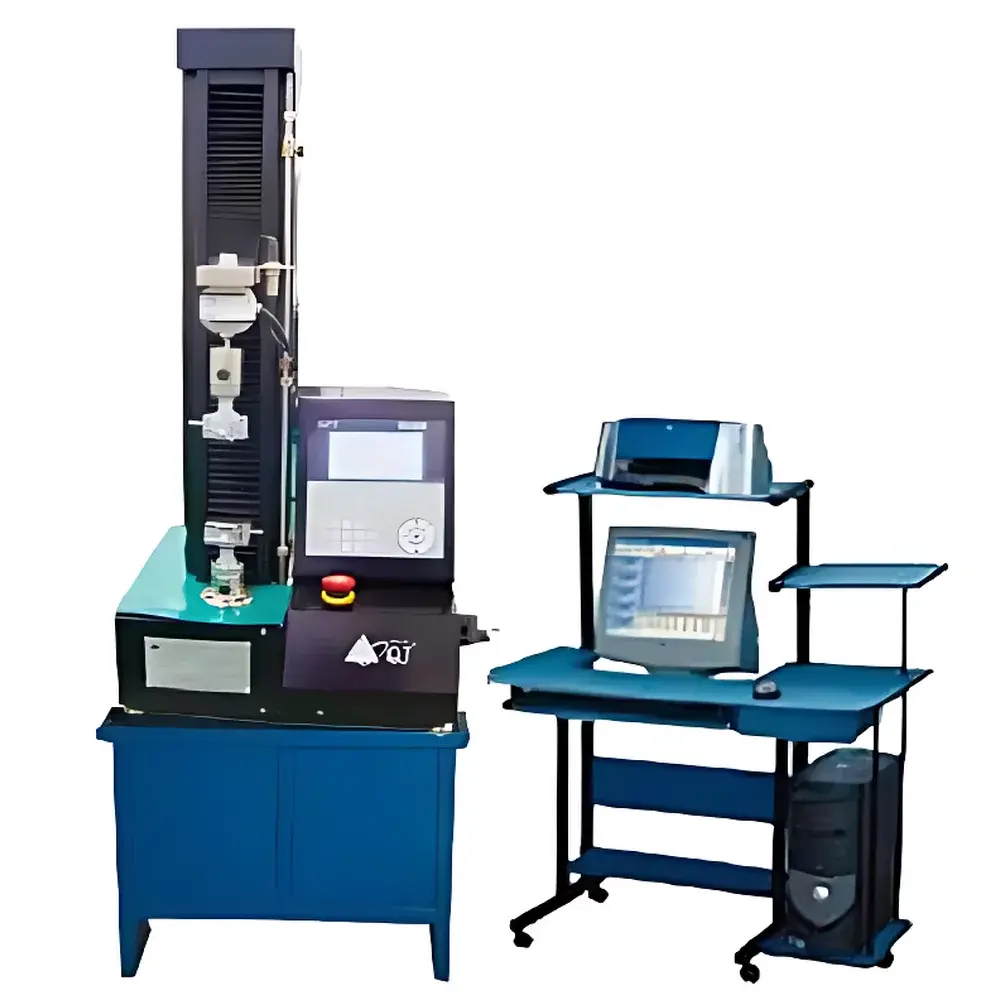
Qinji QJ210 Universal Testing Machine for Adhesion Strength Measurement
| Brand | Qinji |
|---|---|
| Origin | Shanghai, China |
| Model | QJ210 |
| Instrument Type | Electromechanical Universal Testing Machine |
| Load Capacity | 2500 N |
| Force Accuracy Class | 0.5 |
| Effective Test Width | 150 mm |
| Effective Test Height | 300 mm |
| Crosshead Speed Range | 0.001–500 mm/min |
| Speed Accuracy | ±0.5% of reading |
| Force Resolution | 500,000 counts (full-scale, no range switching) |
| Displacement Accuracy | ±0.5% of reading |
| Strain Measurement Accuracy | ±0.5% of reading |
| Safety Protection | Dual electronic and mechanical limit switches, overload protection at 110% of full scale, emergency stop button |
| Power | 200 W |
| Dimensions (L×W×H) | 430 × 315 × 855 mm |
| Net Weight | 40 kg |
Overview
The Qinji QJ210 Universal Testing Machine is an electromechanical static testing system engineered for high-reproducibility mechanical characterization of bonded interfaces, laminates, coatings, adhesives, composites, and structural assemblies. It operates on the principle of controlled uniaxial force application—via precision ball-screw-driven crosshead movement—and synchronized measurement of load, displacement, and optional strain—enabling quantitative determination of adhesion strength according to standardized tensile, peel, shear, and cleavage test configurations. Designed for compliance with international mechanical testing protocols, the QJ210 supports full-cycle static and quasi-static loading regimes including tension, compression, flexure, peel, and low-cycle fatigue (within displacement- and rate-limited boundaries). Its architecture integrates a rigid C-frame structure, high-stiffness load cell, and closed-loop servo control—ensuring minimal compliance error and stable force tracking across the entire 2500 N capacity range.
Key Features
- 0.5-class force accuracy certified per ISO 7500-1 and ASTM E4, with 500,000-count internal resolution—no range switching required across 0.2% to 100% of full scale.
- Programmable crosshead speed from 0.001 to 500 mm/min, with speed fidelity maintained within ±0.5% of setpoint under dynamic load conditions.
- Dual-mode positioning: motorized rapid approach (for specimen alignment) and fine-step jog control for precise zeroing and contact detection.
- Integrated safety architecture: hardware-based electronic limit switches, software-configurable overload cutoff (110% FS), mechanical hard stops, and a dedicated emergency stop circuit meeting IEC 60204-1 requirements.
- Modular extensometer interface supporting clip-on, video, or non-contact strain measurement systems for modulus and elongation analysis.
- Windows-based control software with real-time dual-axis plotting (load vs. displacement, stress vs. strain), dynamic curve annotation, and multi-curve overlay functionality.
Sample Compatibility & Compliance
The QJ210 accommodates flat, tubular, and irregular specimens up to 150 mm wide and 300 mm tall, compatible with standard grips (pneumatic, wedge, vise, peel rollers) and custom fixtures for ASTM D1002 (lap shear), ASTM D903 (peel), ISO 4587 (adhesive lap joints), ISO 1974 (tear propagation), and GB/T 7124 (shear strength of adhesives). All test methods are implemented in accordance with GLP-aligned data integrity practices: audit-trail-enabled user logins, timestamped parameter locking, and immutable raw-data export (CSV, XML, PDF). The system supports 21 CFR Part 11-compliant electronic signatures when deployed with validated software modules and network authentication infrastructure.
Software & Data Management
The embedded Windows application provides full test sequence scripting—including multi-step ramp-hold-relax profiles—and automatic calculation of over 20 mechanical parameters: ultimate tensile strength (UTS), yield strength (0.2% offset), Young’s modulus, fracture toughness (KIC equivalent via J-integral approximation), peel resistance (N/mm), bond strength (MPa), elongation at break (%), and energy absorption (J/m³). Raw data files retain full metadata (operator ID, environmental conditions, calibration traceability, test standard reference). Export formats include ASCII-delimited tables for LIMS integration, vector-based SVG/PDF for regulatory submissions, and native project archives (.qjx) supporting version-controlled reprocessing.
Applications
- Quantitative validation of structural adhesive performance in automotive bonding (e.g., aluminum-to-composite joints per SAE J2243).
- Quality assurance of medical device packaging seal integrity (ASTM F88/F1140) and biocompatible hydrogel adhesion to substrates.
- R&D evaluation of pressure-sensitive tapes, laminated films, and printed electronics interlayer bonding.
- Mechanical screening of repair mortars, grouts, and tile adhesives per EN 12004 and ANSI A118.4.
- Teaching laboratories requiring ISO/IEC 17025-aligned instruction in material property fundamentals and uncertainty budgeting.
FAQ
What international standards does the QJ210 support out-of-the-box?
Preconfigured test templates are provided for ASTM D638, D790, D1002, D903; ISO 527, 178, 4587, 1974; GB/T 1040, 9341, 7124; and JIS K6850—each including compliant reporting fields and pass/fail logic.
Can the system be integrated into an existing LIMS or MES environment?
Yes—via TCP/IP-based API (RESTful endpoints) and OPC UA server option, enabling bidirectional data exchange with laboratory information management systems and manufacturing execution platforms.
Is third-party calibration certification available?
Qinji offers UKAS-accredited calibration services traceable to NIM (China National Institute of Metrology) and NIST, with full uncertainty budgets per ISO/IEC 17025 Annex A.3.
Does the software meet FDA 21 CFR Part 11 requirements?
The base software includes electronic signature capability, audit trail logging, and role-based access control; full Part 11 compliance requires deployment with validated IT infrastructure and documented SOPs per your organization’s quality system.
What maintenance intervals are recommended for long-term accuracy retention?
Load cell and encoder verification every 12 months; annual mechanical inspection of drive train, alignment, and grip wear; daily visual check of limit switch function and emergency stop response.



