
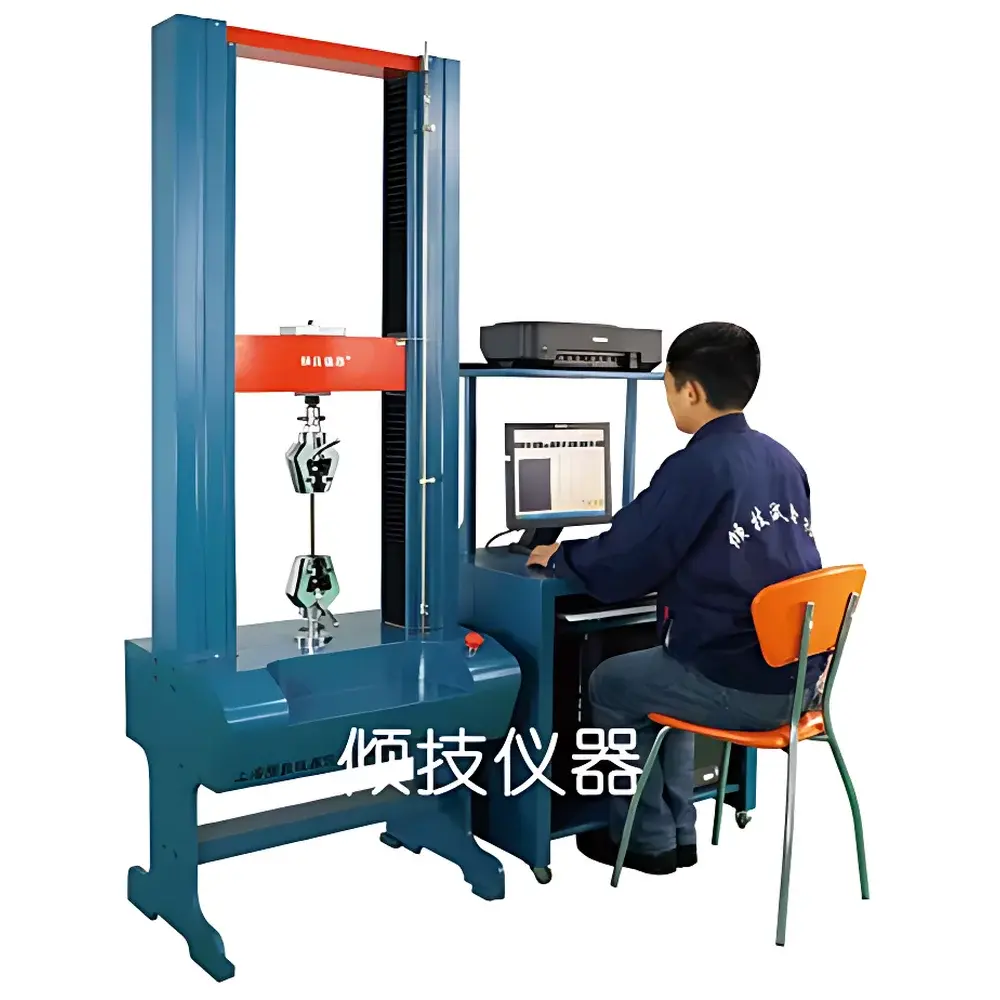
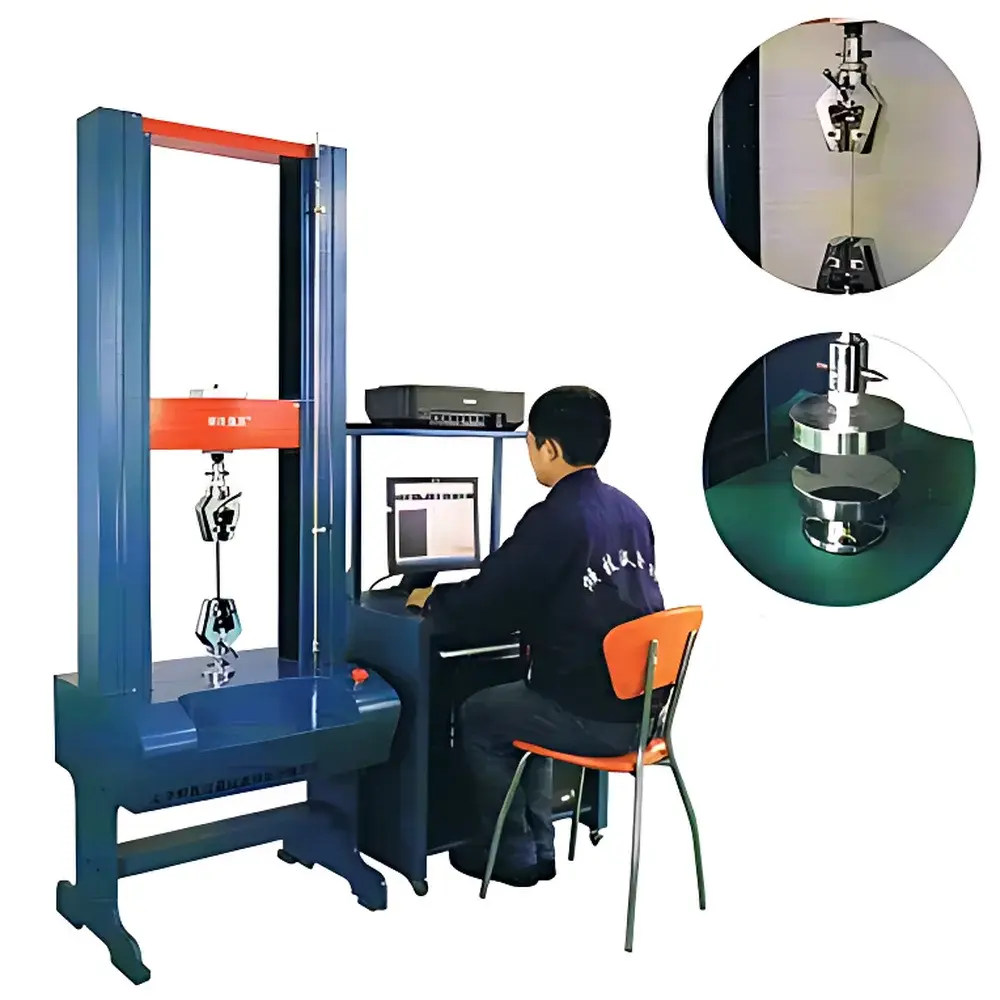
Qinji QJ211 Series Vertical Cable & Conduit Bending Tester
| Brand | Qinji |
|---|---|
| Origin | Shanghai, China |
| Model | QJ211 Series |
| Type | Electromechanical Universal Testing Machine |
| Maximum Load Capacity | 30 kN |
| Load Cell Accuracy | 0.01% FS |
| Force Measurement Accuracy | < ±0.5% |
| Test Speed Range | 0.001–500 mm/min |
| Speed Accuracy | ±0.5% |
| Displacement Accuracy | ±0.5% |
| Deformation Measurement Accuracy | ±0.5% |
| Effective Test Width | ~420 mm |
| Effective Tensile Travel | ~800 mm |
| Safety Features | Electronic Limit Switches, Emergency Stop Button, Stroke Safeguard |
| Machine Weight | ~140 kg |
Overview
The Qinji QJ211 Series Vertical Cable & Conduit Bending Tester is a precision-engineered electromechanical universal testing system designed specifically for evaluating the mechanical flexural endurance and structural integrity of elevator cables, electrical conduit sleeves, flexible tubing, and related polymeric or composite sheathing materials. Unlike general-purpose tensile testers, the QJ211 integrates a vertically oriented loading frame with dedicated bending fixtures—such as mandrel-based wrap-around jigs, fixed-radius bending rollers, and pivot-controlled angular deflection assemblies—to replicate real-world installation stresses encountered during cable routing, conduit bending, and repeated flex cycles in vertical transport systems. The system operates on a closed-loop servo-controlled drive architecture, enabling precise displacement- or load-controlled actuation per ISO 7886-1 (hypodermic needles), ASTM D1596 (flexural fatigue of plastics), IEC 60227-2 (PVC-insulated cables), and GB/T 12706.1 (power cables). Its modular design supports both static bending stiffness assessment and dynamic cyclic bending life validation under controlled amplitude, frequency, and environmental conditions.
Key Features
- Vertical loading configuration optimized for gravity-aligned bending tests—eliminating lateral instability during high-cycle conduit flexing.
- Interchangeable bending fixtures including radius-adjustable mandrels (10–300 mm), dual-roller cradles, and articulated hinge modules compliant with JG/T 400 (building conduit standards) and YY/T 0287 (medical device tubing).
- High-resolution load cell (0.01% full-scale accuracy) and digital encoder-based displacement feedback ensure traceable force–deflection data acquisition.
- Windows-based control software with real-time multi-curve plotting, programmable test profiles (ramp-hold-step-sequence), and automatic pass/fail logic based on angular deviation thresholds or cycle-to-failure counts.
- Comprehensive safety architecture: hardware-triggered electronic limit switches, redundant emergency stop circuitry, and stroke-limited actuator travel to prevent over-bending damage to specimens or fixtures.
- Modular upgrade path for environmental enclosures (optional temperature/humidity chambers) and video-based deformation tracking (DIC-compatible mounting points).
Sample Compatibility & Compliance
The QJ211 accommodates cylindrical, oval, or segmented cross-section specimens ranging from Ø2 mm (fiber optic drop cables) to Ø80 mm (armored elevator traction cables) and conduit sleeves up to 125 mm nominal diameter. Specimen clamping employs pneumatic or mechanical jaw sets with replaceable soft-faced inserts to prevent surface marring. All test protocols align with mandatory regulatory frameworks: ASTM D4065 (fatigue behavior of plastics), ISO 6892-1 (tensile testing), GB/T 2423.2 (environmental testing), and EN 50368 (railway cable bending resistance). Data audit trails comply with GLP requirements, supporting 21 CFR Part 11–ready electronic signatures when paired with validated software configurations.
Software & Data Management
The embedded Windows 10–based control suite provides ISO/IEC 17025–aligned data handling: raw sensor streams are timestamped at 1 kHz, stored in encrypted .tdms binary format, and exportable to CSV, Excel, or XML for LIMS integration. Curve manipulation tools include point-wise annotation, hysteresis loop extraction, stiffness slope calculation (N·m/°), and Weibull distribution fitting for fatigue life prediction. Audit logs record user actions, calibration events, and system errors—retained for ≥12 months. Optional software modules enable automated report generation per ISO/IEC 17025 Annex A.3 and configurable PDF templates aligned with internal QA documentation standards.
Applications
- Endurance validation of elevator traveling cables subjected to 10⁴–10⁶ bending cycles at ±30° amplitude.
- Conduit compliance testing per UL 651 (electrical nonmetallic tubing) and GB 50311 (structured cabling pathways).
- Mechanical qualification of medical catheter shafts (ISO 10555-1) and robotic surgical instrument sheaths.
- Flex-life benchmarking of automotive EV battery harnesses under thermal cycling (−40°C to +105°C with optional chamber).
- R&D evaluation of novel polymer blends for improved springback retention after repeated bending.
FAQ
Does the QJ211 support fully automated cyclic bending tests with variable radius and dwell time?
Yes—test sequences can be programmed with up to 99 steps, each defining radius, angular velocity, hold duration, and reversal logic.
Can bending data be correlated with optical strain measurement systems?
Yes—the machine frame includes M6 threaded mounting points and optical bench rails compatible with commercial DIC systems (e.g., Correlated Solutions VIC-2D).
Is firmware calibration traceable to national metrology institutes?
Load cell and encoder calibrations are performed using NIST-traceable reference standards; certificates include uncertainty budgets per ISO/IEC 17025.
What maintenance intervals are recommended for long-term repeatability?
Biannual verification of load cell linearity and encoder resolution is advised; annual recalibration by an accredited third-party lab is recommended for regulated environments.
Are custom fixture designs available for non-standard conduit geometries?
Yes—Qinji’s engineering team provides CAD-based fixture co-design services with mechanical drawings delivered within 15 business days post-order confirmation.



