
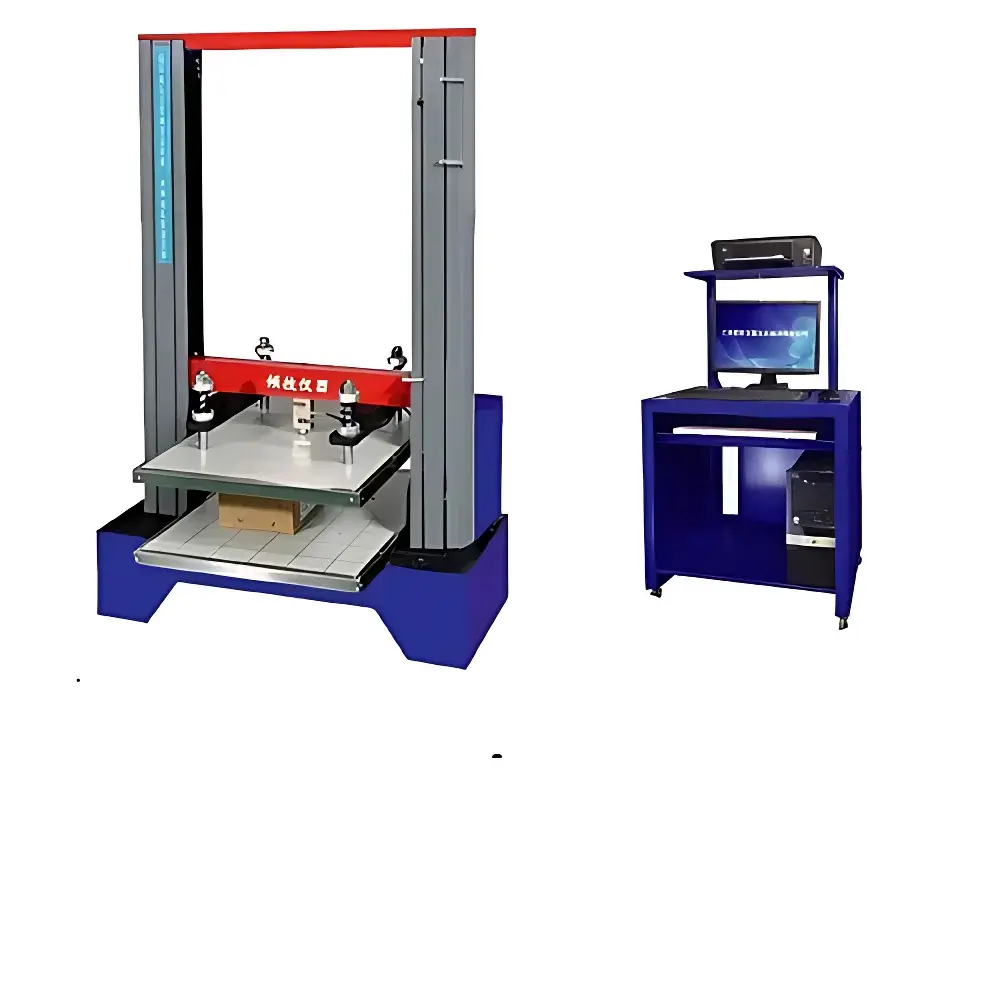
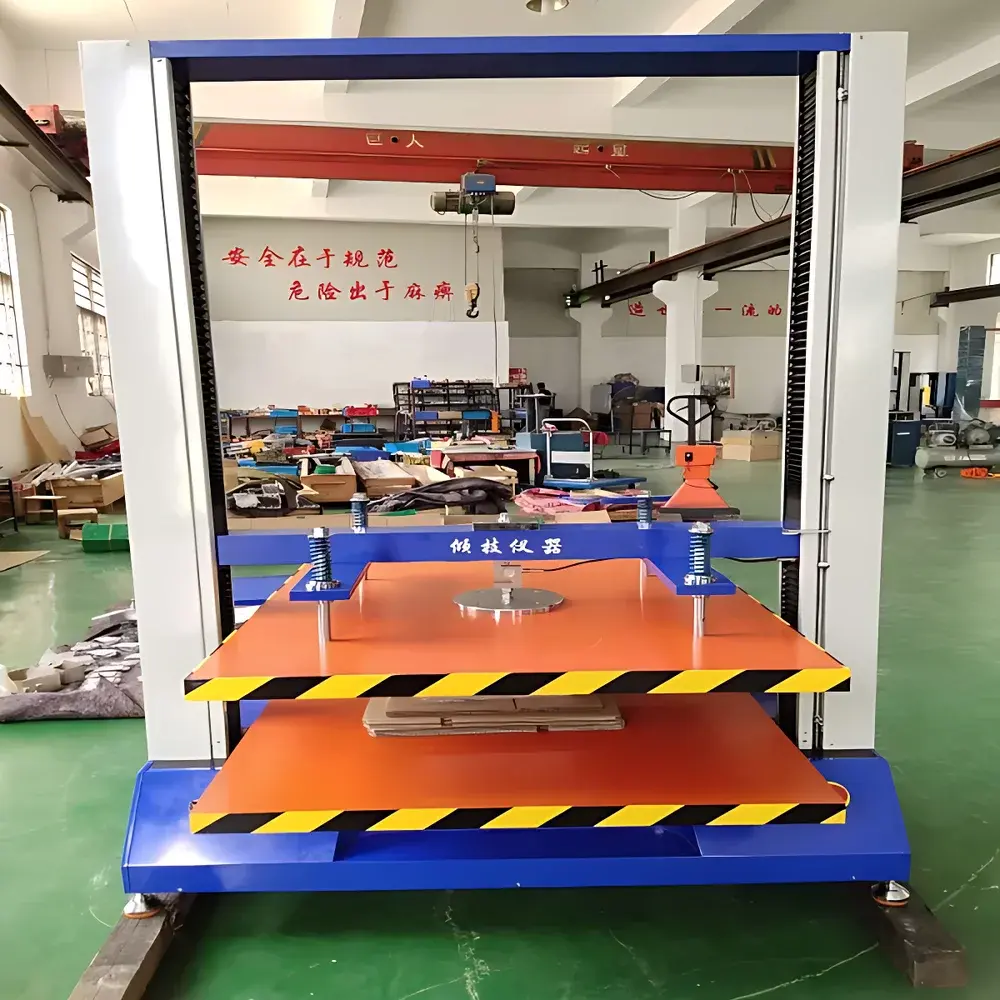
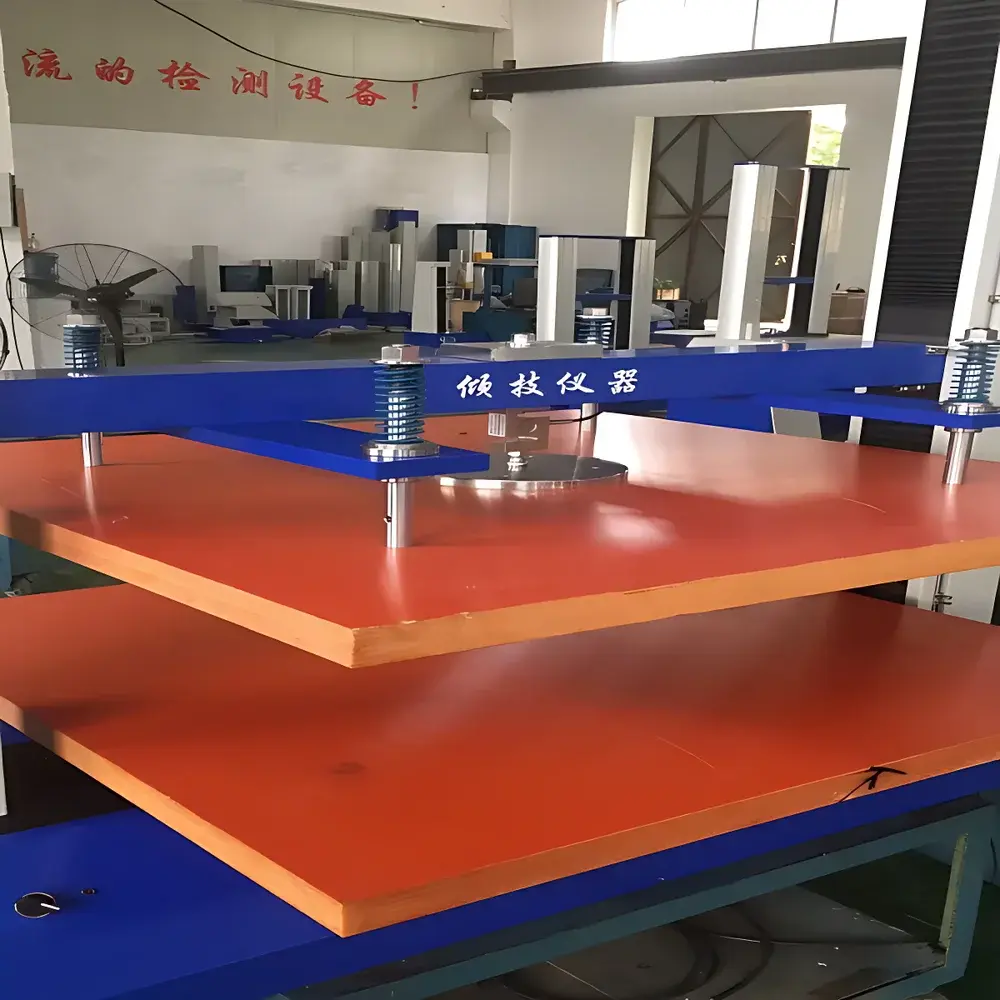
Qinji QJ211H-30KN Compression Testing Machine for Corrugated Boxes
| Brand | Qinji |
|---|---|
| Origin | Shanghai, China |
| Model | QJ211H-30KN |
| Max. Test Force | 30 kN |
| Platen Dimensions | 1000 mm × 1000 mm |
| Platen Spacing | 1000 mm |
| Load Cell Accuracy Class | 0.5 |
| Force Resolution | 500,000 counts (full-scale, no range switching) |
| Effective Test Width | 1000 mm |
| Crosshead Speed Range | 0.001–500 mm/min |
| Speed Accuracy | ±0.5% of reading |
| Displacement & Deformation Accuracy | ±0.5% of reading |
| Load Sensing | High-precision U.S.-sourced load cell |
| Control System | Panasonic full-digital AC servo controller |
| Software | Full-closed-loop digital control system supporting constant-force, constant-strain, and constant-displacement modes |
| Safety Protection | Electronic limit switches, software-based overload diagnosis (10% over capacity), automatic return post-test |
| Power | 2–5 kW |
| Net Weight | ~145 kg |
Overview
The Qinji QJ211H-30KN Compression Testing Machine is a precision-engineered physical property testing instrument designed specifically for evaluating the compressive strength and stacking performance of corrugated fiberboard containers, paper tubes, cartons, and rigid packaging materials. It operates on the principle of uniaxial compression loading under controlled displacement or force conditions, conforming to standardized test methodologies defined in ISO 12048, ASTM D642, ASTM D4577, and GB/T 6543. The system delivers high reproducibility in measuring crush resistance, top-load capacity, and progressive deformation behavior—critical parameters for logistics validation, shelf-life modeling, and package integrity assurance in supply chain environments.
Key Features
- Robust dual-space frame architecture enabling both compression and optional tensile/tear/puncture testing with appropriate fixtures
- Large-format platens (1000 mm × 1000 mm) accommodating oversized packaging specimens including palletized unit loads and industrial paper reels
- High-resolution force measurement via U.S.-sourced precision load cell, delivering 0.5-class accuracy and 500,000-count resolution across the full 30 kN range without auto-ranging
- Panasonic full-digital AC servo drive system ensuring stable crosshead motion from 0.001 to 500 mm/min, with speed accuracy maintained within ±0.5% of setpoint
- Integrated closed-loop digital control software supporting programmable test profiles: constant-rate compression, creep hold, load-controlled collapse, displacement-limited stack simulation, and failure-point detection
- Dual-speed manual/electric crosshead adjustment with electronic end-stop protection and software-based overload cutoff (10% above rated capacity)
- Modular fixture interface allowing rapid configuration for edge crush test (ECT), flat crush test (FCT), ring crush test (RCT), and compression-to-failure protocols
Sample Compatibility & Compliance
The QJ211H-30KN accommodates a wide range of packaging substrates including single- and multi-wall corrugated board, solid fiberboard, molded pulp trays, plastic crates, and composite laminates. Its 1000 mm vertical clearance and expansive platen surface support full-scale shipping container evaluation and simulated warehouse stacking scenarios. All mechanical and software functions comply with GLP documentation requirements, supporting audit-ready test logs with timestamped metadata. The system meets essential electromagnetic compatibility (EMC) and electrical safety standards per IEC 61000-6-3 and IEC 61000-6-2, and its force calibration traceability aligns with ISO/IEC 17025-accredited practices when paired with certified reference standards.
Software & Data Management
The embedded test control software provides real-time graphical display of force–displacement curves, peak load capture, yield point identification, and deformation rate analysis. Raw data export is supported in CSV and XML formats for integration into LIMS or statistical process control (SPC) platforms. Audit trails record operator ID, test parameters, calibration status, and event timestamps—fully compliant with FDA 21 CFR Part 11 requirements when deployed with user authentication and electronic signature modules. Optional reporting templates include ASTM D642-compliant summary sheets, ISO 12048 pass/fail verification outputs, and custom certificate generation with embedded digital signatures.
Applications
- Corrugated box compression strength validation for e-commerce fulfillment centers
- Stack load simulation of palletized goods under static and dynamic warehouse conditions
- Edge crush test (ECT) preparation and correlation studies with burst strength and puncture resistance
- Quality assurance of paper tube and core rigidity for winding and converting operations
- R&D evaluation of recycled fiber content impact on structural integrity
- Third-party certification testing for ISTA 3A, ASTM D4169, and ISO 2234 compliance
- Supplier qualification programs requiring repeatable, documented mechanical performance metrics
FAQ
What standards does the QJ211H-30KN support for compression testing?
It supports ISO 12048, ASTM D642, ASTM D4577, TAPPI T811, and GB/T 6543, with configurable test profiles matching each standard’s procedural requirements.
Can the machine perform edge crush testing (ECT) out of the box?
ECT requires dedicated fixtures and specimen alignment jigs; these are available as optional accessories and must be specified at time of order.
Is calibration documentation included with shipment?
Yes—a factory calibration certificate traceable to national metrology institutes is provided, along with instructions for periodic recalibration using certified deadweight standards.
Does the system support networked data transfer to enterprise QA systems?
Yes, via TCP/IP-enabled data export and optional OPC UA server integration for direct connectivity to MES or SAP QM modules.
What maintenance is required to sustain measurement accuracy?
Annual verification of load cell linearity and crosshead alignment is recommended; routine checks include lubrication of lead screws and inspection of platen surface flatness per ISO 7500-1 Annex B.



