
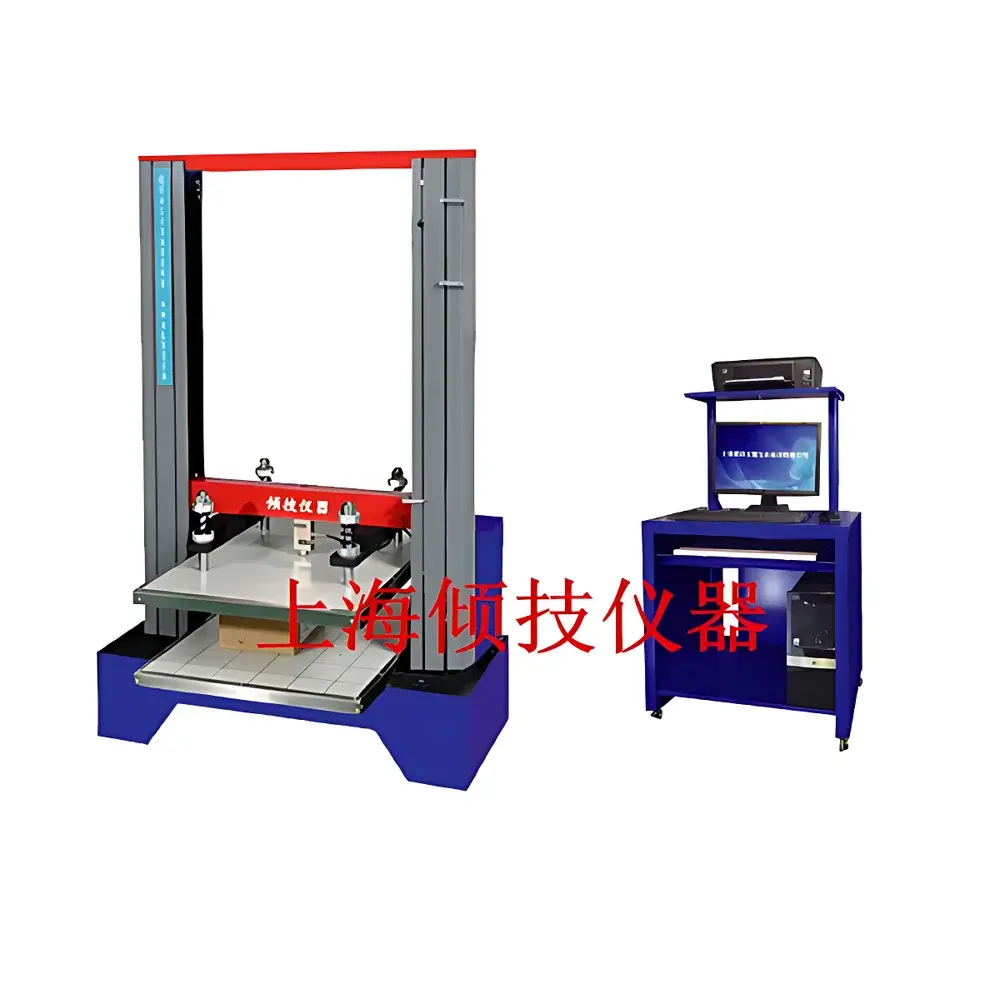
Qinji QJ211H Universal Compression Testing Machine for Corrugated Boxes and Packaging Containers
| Brand | Qinji |
|---|---|
| Origin | Shanghai, China |
| Model | QJ211H |
| Max. Test Load | 30 kN |
| Platen Dimensions | 1000 mm × 1000 mm |
| Platen Spacing | 1000 mm |
| Accuracy Class | 0.5 |
| Force Resolution | 500,000 counts (full-scale, no range switching) |
| Effective Test Width | 320 mm |
| Travel Range | 500 mm (extendable to 800 mm) |
| Speed Range | 0.01–300 mm/min |
| Speed Accuracy | ±0.5% of indicated value |
| Displacement & Deformation Accuracy | ±0.5% of indicated value |
| Control System | Panasonic full-digital AC servo controller |
| Software | Full-closed-loop digital control system supporting constant-force, constant-strain, and constant-displacement modes |
| Safety Protection | Automatic overload cutoff at 110% FS, electronic limit switches, real-time software diagnostics |
| Power | 2–5 kW |
| Net Weight | ~145 kg |
Overview
The Qinji QJ211H Universal Compression Testing Machine is an engineered solution for standardized mechanical evaluation of packaging integrity under compressive loading conditions. Designed in accordance with core principles of uniaxial quasi-static compression testing, it delivers traceable, repeatable force–displacement data essential for validating structural performance of corrugated fiberboard containers, paper tubes, plastic crates, and other rigid or semi-rigid packaging systems. Its dual-space configuration supports not only compression and stacking tests—per ASTM D642, ISO 12048, and TAPPI T810—but also optional tensile, tear, and puncture assessments when equipped with appropriate fixtures. The machine operates on a robust load frame architecture with high-rigidity crosshead guidance, ensuring minimal lateral deflection during high-load (up to 30 kN) application and maintaining alignment fidelity across the full platen travel range of 1000 mm.
Key Features
- High-precision 0.5-class load cell calibrated to national metrological standards, delivering consistent resolution of 500,000 internal counts across the entire 30 kN range—no manual range switching required.
- Full-digital closed-loop control system powered by Panasonic AC servo technology, enabling precise regulation of displacement rate from 0.01 to 300 mm/min with ≤±0.5% speed deviation.
- Large-format platens (1000 mm × 1000 mm) accommodate oversized packaging units including palletized loads and industrial drums, while maintaining uniform pressure distribution.
- Dual-mode operation: programmable constant-force hold (for creep or stress-relaxation simulation) and constant-displacement ramping (for crush resistance and deformation threshold analysis).
- Integrated safety architecture featuring hardware-based electronic limits, real-time software fault detection, and automatic shutdown at 110% of full-scale load—fully compliant with IEC 61000-6-2 electromagnetic compatibility and ISO 13857 safeguarding requirements.
- Modular fixture interface allows rapid reconfiguration for stack compression (ASTM D4169), edge crush test (ECT), flat crush test (FCT), and ring crush test (RCT) per TAPPI standards.
Sample Compatibility & Compliance
The QJ211H is validated for use with single-wall and multi-wall corrugated board, solid fiberboard, molded pulp trays, rigid plastic containers, and laminated composite packaging. It meets functional requirements specified in ASTM D642 (compression resistance of shipping containers), ASTM D4577 (stacking strength), ISO 12048 (compression testing of packaging), and GB/T 4857.3–2008 (Chinese national standard for package compression testing). All measurement outputs—including peak crush load, yield point, energy absorption (area under curve), and deformation at defined load thresholds—are traceable to SI units via factory-certified calibration reports. For regulated environments, the system supports audit-ready data logging aligned with GLP and GMP documentation practices, including user-access controls and electronic signature capability when paired with compliant PC-based acquisition software.
Software & Data Management
The embedded Windows-compatible control software provides ISO/IEC 17025-aligned test sequencing, real-time graphical display of force–displacement curves, and automated calculation of industry-specific metrics such as compression strength index (CSI), stacking load capacity, and residual height retention. Raw data exports to CSV, Excel, and PDF formats include timestamped metadata, operator ID, environmental conditions (if external sensors are connected), and calibration certificate references. Optional integration with LIMS platforms is supported via TCP/IP and OPC UA protocols. Audit trails record all parameter modifications, test executions, and system events—meeting FDA 21 CFR Part 11 requirements when deployed with qualified validation packages and role-based access configuration.
Applications
- Corrugated box compression strength verification prior to distribution cycle qualification (e.g., ASTM D4169 logistics simulation).
- Edge crush test (ECT) and flat crush test (FCT) correlation studies for predicting board performance in real-world stacking scenarios.
- Validation of protective packaging designs for electronics, pharmaceuticals, and aerospace components requiring ISTA-compliant compression profiles.
- Quality assurance testing in packaging supplier audits, including third-party certification bodies conducting BRCGS or SQF assessments.
- Material development labs evaluating novel bio-based substrates, recycled fiber blends, or moisture-resistant coatings under controlled humidity and temperature conditions.
FAQ
What international standards does the QJ211H support out-of-the-box?
It natively implements test routines aligned with ASTM D642, ASTM D4577, ISO 12048, TAPPI T810, and GB/T 4857.3. Custom protocol scripting is available for non-standard or proprietary methods.
Can the system perform both compression and tensile testing without hardware modification?
Yes—the dual-space design includes upper and lower crossheads with independent actuation paths, allowing seamless transition between compression, tensile, tear, and puncture configurations using interchangeable grips and platens.
Is calibration certification included with shipment?
Each unit ships with a factory-issued calibration certificate traceable to CNAS-accredited reference standards, valid for one year under normal operating conditions.
Does the software meet regulatory requirements for electronic records in pharmaceutical packaging QA?
When configured with user authentication, audit trail logging, and electronic signature modules, the system satisfies 21 CFR Part 11 compliance criteria for computerized systems used in GxP environments.
What maintenance intervals are recommended for long-term accuracy?
Annual recalibration of the load cell and displacement encoder is advised; routine inspection of guide rails, belt tension, and emergency stop functionality should occur every 500 operational hours.



