
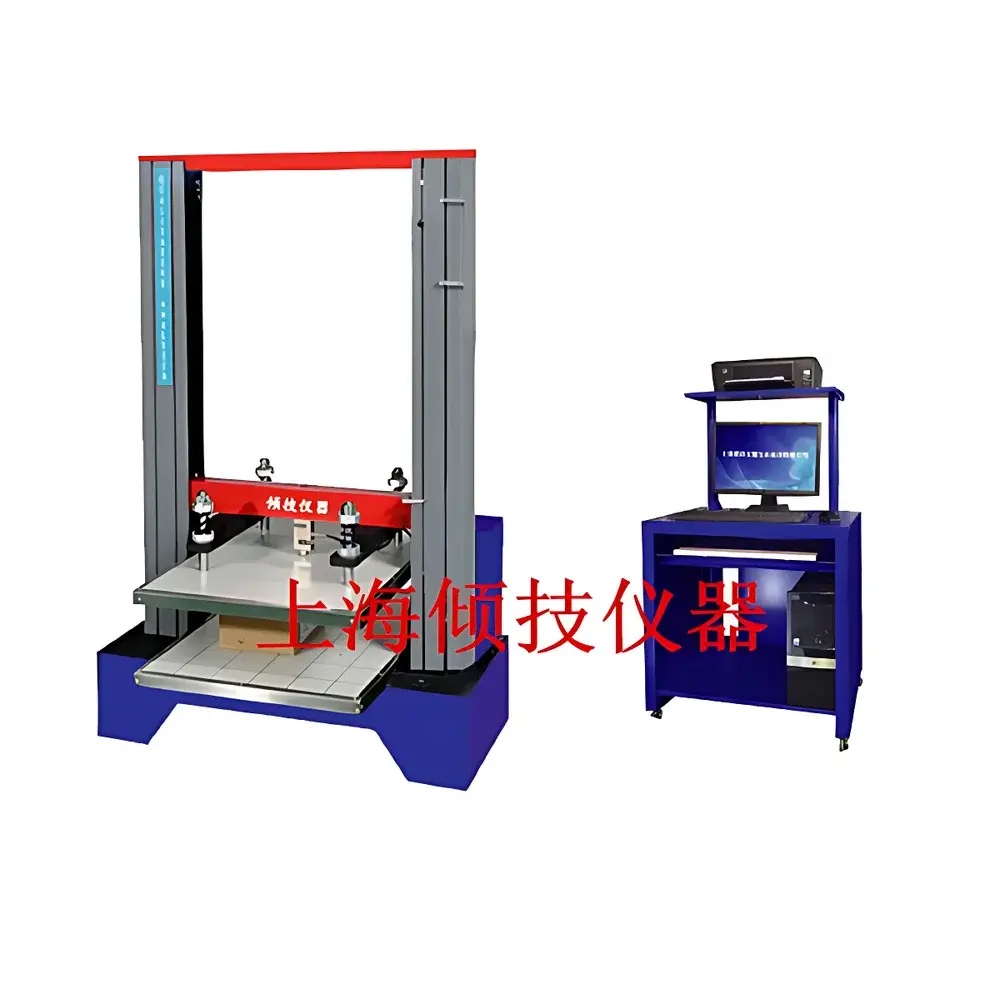
Qinji QJ211H2 Universal Compression & Crush Resistance Tester for Corrugated Boxes and Packaging Containers
| [Brand | Qinji |
|---|---|
| Origin | Shanghai, China |
| Model | QJ211H2 |
| Max Load Capacity | 30 kN |
| Load Accuracy | Class 0.5 |
| Force Resolution | 500,000 counts (full-scale, no range switching) |
| Effective Test Width | 320 mm |
| Effective Stroke | 500 mm (extendable to 800 mm) |
| Test Speed Range | 0.01–300 mm/min |
| Speed Accuracy | ±0.5% of indicated value |
| Displacement & Strain Measurement Accuracy | ±0.5% of indicated value |
| Sensor | High-precision U.S.-sourced load cell |
| Controller | Panasonic all-digital AC servo system |
| Control System | Full-digital closed-loop architecture supporting constant stress, constant strain, and constant displacement modes |
| Safety Protection | Software-based diagnostics, electronic limit switches, overload protection at 110% of full scale |
| Power | 2–5 kW |
| Net Weight | ~145 kg] |
Overview
The Qinji QJ211H2 Universal Compression & Crush Resistance Tester is an electromechanical universal testing system engineered for precise evaluation of compressive strength, crush resistance, and structural integrity of corrugated fiberboard containers, paper tubes, cartons, plastic packaging, and related rigid or semi-rigid packaging materials. It operates on the principle of controlled axial force application under programmable displacement or load control, conforming to standardized mechanical testing methodologies defined in ASTM D642 (Standard Test Method for Determining Compressive Resistance of Shipping Containers), ISO 12048 (Packaging—Complete, filled transport packages—Compression and stacking tests), and TAPPI T 810 (Compression Resistance of Corrugated and Solid Fiberboard). The system delivers high reproducibility in stack-load simulation, edge-crush testing (ECT), flat-crush testing (FCT), and compression-to-failure analysis—critical parameters for logistics validation, shelf-life assessment, and regulatory compliance in global supply chains.
Key Features
- Robust dual-zone test frame enabling both top-down compression and bottom-up tensile/tear/puncture configurations without hardware reconfiguration
- Class 0.5 load accuracy certified per ISO 7500-1 and ASTM E4, ensuring traceable metrological performance for QA/QC reporting
- Full-scale force resolution of 500,000 counts with no internal range switching—maintaining consistent resolution across the entire 0.02%–100% load span
- Panasonic all-digital AC servo drive with real-time position feedback, delivering speed stability within ±0.5% of setpoint from 0.01 to 300 mm/min
- Integrated safety architecture including software-driven fault diagnostics, dual-mode electronic end-limit detection, and automatic overload cutoff at 110% of rated capacity (33 kN)
- Motorized crosshead with independent fast/slow speed selection for rapid positioning and fine-force ramping
- Modular fixture interface supporting user-defined tooling—including ECT clamps, compression platens, and custom mandrels for cylindrical specimens
Sample Compatibility & Compliance
The QJ211H2 accommodates standard and non-standard specimens up to 320 mm wide and 500 mm (or optionally 800 mm) in active stroke length. It is routinely deployed for testing single-wall and multi-wall corrugated board, honeycomb paper, rigid plastic trays, molded pulp containers, and composite laminates. All test protocols align with international packaging standards including ASTM D642, D4577 (Edge Crush Test), D7293 (Flat Crush Test), ISO 3037 (Corrugated Fiberboard—Determination of Edge Crush Resistance), and GB/T 6543 (Chinese national standard for transport packaging boxes). The system supports GLP-compliant audit trails when integrated with validated software environments and meets mechanical safety requirements per ISO 12100 and EN 61000-6-2 (EMC immunity).
Software & Data Management
Equipped with a full-digital closed-loop control platform, the QJ211H2 executes pre-programmed test sequences—including constant-rate compression, creep hold, step-load stacking simulation, and failure-point capture—with synchronized acquisition of load, displacement, and time-stamped deformation data. Raw data export is supported in CSV and XML formats for third-party statistical analysis (e.g., Minitab, JMP). Optional integration with LIMS or ERP systems via TCP/IP or RS-232 enables automated report generation and digital signature logging compliant with FDA 21 CFR Part 11 requirements when paired with qualified electronic record workflows. Calibration certificates are digitally archived with unique ID tagging and revision-controlled metadata.
Applications
- Stack load simulation for warehouse and containerized shipping validation
- Edge crush resistance (ECT) and flat crush resistance (FCT) characterization per TAPPI and ISO specifications
- Compression-to-failure analysis of finished cartons under static and dynamic loading conditions
- Tensile strength, tear propagation, and puncture resistance testing of linerboard and medium layers
- Quality conformance verification for ISO 9001, IATF 16949, and AIB-certified production lines
- R&D benchmarking of new substrate formulations, adhesive systems, and structural geometries
FAQ
What standards does the QJ211H2 support for packaging compression testing?
ASTM D642, D4577, D7293; ISO 12048, 3037; TAPPI T 810, T 822; GB/T 6543 and GB/T 2679.17.
Can the system perform both compression and tensile tests on the same platform?
Yes—the dual-space configuration allows interchangeable use of upper compression platens and lower grip assemblies for tension, tear, and puncture testing without structural modification.
Is the load cell calibration traceable to national metrology institutes?
All factory-installed load cells are supplied with NIST-traceable calibration certificates, and field recalibration services include ISO/IEC 17025-accredited documentation upon request.
What level of software validation support is provided for regulated industries?
IQ/OQ documentation templates, 21 CFR Part 11 readiness assessments, and audit-ready electronic log exports are available as optional service packages.
Does the system require compressed air or hydraulic power?
No—it is fully electric, driven by a 2–5 kW AC servo motor; no external utilities beyond standard 3-phase industrial power are required.



