
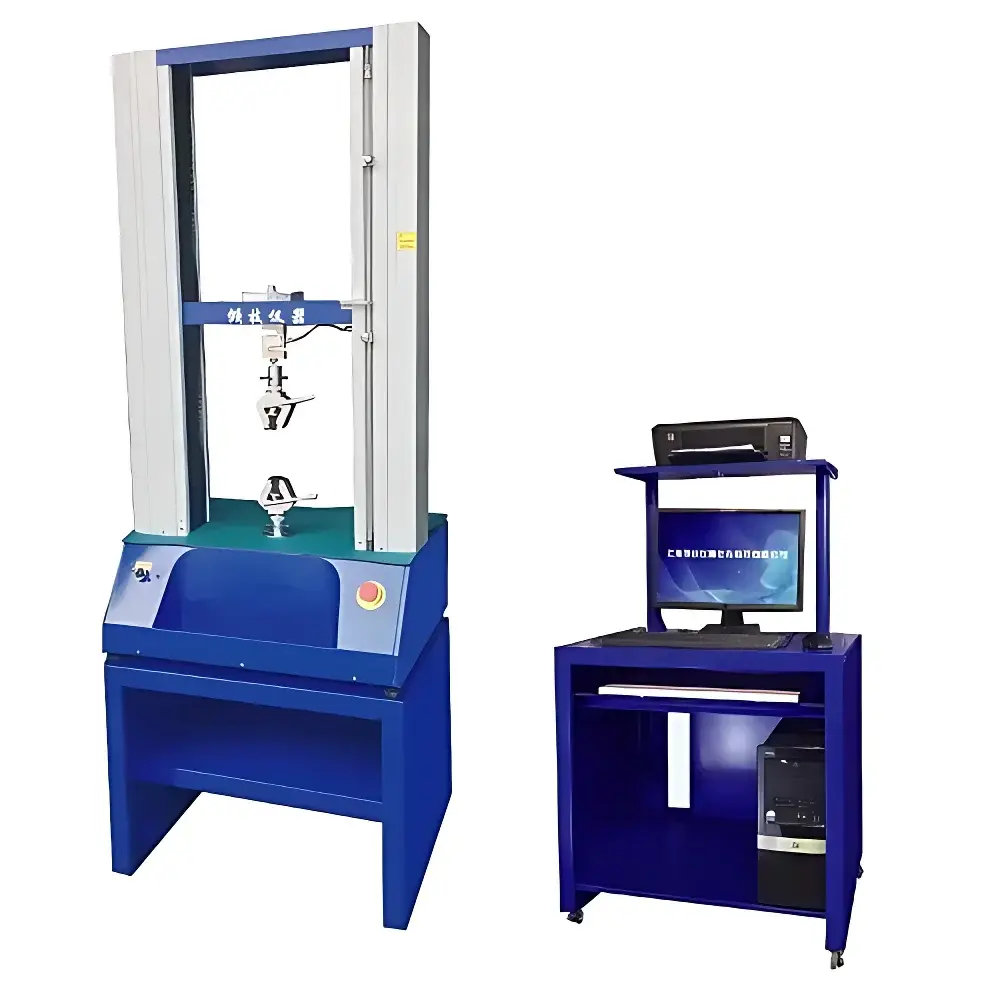
Qinji QJ211S Advanced Compression Testing Machine
| Brand | Qinji |
|---|---|
| Origin | Shanghai, China |
| Model | QJ211S |
| Max. Test Load | 20 kN |
| Platen Dimensions | 420 mm × 420 mm |
| Load Accuracy | ±0.5% of full scale |
| Force Resolution | 1/500,000 FS |
| Deformation Measurement Range | 0.2–100% FS |
| Deformation Accuracy | ±0.5% of set value |
| Displacement Resolution | 0.048 µm |
| Displacement Accuracy | ±0.5% of set value |
| Data Acquisition Rate | Up to 1000 Hz |
| Closed-Loop Control Frequency | 1000 Hz |
| Crosshead Speed Range | 1×10⁻⁷ – 1×10⁻³ mm/min (infinitely variable) |
| Test Width | 420 mm |
| Heating Power | 2000 W |
| Temperature Stability | ±1 °C |
| Temperature Accuracy | ±0.2 °C |
| Overall Dimensions (W×D×H) | 775 × 660 × 1740 mm |
| Motor Power | 750 W |
| Net Weight | 280 kg |
| Safety Features | Overload protection, mechanical travel limit, voltage overload protection |
| Compliance | Meets ISO 7500-1 Class 0.5, ASTM E4, ASTM D695, ISO 604, GB/T 228.1, GB/T 1041 |
Overview
The Qinji QJ211S Advanced Compression Testing Machine is a high-precision, microprocessor-controlled electromechanical testing system engineered for static uniaxial compression, compression-to-failure, and multi-modal mechanical characterization of rigid and semi-rigid materials. Operating on the principle of controlled displacement-driven loading with real-time force feedback, the system adheres to fundamental mechanics-of-materials test protocols defined in ISO 7500-1 (Class 0.5 accuracy), ASTM E4 (verification of force-measuring systems), and ASTM D695 (compressive properties of rigid plastics). Its dual-mode architecture supports both single-space and dual-space configurations, enabling seamless transition between compression, flexure, shear, and tensile testing when paired with standardized accessories—such as wedge grips, three/four-point bending fixtures, and shear adapters—without requiring hardware reconfiguration.
Key Features
- High-resolution force measurement system with 1/500,000 full-scale resolution and ≤±0.5% indication error across 0.4–100% FS range
- Sub-micron displacement resolution (0.048 µm) and closed-loop control at 1000 Hz, ensuring stable load ramping and precise strain-rate execution
- Ultra-low-speed crosshead actuation (1×10⁻⁷ to 1×10⁻³ mm/min), critical for creep, stress-relaxation, and quasi-static viscoelastic analysis
- Integrated environmental chamber capability: 2000 W heating element with ±0.2 °C temperature accuracy and ±1 °C stability over time, compliant with ISO 291 conditioning requirements
- Rigid C-frame construction with 420 mm test width and 420 mm × 420 mm platens, accommodating standard ISO/ASTM specimens up to 150 mm cube or 100 mm diameter cylinders
- Comprehensive safety architecture including hardware-based overload cutoff, mechanical end-stop limits, and motor drive voltage monitoring per IEC 61800-5-1
Sample Compatibility & Compliance
The QJ211S accommodates a broad spectrum of solid-state materials—including concrete, ceramics, polymers, composites, metals (in cast or sintered form), pharmaceutical tablets, and food products—within standardized specimen geometries defined by ASTM D695, ISO 604, GB/T 1041, and USP <1217>. Its force transducer calibration traceability follows ISO/IEC 17025-accredited procedures, and all test reports include audit-ready metadata: operator ID, timestamp, environmental conditions (temperature/humidity), calibration certificate numbers, and raw data checksums. The system supports GLP/GMP-aligned workflows through optional electronic signature modules and 21 CFR Part 11-compliant software packages (available upon request).
Software & Data Management
Equipped with Qinji’s proprietary TestMaster v4.2 software suite, the QJ211S delivers ISO 17025-aligned data acquisition, real-time curve overlay, and automated report generation in PDF/A-1b and CSV formats. All test sequences are scriptable via XML-based protocol templates, supporting repeatable execution of multi-step tests (e.g., preload → hold → ramp → dwell → unload). Raw data streams at up to 1000 Hz are stored losslessly with nanosecond-precision timestamps. Software logs include full change history, user access records, and cryptographic hash verification for data integrity—enabling full traceability during regulatory inspections or inter-laboratory comparisons.
Applications
- Determination of compressive strength, yield strength, modulus of elasticity (E), and Poisson’s ratio in structural ceramics and refractory materials (per ISO 5013)
- Pharmaceutical tablet hardness and friability assessment under controlled humidity and temperature (aligned with Ph. Eur. 2.9.8 and USP <1217>)
- Mechanical validation of additive-manufactured metal and polymer parts under ASTM F3049 and ISO/ASTM 52900
- Creep compliance and stress relaxation profiling of thermoset composites per ISO 899-1 and ASTM D2990
- Quality control of precast concrete elements using ASTM C39 and GB/T 50081 compression protocols
FAQ
What standards does the QJ211S comply with for force calibration?
It conforms to ISO 7500-1 Class 0.5 and ASTM E4 for verification of static force measurement systems.
Can the system perform tests beyond compression?
Yes—when equipped with optional fixtures, it supports tension, flexure, shear, and peel testing per ASTM D882, D790, D732, and D903.
Is temperature-controlled testing supported out-of-the-box?
The integrated heating module enables ambient-to-200 °C thermal conditioning; external environmental chambers are required for sub-ambient or humidity-controlled operation.
How is data integrity ensured during long-duration creep tests?
All acquired data are written to non-volatile memory with cyclic redundancy checks (CRC-32), and the software enforces write-verification before finalizing test records.
Does the system support remote monitoring and control?
TestMaster v4.2 includes secure HTTPS-based remote access (TLS 1.2+), role-based permissions, and live dashboard streaming via Ethernet or Wi-Fi (IEEE 802.11ac).



