
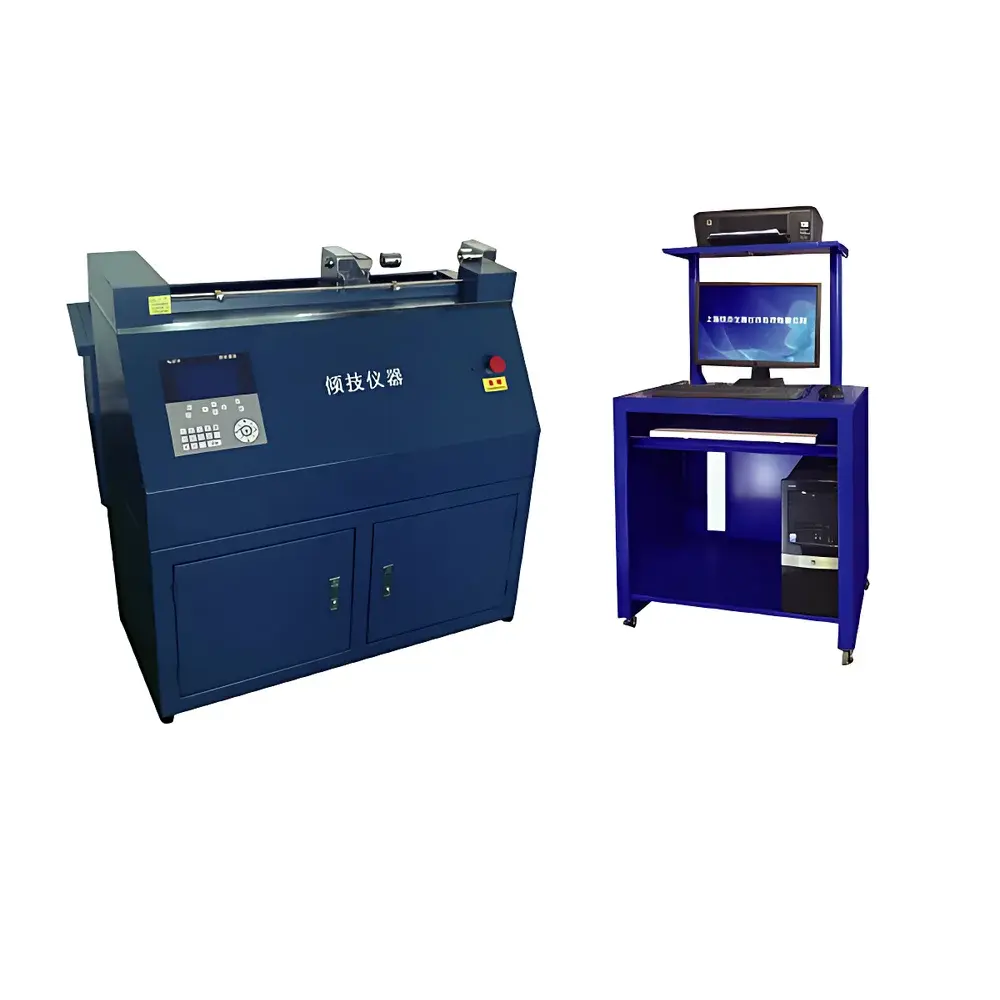
Qinji QJ310 Desktop Horizontal Tensile and Push-Pull Testing Machine
| Brand | Qinji |
|---|---|
| Origin | Shanghai, China |
| Model | QJ310 Desktop |
| Max Test Load | 2500 N or 5000 N |
| Load Accuracy | < ±0.5% of full scale |
| Stroke Range | 200 mm |
| Displacement Resolution | 0.001 mm |
| Speed Range | 0.001–300 mm/min |
| Dimensions (W×D×H) | 600 × 300 × 300 mm |
| Weight | ~40 kg |
| Power Supply | AC 220 V, 50/60 Hz |
Overview
The Qinji QJ310 Desktop Horizontal Tensile and Push-Pull Testing Machine is an electromechanical force-testing system engineered for precision mechanical characterization of small- to medium-scale components under uniaxial tension, compression, peel, and pull-off loading conditions. Designed specifically for horizontal configuration, it eliminates gravitational alignment errors common in vertical frames and provides optimal ergonomics for repetitive testing of connectors, wire harnesses, terminals, PCB-mounted sockets, adhesive bonds, lamp holders, and miniature electronic assemblies. The instrument operates on a servo-controlled ball-screw actuation principle, delivering high-resolution displacement control and real-time force feedback via a calibrated load cell. Its modular architecture supports both standalone operation—via integrated LCD controller with dynamic curve plotting—and fully synchronized PC-based control through USB or RS232 interface, enabling automated test sequencing, data logging, and compliant reporting.
Key Features
- Horizontal test orientation ensures consistent specimen alignment and minimizes bending moments during axial loading—critical for evaluating crimp integrity, solder joint strength, and micro-connector retention forces.
- High-precision ball-screw drive system with backlash compensation delivers stable velocity control across the full speed range (0.001–300 mm/min), supporting quasi-static creep tests as well as rapid detachment assessments.
- Integrated 7-inch TFT-LCD controller with real-time graphical display of force–displacement curves, peak load capture, and programmable test limits—no external PC required for basic operation.
- Calibrated load cells available in two capacities: 2500 N and 5000 N, both traceable to national standards with verified accuracy better than ±0.5% FS and internal resolution down to 0.01% of full scale.
- Rigid steel frame with powder-coated enclosure and reinforced mounting base ensures mechanical stability and long-term repeatability—tested per ISO 7500-1 Class 1 requirements for static force measurement systems.
- Comprehensive software suite includes test method templates aligned with ASTM D903 (peel strength), ASTM D1876 (T-peel), IEC 60512-2 (electrical connector mechanical testing), and IPC-TM-650 2.4.1 (solder joint pull strength).
Sample Compatibility & Compliance
The QJ310 accommodates specimens up to 200 mm in active stroke length and is compatible with standard grips (pneumatic, wedge, vise, and custom fixture interfaces) for flat, cylindrical, or irregular geometries—including insulated wires (AWG 30–10), FPC/FFC connectors, SMT-mounted LEDs, and thermoset adhesive joints. Fixture adaptability enables direct integration into production line QA stations or R&D labs performing GLP-compliant material qualification. All firmware and software modules comply with audit-trail requirements per FDA 21 CFR Part 11 when configured with user authentication, electronic signatures, and immutable data export (PDF/XLS). System documentation conforms to ISO/IEC 17025 calibration traceability protocols.
Software & Data Management
The included Windows-based control software supports multi-channel acquisition (force, displacement, time), real-time statistical analysis (mean, SD, CV%, max/min), and customizable report generation with embedded test parameters, environmental metadata, and digital signature fields. Raw data exports in CSV format preserve full temporal resolution for post-processing in MATLAB, Python (NumPy/Pandas), or Minitab. Software architecture supports version-controlled test methods, password-protected parameter locking, and automated pass/fail evaluation against user-defined thresholds—essential for IQ/OQ validation in regulated manufacturing environments.
Applications
- Quantitative assessment of crimp retention force for automotive wire harness terminals (SAE J2038, USCAR-21)
- Peel strength evaluation of pressure-sensitive adhesives used in medical device assembly (ISO 2556, ASTM D3330)
- Pull-off testing of surface-mount LED packages per JEDEC JESD22-B108
- Mechanical verification of USB-C and HDMI connector insertion/extraction cycles
- Quality screening of solder joint reliability in consumer electronics prior to thermal cycling
- Validation of epoxy bond strength in optoelectronic packaging under controlled humidity conditions
FAQ
Is the QJ310 compliant with ISO 17025 calibration requirements?
Yes—the load cell and displacement encoder are supplied with factory calibration certificates traceable to CNAS-accredited laboratories; users may perform in-house verification using certified reference weights and gauge blocks.
Can the system be integrated into a LabView or Python-based automation framework?
Yes—DLL libraries and documented ASCII command protocol (SCPI-like) enable seamless integration with third-party control environments.
What maintenance intervals are recommended for long-term accuracy retention?
Annual recalibration is advised; routine inspection of grip surfaces, ball-screw lubrication, and encoder belt tension should occur every 6 months under continuous use.
Does the software support multi-user role-based access control?
Yes—administrator, operator, and reviewer roles can be defined with granular permissions for method editing, test execution, and report approval.
Are custom fixtures available for non-standard samples?
Qinji offers OEM fixture design services with mechanical drawings and FEA-supported validation reports upon request.



