
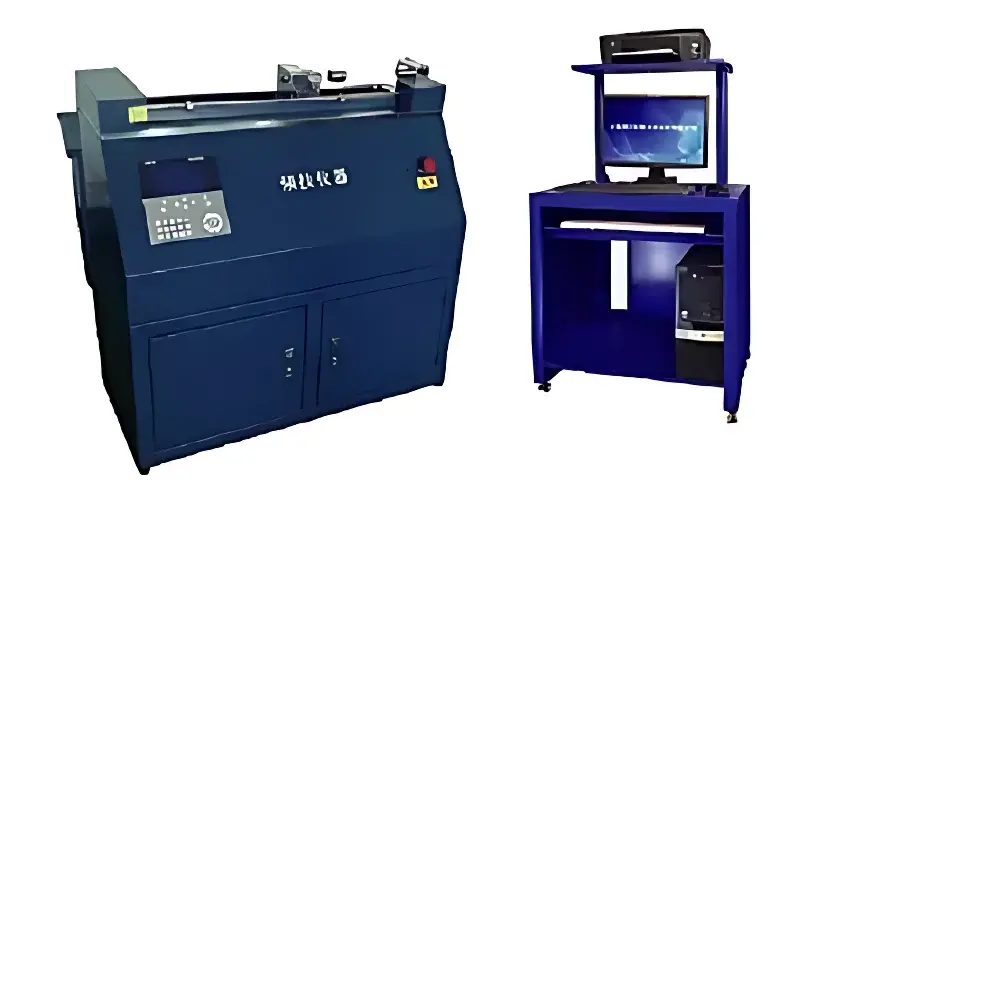
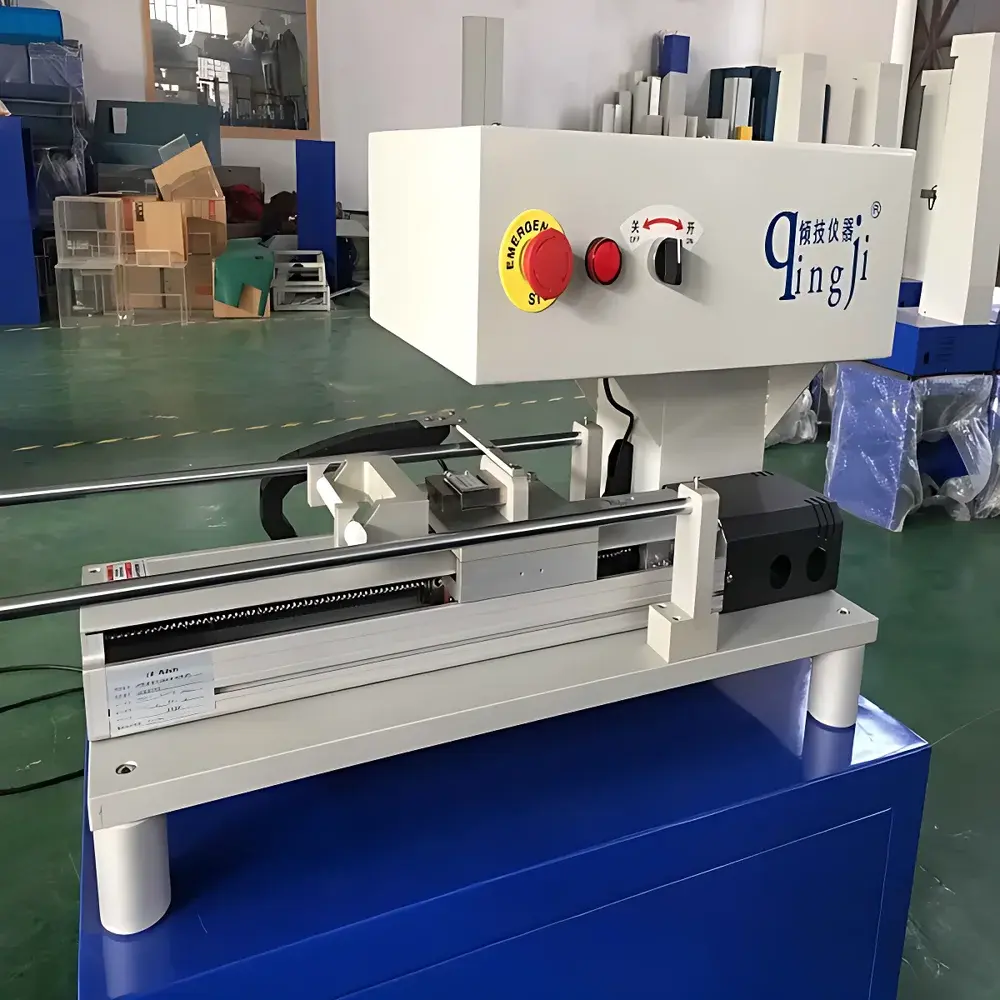
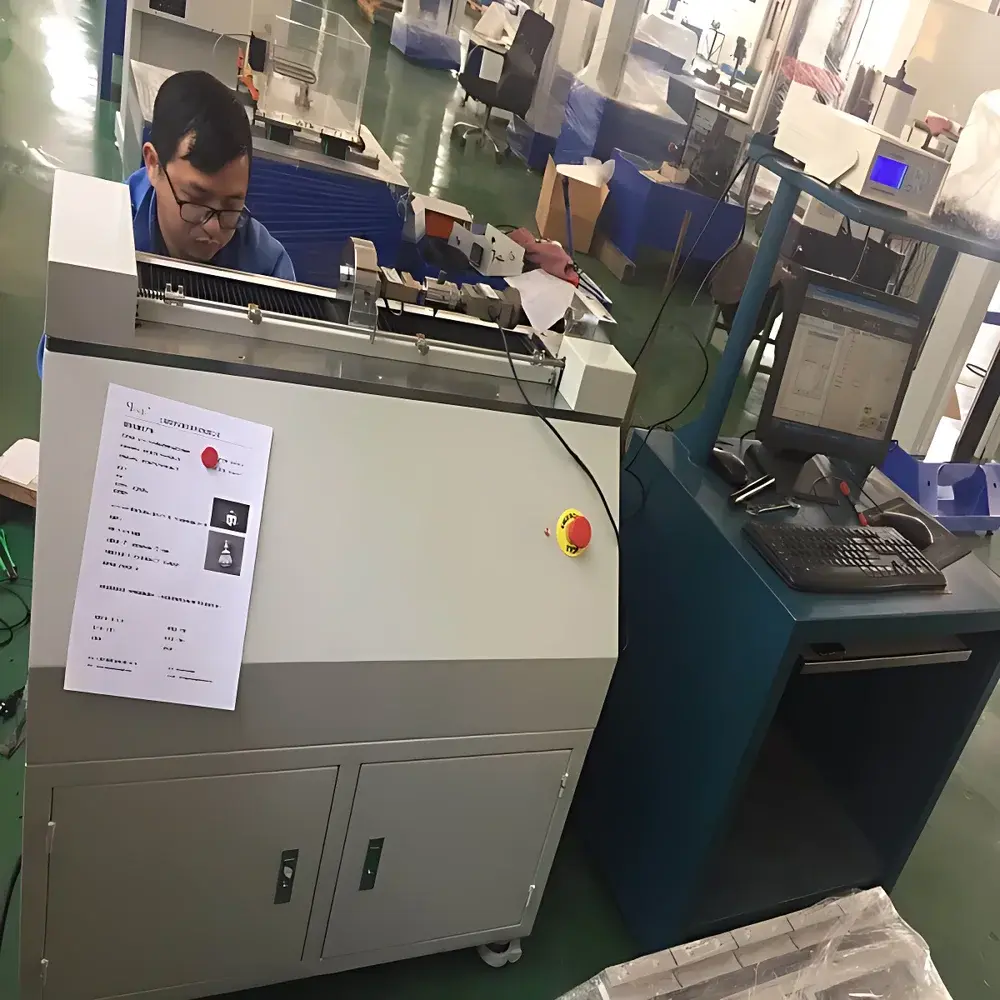
Qinji QJ310 Horizontal Tensile Testing Machine
| Brand | Qinji |
|---|---|
| Origin | Shanghai, China |
| Model | QJ310 |
| Instrument Type | Electronic Tensile Testing Machine |
| Maximum Test Load | 5000 N |
| Load Range | Up to 2500 N or 5000 N (FS) |
| Load Accuracy | ±0.5% |
| Stroke | >300 mm |
| Displacement Resolution | 0.001 mm |
| Test Speed | 0.001–300 mm/min |
| Test Space | ≥200 mm |
| Power Supply | AC 220 V, 50/60 Hz |
| Dimensions (W×D×H) | 600 × 300 × 300 mm |
| Weight | ~485 kg |
Overview
The Qinji QJ310 Horizontal Tensile Testing Machine is an electromechanical force-testing system engineered for precise static and quasi-static tensile, peel, pull-off, and bond strength evaluation of compact mechanical and electrical components. Unlike vertical configurations, its horizontal architecture accommodates elongated or asymmetric specimens—such as wire harnesses, crimped terminals, connectors, LED lamp bases, adhesive joints, and miniature electronic assemblies—without gravitational interference on load alignment or specimen handling. The system operates on a servo-controlled ball screw drive mechanism coupled with high-resolution load cell feedback (0.01% internal resolution), enabling traceable force measurement per ISO 7500-1 Class 1 and ASTM E4 compliance protocols. Real-time force-displacement curves are rendered dynamically on an integrated industrial LCD controller, while optional PC-based control supports full test sequence programming, data logging, and report generation in accordance with GLP and ISO/IEC 17025 documentation requirements.
Key Features
- Horizontal loading configuration optimized for axial alignment of low-profile, high-aspect-ratio specimens including cable assemblies and PCB-mounted connectors
- High-precision ball screw actuation system delivering smooth, backlash-free motion across the full speed range (0.001–300 mm/min)
- Dual-range load capacity (2500 N / 5000 N) selectable via software calibration; certified accuracy of ±0.5% of full scale per ISO 7500-1
- Sub-micron displacement resolution (0.001 mm) enabled by optical encoder feedback integrated into the crosshead drive train
- Robust structural frame fabricated from precision-machined, powder-coated steel with vibration-damped base mounting
- Onboard 7-inch industrial LCD touchscreen interface supporting real-time curve plotting, parameter setting, and local data export (USB)
- Standard RS232 and USB interfaces for bidirectional communication with Windows-based testing software (e.g., Qinji TestSuite v3.x)
Sample Compatibility & Compliance
The QJ310 is routinely deployed in QC laboratories validating mechanical integrity of automotive wiring harnesses (SAE J1128), consumer electronics interconnects (IEC 60512-2), and medical device terminations (ISO 10993-18). Its open-test-zone geometry permits direct clamping of specimens up to 300 mm in gauge length and accommodates custom fixtures—including pneumatic grips, peel jigs, and crimp-pull adapters—for standardized tests such as ASTM D903 (peel strength), ASTM D638 (tensile properties of plastics), and UL 486A-B (wire connector pull-out). All hardware and firmware conform to CE marking directives (2014/30/EU EMC, 2014/35/EU LVD), and software modules support audit-trail functionality compliant with FDA 21 CFR Part 11 when configured with user authentication and electronic signature modules.
Software & Data Management
Qinji TestSuite software provides full I/O control, method-driven test execution, and automated pass/fail evaluation against user-defined limits. Raw data (force, displacement, time) are recorded at ≥100 Hz sampling rate and stored in CSV and XML formats compatible with third-party statistical analysis tools (e.g., Minitab, JMP). Report templates adhere to ISO 14289-1 (PDF/A-1a) archival standards and include embedded metadata: operator ID, calibration certificate number, environmental conditions (optional sensor input), and digital signatures. Data integrity safeguards include cyclic redundancy checks (CRC32), write-once storage mode, and configurable auto-backup to network drives or NAS devices.
Applications
- Quantitative verification of crimp joint strength in automotive wire harnesses per OEM specifications (e.g., Ford WSS-M99P1111-A, GM GMW3172)
- Peel adhesion testing of flexible printed circuits (FPCs) and pressure-sensitive tapes under controlled humidity conditions
- Pull-out force validation of USB-C, HDMI, and micro-USB receptacles mounted on rigid or flex-rigid PCBs
- Mechanical endurance screening of LED lamp holders subjected to thermal cycling and vibration pre-test
- Quality gate testing for medical sensor cable terminations requiring <1.5 N variation across 50-unit batches
FAQ
What standards does the QJ310 support for tensile testing?
It supports method implementation aligned with ASTM D638, ISO 527-1, ISO 1924-2, and EN 14410 for material and component-level characterization.
Can the system be integrated into an automated production line?
Yes—via digital I/O signals (start/stop, pass/fail output) and Modbus TCP protocol for PLC synchronization.
Is calibration certification included with shipment?
Each unit ships with a factory calibration certificate traceable to NIM (National Institute of Metrology, China), valid for 12 months.
Does the software support multi-language UI and report generation?
English and Chinese language packs are standard; report localization (e.g., German, Japanese) requires configuration file import and font licensing.
What maintenance intervals are recommended for long-term accuracy?
Load cell recalibration every 12 months or after 10,000 test cycles; ball screw lubrication every 6 months under continuous operation.



