
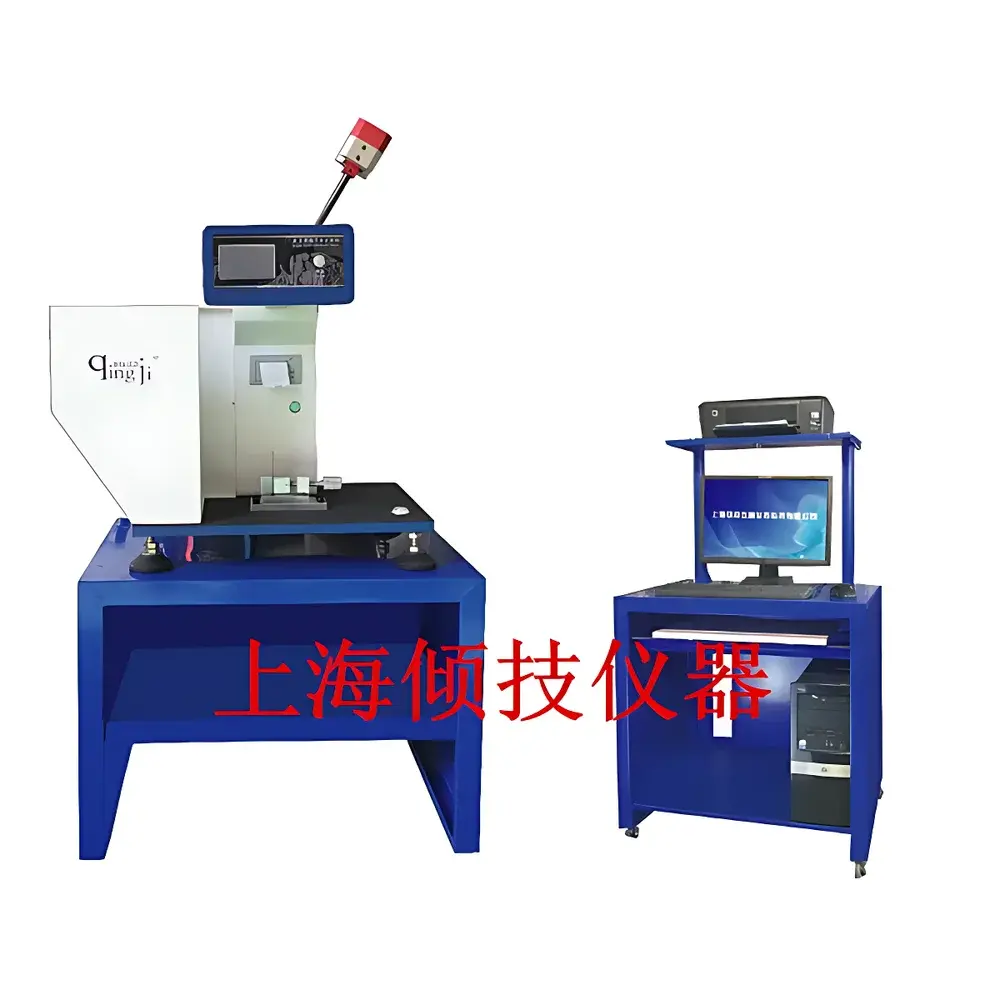
Qinji QJBCS300J Pendulum Impact Tester for Non-Metallic Materials
| Brand | Qinji |
|---|---|
| Origin | Shanghai, China |
| Model | QJBCS300J |
| Impact Energy | 150 J / 300 J / 450 J |
| Impact Velocity | ~5.2 m/s |
| Pendulum Pre-Lift Angle | 150° |
| Center of Percussion Distance | 335 mm |
| Impact Blade Radius | R 0.8 mm |
| Display | Chinese Character LCD with Manual Button Control and Automatic Angle/Energy Readout |
| Power Supply | 220 V ±10%, 50 Hz |
| Net Weight | ~210 kg |
| Compliance | GB/T 1843, ISO 180, GB/T 2611, JB/T 8761 |
Overview
The Qinji QJBCS300J Pendulum Impact Tester is a precision-engineered instrument designed for standardized Charpy-type (cantilever-beam) impact testing of non-metallic materials. It operates on the classical pendulum principle: a calibrated hammer arm is raised to a defined pre-lift angle, released under gravity, and strikes a notched specimen clamped in a fixed cantilever configuration. The energy absorbed during fracture—calculated from the difference between initial and residual potential energy of the pendulum—is quantified as impact toughness (kJ/m² or J/m). This method provides reproducible, comparative mechanical data essential for quality control, material development, and regulatory compliance in polymer, composite, and ceramic manufacturing. The QJBCS300J is explicitly configured to meet the geometric, kinematic, and reporting requirements of GB/T 1843 (equivalent to ISO 180), ensuring traceability to national and international standards frameworks.
Key Features
- Triple-range impact energy capability (150 J, 300 J, 450 J) achieved via interchangeable pendulum hammers—enabling single-instrument coverage across low-, medium-, and high-toughness material classes.
- Fixed center-of-percussion distance (335 mm) and standardized impact blade geometry (R 0.8 mm radius) guarantee strict adherence to ISO 180 and GB/T 1843 specimen alignment and loading conditions.
- High-contrast Chinese-character LCD display with integrated microprocessor control delivers real-time readout of pendulum angle, impact energy, and test status—eliminating manual scale interpolation and reducing operator-induced error.
- Robust cast-iron base and hardened steel frame provide vibration damping and long-term dimensional stability, critical for repeatable energy transfer and fracture initiation consistency.
- Manual button-actuated release mechanism ensures precise timing control and eliminates electromagnetic interference risks associated with solenoid-based triggers—enhancing measurement integrity in electromagnetically noisy lab environments.
- Compliant with mechanical safety requirements per GB/T 2611 (General Requirements for Testing Machines) and JB/T 8761 (Technical Specifications for Plastic Impact Testing Machines).
Sample Compatibility & Compliance
The QJBCS300J is validated for standardized testing of rigid and semi-rigid non-metallic specimens including thermoplastics (e.g., ABS, PC, PP), fiber-reinforced composites (e.g., glass-fiber nylon, carbon-fiber epoxy), advanced ceramics, electrical insulating materials (e.g., phenolic laminates, silicone rubber sheets), and mineral-based castings (e.g., cast stone). Specimens must conform to ISO 180/GB/T 1843 dimensions (typically 80 × 10 × 4 mm with standardized notch geometry) and be conditioned per ISO 291 prior to testing. Data generated supports conformance reporting for ISO 9001 internal audits, IATF 16949 supplier qualification, and CE marking technical documentation under EU Construction Products Regulation (CPR) Annex ZA for building material classification.
Software & Data Management
While the QJBCS300J operates as a stand-alone analog-digital hybrid system without embedded PC connectivity, its LCD interface outputs fully traceable numeric results—including pre-impact angle, post-impact angle, calculated absorbed energy (J), and pass/fail flags against user-defined thresholds. All displayed values are stored in non-volatile memory with timestamping. For integration into GLP/GMP environments, optional RS-232 or USB-to-serial adapters enable export of ASCII-formatted test logs to LIMS or Excel-based QA databases. Audit trails—including operator ID input, calibration date entry, and firmware version—can be manually recorded in laboratory notebooks compliant with FDA 21 CFR Part 11 principles when paired with controlled electronic record procedures.
Applications
- Quality assurance of injection-molded plastic components in automotive interiors and consumer electronics housings.
- Evaluation of notch sensitivity in biodegradable polymers for medical device packaging validation.
- Batch release testing of FRP (fiber-reinforced polymer) grating used in chemical plant walkways per ASTM D7264.
- Comparative impact performance assessment of ceramic matrix composites in aerospace thermal protection systems.
- Failure analysis of brittle electrical insulators subjected to mechanical shock during transportation and installation.
- Supporting ASTM D256 and ISO 180 interlaboratory round-robin studies for method verification and uncertainty budgeting.
FAQ
Does the QJBCS300J support both ISO 180 and ASTM D256 configurations?
No—the QJBCS300J is configured exclusively for cantilever-beam (ISO 180/GB/T 1843) impact testing. ASTM D256 requires a different specimen support geometry (notched Izod) and is not mechanically supported.
Is calibration certification included with shipment?
Yes—a factory-issued calibration certificate traceable to CNAS-accredited reference standards is provided, covering pendulum moment of inertia, impact velocity verification, and energy scale linearity across all three ranges.
Can the instrument be upgraded for automated data capture?
Yes—via third-party serial interface modules compatible with LabVIEW, Python pySerial, or MATLAB, enabling script-driven batch testing and CSV log generation.
What maintenance intervals are recommended for long-term accuracy?
Blade edge inspection and replacement every 500 impacts; bearing lubrication every 12 months; annual verification of pendulum axis alignment and zero-energy offset per GB/T 2611 Annex C.
Is the machine suitable for use in ISO 17025-accredited laboratories?
Yes—when operated within documented SOPs, maintained per manufacturer guidelines, and verified using certified reference specimens (e.g., NIST SRM 2822), it meets the metrological requirements for accredited impact testing.



