
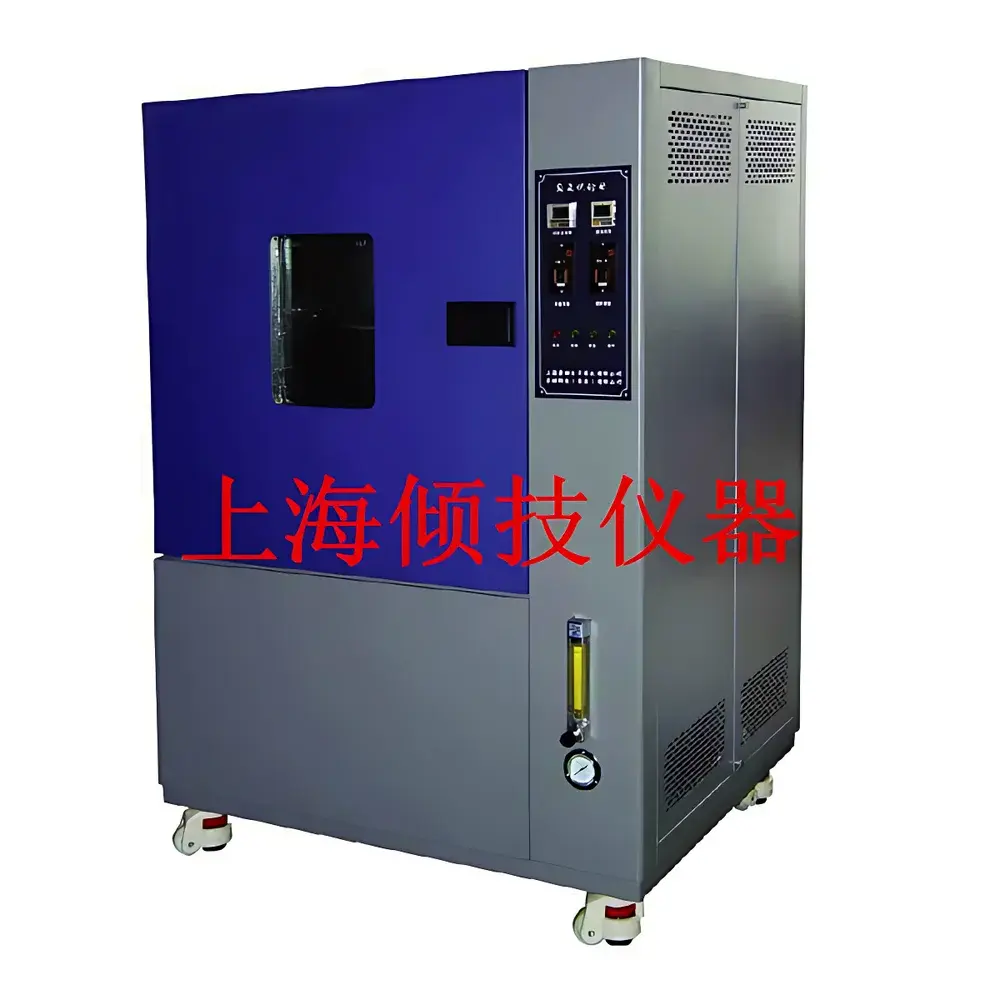
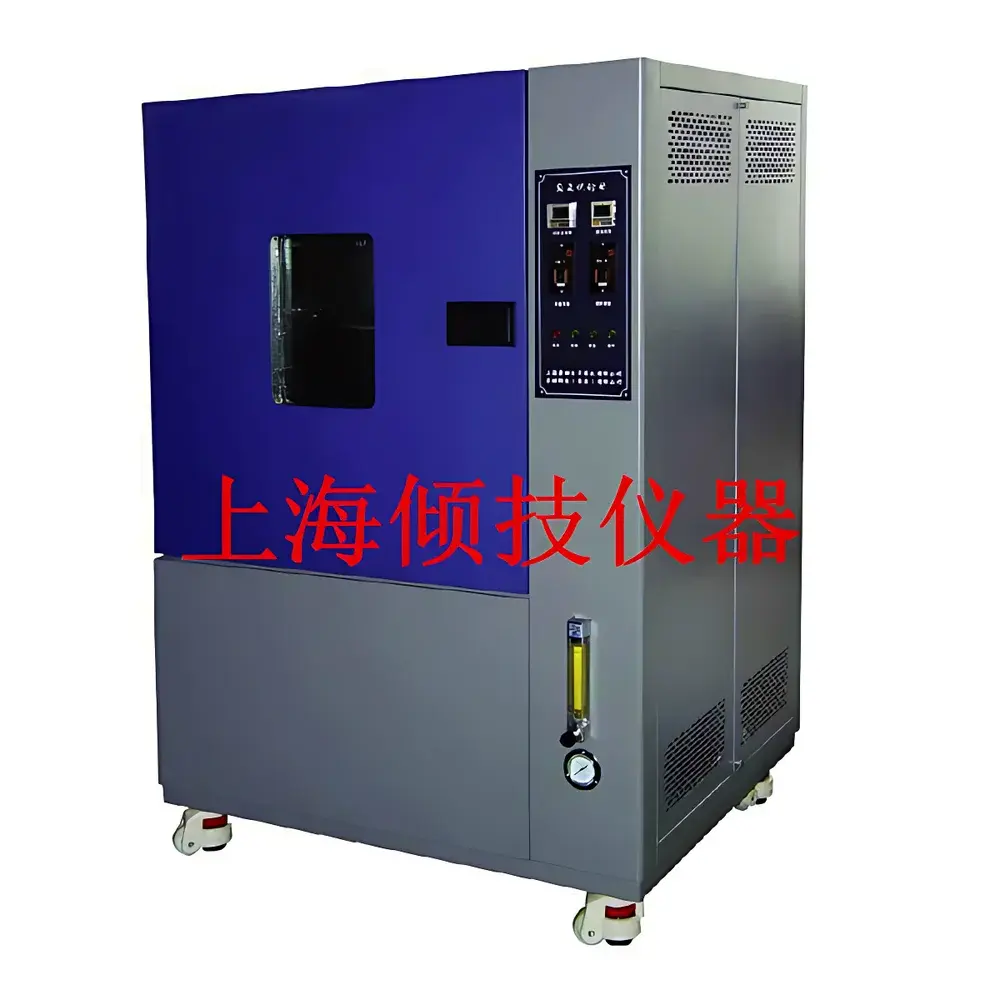
Qinji QJCYX-542 Ozone Aging Test Chamber
| Brand | Qinji |
|---|---|
| Origin | Shanghai, China |
| Model | QJCYX-542 |
| Temperature Range | 0–60 °C |
| Humidity Range | 40–98% RH (at 30–60 °C) |
| Temperature Uniformity | ≤±2 °C |
| Temperature Stability | ≤±0.5 °C |
| Humidity Stability | +2 / −3% RH |
| Heating Rate | 0.7–1.0 °C/min |
| Cooling Rate | ≤20 min (from ambient to 10 °C, non-restricted) |
| Ozone Concentration Range | 10–1000 pphm |
| Gas Flow Velocity | 12–16 mm/s |
| Compliance | GB/T 7762–2003, GB/T 3642–1992 |
Overview
The Qinji QJCYX-542 Ozone Aging Test Chamber is an engineered environmental test system designed specifically for evaluating the ozone resistance of elastomers, rubber compounds, and other non-metallic polymeric materials. It operates on the principle of controlled atmospheric exposure within a sealed, recirculating gas loop—where ozone is generated in situ via silent corona discharge and precisely metered to achieve stable concentrations between 10 and 1000 parts per hundred million (pphm). Unlike open-air ozone exposure methods, this closed-loop architecture ensures high reproducibility, eliminates ambient interference, and enables strict adherence to standardized aging protocols defined in GB/T 7762–2003 (equivalent to ISO 1431-1) and GB/T 3642–1992. The chamber integrates independent regulation of temperature (0–60 °C), relative humidity (40–98% RH, conditioned within the 30–60 °C operational band), and laminar gas flow velocity (12–16 mm/s), all of which are critical parameters influencing crack initiation and propagation kinetics during accelerated ozone aging.
Key Features
- Integrated ozone generation system using high-efficiency silent corona discharge—no external ozone source required
- Precise digital concentration control with real-time feedback via electrochemical ozone sensor (calibrated traceable to NIST standards)
- Double-wall insulated stainless-steel chamber with forced-air convection and PID-controlled heating/cooling circuits
- Temperature uniformity ≤±2 °C and stability ≤±0.5 °C across working volume; humidity stability maintained at +2 / −3% RH
- Adjustable sample rack configuration supporting static exposure of flat specimens, dumbbell strips, or molded parts per ASTM D1149 and ISO 1431-1 specimen mounting guidelines
- Non-restricted cooling design enabling ambient-to-10 °C transition in ≤20 minutes, facilitating rapid thermal cycling sequences
- Full IEC 61000-4 EMC compliance and Class I electrical safety certification
Sample Compatibility & Compliance
The QJCYX-542 accommodates standard test specimens—including ASTM D1149 Type 1 and Type 2 dumbbells, ISO 1431-1 rectangular strips (25 × 6 × 2 mm), and custom-cut vulcanized sheets up to 300 mm in length. Specimen holders are constructed from ozone-resistant 316 stainless steel and designed to minimize local airflow disruption. The system meets national and international regulatory requirements for material qualification in automotive, aerospace, and wire & cable industries. Its operational parameters align with GB/T 7762–2003 (identical in technical scope to ISO 1431-1:2017), GB/T 3642–1992 (ozone resistance classification of rubber), and supports data traceability under GLP-compliant laboratory practices. While not inherently 21 CFR Part 11–certified, audit-ready electronic logs can be exported for internal QA review.
Software & Data Management
The embedded controller features a 7-inch resistive touchscreen HMI with multilingual interface (English default), capable of storing up to 100 programmable test profiles. All process variables—ozone concentration, chamber temperature, RH, and elapsed time—are logged at user-defined intervals (1 s to 60 min) and exportable via USB to CSV format. Optional RS485 Modbus RTU interface enables integration into centralized SCADA or LIMS environments. Data integrity safeguards include password-protected parameter editing, timestamped event logging (e.g., door opening, sensor fault, setpoint change), and automatic backup to internal flash memory. Raw sensor outputs are linearized and compensated for temperature drift in firmware, ensuring metrological consistency over extended validation cycles.
Applications
- Accelerated evaluation of ozone-induced surface cracking in natural rubber (NR), styrene-butadiene rubber (SBR), nitrile rubber (NBR), and ethylene propylene diene monomer (EPDM)
- Quality assurance testing of rubber seals, gaskets, hoses, and vibration dampers prior to OEM release
- Formulation screening for antioxidant and antiozonant additives in synthetic elastomer development
- Comparative durability assessment of recycled rubber compounds versus virgin stock
- Supporting failure analysis investigations where field-exposed components exhibit premature fissuring under ambient ozone stress
FAQ
What ozone concentration range is validated and calibrated?
The chamber is factory-calibrated for 10–1000 pphm using dual-point verification against NIST-traceable ozone reference standards. Extended operation up to 20000 pphm is mechanically feasible but outside certified accuracy limits.
Can humidity be controlled independently of temperature?
Yes—humidity is regulated via steam injection and condensation-based dehumidification, decoupled from thermal control loops. RH setpoints are only valid within the 30–60 °C temperature window per GB/T 7762–2003.
Is the system compatible with dynamic (tensile-strained) testing?
No—the QJCYX-542 is configured exclusively for static exposure. Dynamic strain fixtures require optional third-party mechanical stages and are not integrated or supported by default.
What maintenance intervals are recommended for the ozone generator?
The corona discharge cell requires cleaning every 500 operational hours; full recalibration is advised annually or after any sensor replacement.
Does the unit include test report generation software?
Basic pass/fail summary reports are auto-generated upon test completion. Advanced statistical analysis (e.g., crack density quantification, Weibull lifetime modeling) requires post-processing in external tools such as MATLAB or JMP.



