
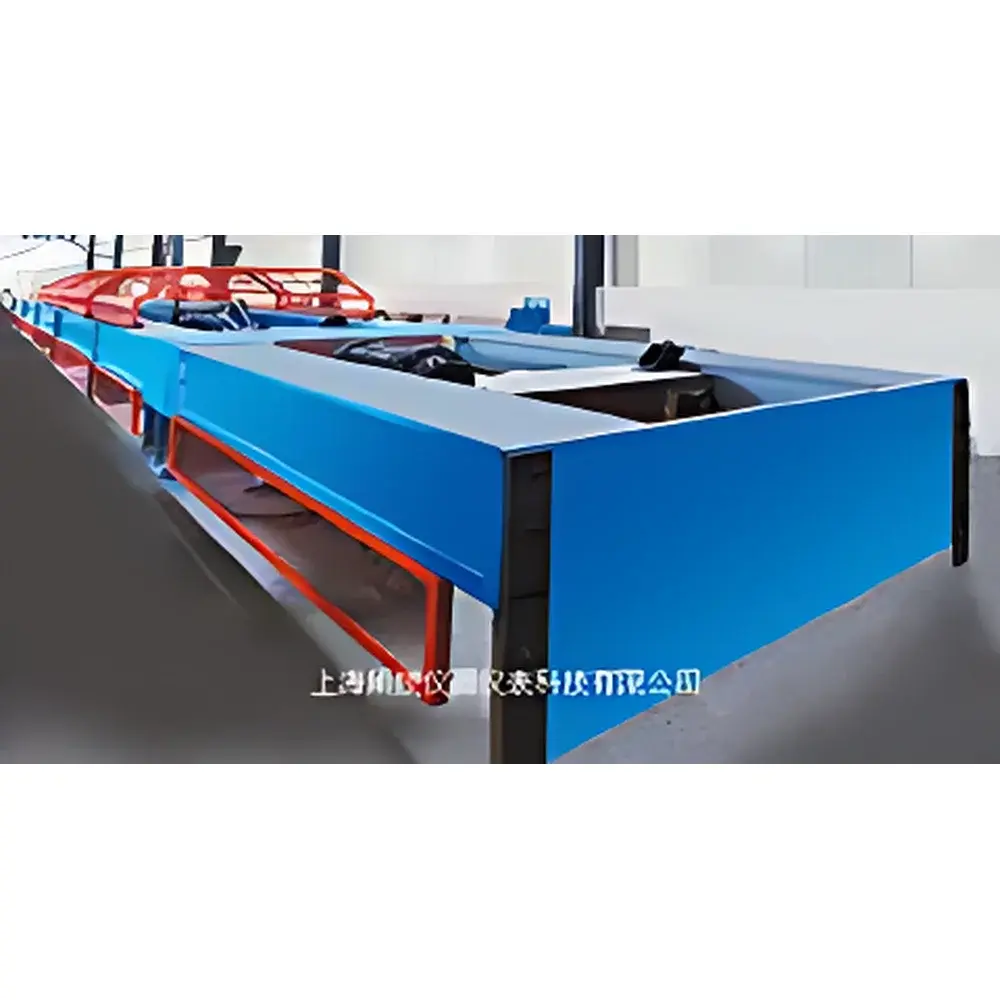
Qinji QJDW50000KN Heavy-Duty Wire Rope Tensile Testing Machine
| Brand | Qinji |
|---|---|
| Origin | Shanghai, China |
| Model | QJDW50000KN |
| Maximum Test Force | 50000 kN |
| Force Measurement Range | 0–50000 kN (Full Scale) |
| Force Accuracy | ≤1% of reading |
| Displacement Accuracy | ≤1% of reading |
| Position Resolution | ≤1 mm |
| Test Mode | Fully Computer-Controlled |
| Compliance Standards | GB/T 228.1, ISO 6892-1, ASTM E8/E21, JIS Z 2241, DIN 50145 |
| Classification | Electromechanical Universal Tensile Testing System |
| Warranty | 12 months standard, lifetime technical support and spare parts availability |
Overview
The Qinji QJDW50000KN Heavy-Duty Wire Rope Tensile Testing Machine is an electromechanical universal testing system engineered for high-capacity static tensile evaluation of structural wire ropes, steel cables, prestressed tendons, and other high-strength flexible elongated specimens. Designed in accordance with the mechanical principles of uniaxial quasi-static loading under controlled displacement or load control modes, this system applies precisely regulated axial force to determine ultimate tensile strength (UTS), yield strength, elongation at break, modulus of elasticity, and load–elongation behavior. Its robust dual-column frame architecture, reinforced crosshead guidance, and high-rigidity load train ensure minimal deflection and high reproducibility during tests exceeding 45 MN — a capacity essential for validating critical infrastructure components such as suspension bridge cables, mining hoist ropes, offshore mooring lines, and nuclear containment tendons.
Key Features
- High-load capacity frame rated for continuous operation up to 50,000 kN (5,000 metric tons force), with overload protection and mechanical safety interlocks compliant with EN ISO 12100.
- High-precision load cell with 0.01% full-scale linearity and thermal drift compensation, calibrated traceable to NIM (National Institute of Metrology, China) and compatible with third-party accreditation (e.g., ISO/IEC 17025).
- Integrated servo-hydraulic or electromechanical actuation system (configurable per application), delivering stable force ramping, hold, and cycling profiles per ASTM E2309 and ISO 5893.
- Real-time digital control interface supporting both load-controlled and displacement-controlled test protocols, with closed-loop PID regulation and dynamic sampling rates ≥1 kHz.
- Modular extensometer integration capability (contact and non-contact types), enabling direct strain measurement per ISO 9513 Class 1 requirements for modulus determination.
- Comprehensive mechanical safety package including emergency stop circuitry, light curtain guarding (optional), and automatic crosshead deceleration upon limit switch activation.
Sample Compatibility & Compliance
The QJDW50000KN accommodates specimens up to 10 m in gauge length and 150 mm in nominal diameter, with custom jaw configurations for wedge-type, swage-type, and clevis-end terminations. It supports standardized test geometries for wire rope lay configurations (e.g., 6×19, 6×36, 8×19 IWRC) per ISO 3154 and ASTM A1023. The system is validated for conformance with international mechanical testing standards including GB/T 228.1–2021 (Metallic materials — Tensile testing — Part 1: Method of test at room temperature), ISO 6892-1:2019, ASTM E8/E21, JIS Z 2241, and DIN 50145. Calibration documentation satisfies GLP audit requirements and supports FDA 21 CFR Part 11-compliant electronic records when paired with optional audit-trail-enabled software.
Software & Data Management
The system operates with Qinji’s proprietary TESTMASTER v5.2 software suite, a Windows-based platform supporting multi-channel synchronized acquisition (load, displacement, strain, temperature), real-time curve overlay, and automated report generation in PDF/Excel formats. All test data are stored in encrypted SQLite databases with timestamped metadata, user authentication logs, and version-controlled calibration history. Optional modules include statistical process control (SPC) dashboards, batch comparison tools, and API-driven integration with LIMS or MES platforms via RESTful web services. Software validation packages (IQ/OQ/PQ documentation) are available upon request for regulated environments.
Applications
- Qualification testing of galvanized and stainless steel wire ropes used in elevator systems, cable-stayed bridges, and wind turbine guy wires.
- Mechanical validation of post-tensioning tendons and strand anchors in precast concrete construction.
- Research-grade characterization of fatigue–tensile interaction in multi-cycle loading protocols (e.g., ISO 10424-2).
- Third-party certification testing for ISO 9001 and API Q1 quality management system audits.
- Failure analysis of broken rope segments via comparative stress–strain reconstruction and fracture surface correlation.
FAQ
What is the maximum specimen diameter supported by the standard jaw configuration?
Standard hydraulic wedge grips accommodate diameters up to 80 mm; custom jaws for 150 mm diameter ropes are available as an optional configuration.
Does the system meet ISO/IEC 17025 calibration traceability requirements?
Yes — factory calibration certificates include uncertainty budgets and traceability to national standards; on-site recalibration services are provided globally.
Can the machine perform cyclic loading tests (e.g., tension–tension fatigue)?
While primarily designed for static tensile evaluation, optional servo-hydraulic configurations support low-cycle fatigue testing per ASTM E606 with programmable waveforms.
Is remote diagnostics and software update support available?
Yes — the embedded controller supports secure VPN-based remote access for troubleshooting, firmware updates, and parameter optimization under signed maintenance agreements.
What documentation is supplied with the system for regulatory compliance?
Standard delivery includes Declaration of Conformity (CE), Factory Calibration Report, Mechanical Safety Risk Assessment (per ISO 12100), and User Manual with maintenance schedules and torque specifications.



