
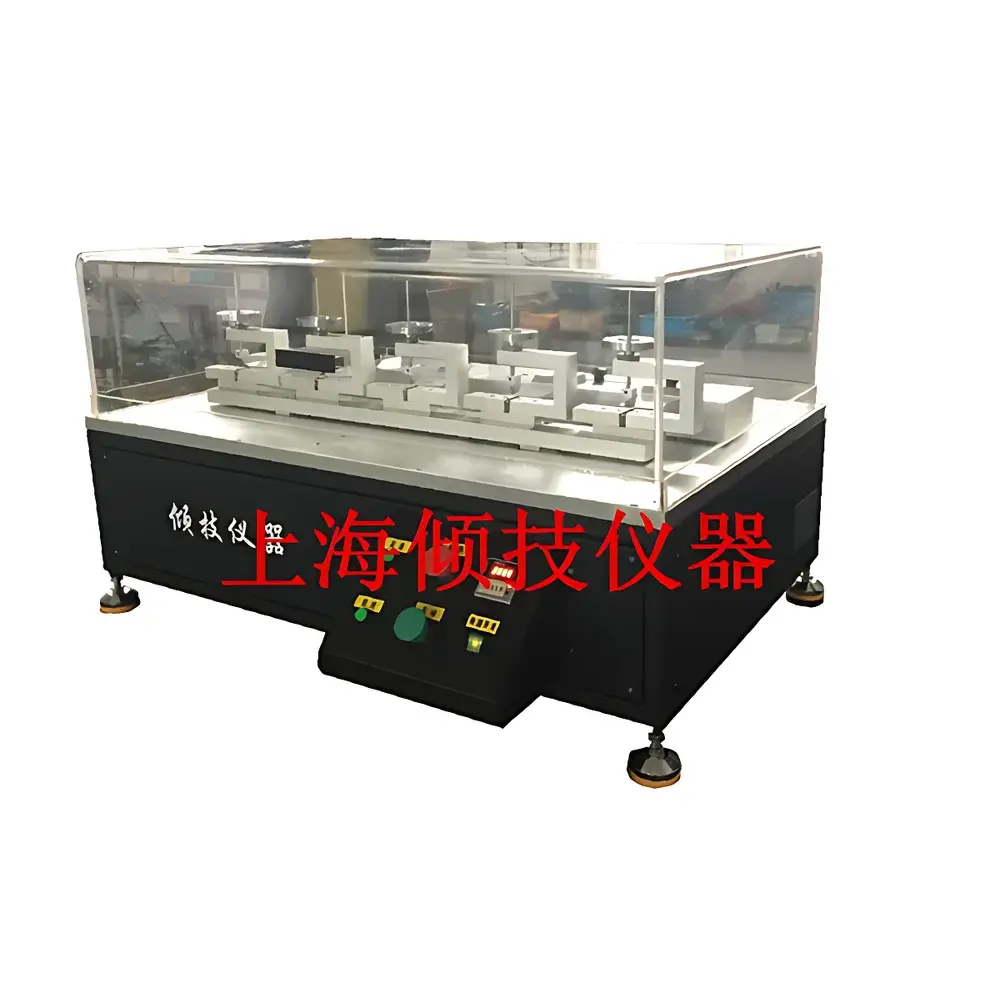
Qinji QJICHL Five-Station Triple-Roller Card Durability Tester
| Brand | Qinji |
|---|---|
| Origin | Shanghai, China |
| Manufacturer Type | Authorized Distributor |
| Country of Origin | China |
| Model | QJICHL |
| Price Range | USD 1,400 – 7,200 |
| Test Stations | 5 (simultaneous control & display) |
| Adjustable Roller Cycles | 0–200 cycles |
| Cycle Frequency | 0.5 Hz |
| Applied Load | 8 N (standard) |
| optional weights | 3 N, 5 N, 7 N |
| Power Supply | AC 220 V |
| Dimensions (L×W×H) | 500 × 400 × 400 mm |
| Weight | 12 kg |
| Roller Initial Position & Height | Manually adjustable |
| Dual Support Plates | One movable plate on roller side |
Overview
The Qinji QJICHL Five-Station Triple-Roller Card Durability Tester is an electromechanical test system engineered for standardized mechanical stress evaluation of contact-type integrated circuit (IC) cards, including ISO/IEC 7816-compliant smart cards and identification cards. It implements the triple-roller bending methodology defined in ISO/IEC 10373-3:2001 — Clause 7.2 (“Bending Stress Test”) — to simulate repeated flexural loading at the card’s longitudinal axis, replicating real-world handling conditions such as insertion into readers, wallet compression, or manual flexing. Each of the five independent test stations operates synchronously under identical kinematic parameters, enabling high-throughput validation of batch-produced cards against the Contact Quality Monitoring (CQM) requirements established by Mastercard’s Secure Technology program. The device applies controlled cyclic downward force via a precision-ground steel roller traveling along two parallel support plates; the card remains clamped between them while undergoing up to 200 programmable bending cycles at a fixed frequency of 0.5 Hz (i.e., one cycle every 2 seconds). Post-test functional verification — including electrical continuity, contact resistance, and chip response — must confirm no degradation in performance or physical integrity.
Key Features
- Five parallel test stations with synchronized actuation and individual real-time status indication — significantly reducing per-batch qualification time without compromising repeatability.
- Manually adjustable roller initial position and vertical height, allowing precise alignment relative to card thickness (0.76 mm standard) and contact zone geometry.
- Dual support plates with one laterally movable plate to accommodate minor dimensional variances across card batches and ensure consistent load distribution.
- Standardized 8 N nominal test load, supplemented by three calibrated auxiliary weights (3 N, 5 N, 7 N) for compliance with CQM-recommended load-tiered validation protocols.
- Robust aluminum-alloy frame with vibration-dampened base and precision linear guides for roller motion — minimizing mechanical drift and ensuring long-term positional stability.
- Front-panel digital counter with reset function and LED status indicators per station — enabling unambiguous cycle tracking and immediate fault detection during operation.
Sample Compatibility & Compliance
The QJICHL tester accepts standard ISO/IEC 7816-1/2/3 ID-1 format cards (85.6 × 53.98 × 0.76 mm), including PVC, PET, and polycarbonate substrates with embedded copper contact pads or antenna traces. It supports both single-layer and multi-layer laminated constructions typical of EMV-compliant payment cards and government-issued eID cards. All mechanical parameters conform strictly to the dimensional tolerances and loading specifications outlined in ISO/IEC 10373-3:2001 Annex B and Mastercard CQM v4.0 Section 5.2. The system does not incorporate automated electrical testing; however, its mechanical output is fully compatible with downstream validation using external multimeters, contact resistance analyzers (e.g., Keysight B2901B), or dedicated IC card testers (e.g., Feitian CT-1000). No regulatory certification (e.g., CE, FCC) is claimed; users are responsible for verifying local electromagnetic compatibility and safety compliance prior to deployment in GLP/GMP environments.
Software & Data Management
The QJICHL operates as a standalone hardware platform with no embedded microcontroller or digital interface. All operational parameters — cycle count, load configuration, and station enablement — are set manually via mechanical dials and physical weight placement. Consequently, no firmware, driver software, or data export capability is provided. This design prioritizes operational simplicity, calibration transparency, and immunity to software obsolescence — aligning with laboratories requiring audit-ready, deterministic test execution per ISO/IEC 17025 clause 7.2.2 (Verification of Equipment Functionality). For traceability, users are advised to log test configurations and outcomes manually in bound laboratory notebooks or LIMS-integrated spreadsheets referencing batch IDs, operator initials, date/time stamps, and pass/fail criteria per ISO/IEC 10373-3 Table 2.
Applications
- Pre-certification mechanical endurance screening of IC cards prior to submission to accredited test labs (e.g., UL, Bureau Veritas, SGS) for full ISO/IEC 10373-3 certification.
- In-process quality assurance during card personalization — validating lamination integrity and contact pad adhesion after chip embedding and hot-stamping.
- Root-cause analysis of field failures related to bending-induced delamination, solder joint fracture, or antenna trace cracking.
- Supplier qualification audits where OEMs require evidence of mechanical robustness across multiple production lots.
- Educational use in materials science and electronics packaging curricula to demonstrate polymer substrate fatigue behavior under cyclic flexural stress.
FAQ
Does the QJICHL support automated data logging or USB/RS232 connectivity?
No. The instrument is purely electromechanical and lacks any digital interface or internal memory. All test records must be documented externally.
Can it test contactless (RFID/NFC) cards without metal contacts?
Yes — mechanically, but functional validation requires separate RF testing equipment, as the QJICHL only assesses structural durability, not wireless performance.
What maintenance is required to sustain measurement accuracy over time?
Annual verification of roller alignment, support plate parallelism, and weight calibration is recommended. Clean roller surfaces with isopropyl alcohol before each test session to prevent particulate-induced abrasion.
Is the 0.5 Hz cycle frequency adjustable?
No. The motor-driven cam mechanism is fixed at 0.5 Hz to maintain strict adherence to ISO/IEC 10373-3 timing requirements.
How is traceability ensured for ISO/IEC 17025 compliance?
Through documented operator training records, periodic mechanical calibration logs (per ISO/IEC 17025 clause 6.4.10), and retention of raw test sheets showing load configuration, cycle count, and visual inspection results.



