
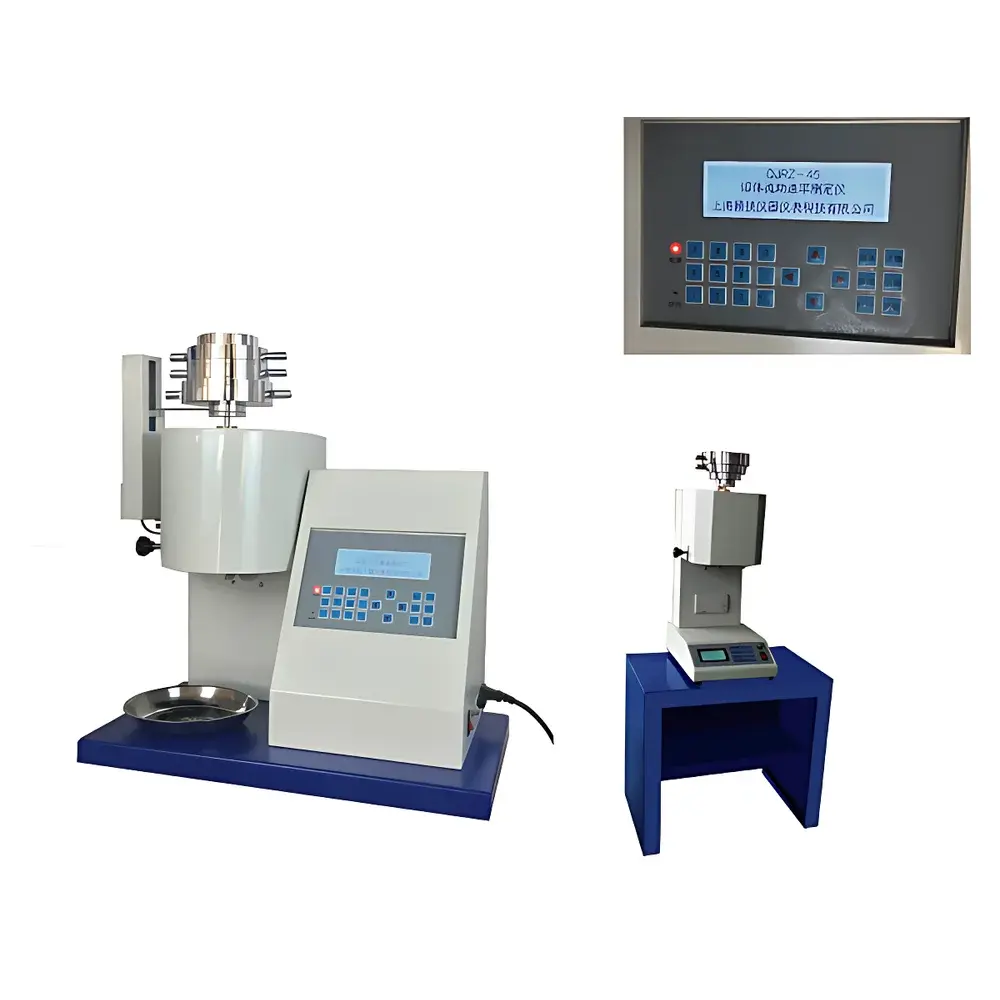
Qinji QJRZ-45 Melt Flow Rate Tester (Upgraded Model)
| Brand | Qinji |
|---|---|
| Origin | Shanghai, China |
| Manufacturer Type | Authorized Distributor |
| Country of Manufacture | China |
| Model | QJRZ-45 |
| Price | USD 2,800 (FOB Shanghai) |
| Temperature Range | 50–400 °C |
| Temperature Stability | ±0.5 °C |
| Temperature Resolution | 0.1 °C |
| Barrel Diameter | Φ9.55 mm ±0.025 mm |
| Die Orifice Diameters | Φ2.095 mm ±0.005 mm and Φ1.180 mm ±0.010 mm |
| Power Supply | AC 220 V, 50 Hz |
| Dimensions (W×D×H) | 250 mm × 400 mm × 500 mm |
| Net Weight | 35 kg |
Overview
The Qinji QJRZ-45 Melt Flow Rate Tester (Upgraded Model) is a precision gravimetric and volumetric instrument engineered for the standardized determination of melt mass-flow rate (MFR) and melt volume-flow rate (MVR) of thermoplastic polymers under defined temperature and load conditions. Operating on the principle of extrusion rheometry—where molten polymer is forced through a standardized capillary die under controlled thermal and mechanical conditions—the QJRZ-45 delivers repeatable, traceable measurements per ISO 1133-2 and ASTM D1238. Its design adheres to the fundamental requirements of capillary flow measurement: constant temperature bath stability, precise die geometry, consistent piston loading, and accurate timing of extrudate collection intervals. The instrument is calibrated for compliance with GB/T 3682–2022 (equivalent to ISO 1133:2011) and supports both single- and multi-load testing protocols required for material classification, quality control, and process validation in polymer manufacturing environments.
Key Features
- Thermally stabilized heating system with PID-controlled furnace, maintaining ±0.5 °C uniformity across the 50–400 °C operating range—suitable for high-melting engineering resins (e.g., polycarbonate, polyarylsulfone, PEEK, fluoropolymers) and commodity thermoplastics (e.g., PP, PE, PS, ABS, POM).
- Dual-standard capillary dies included: Φ2.095 mm ±0.005 mm (standard for MFR/MVR per ISO 1133–1) and Φ1.180 mm ±0.010 mm (for high-viscosity or low-flow-rate materials), both manufactured to ISO 1133 Annex A tolerances and supplied with calibration certificates.
- Automated cutting mechanism with programmable time intervals (default 10 min, adjustable in 1-second increments), eliminating operator-dependent timing errors during extrudate collection.
- Integrated microprocessor-based controller with flash memory storage (≥1,000 test records), real-time temperature and load monitoring, and on-device MFR/MVR calculation using ASTM D1238 Equation 1 and ISO 1133 Clause 8.3 algorithms.
- Robust barrel assembly with Φ9.55 mm ±0.025 mm internal diameter, precision-ground stainless steel construction, and corrosion-resistant surface treatment for long-term dimensional stability under repeated thermal cycling.
Sample Compatibility & Compliance
The QJRZ-45 accommodates granular, pelletized, or powdered thermoplastic specimens ranging from low-MFR polyethylenes (e.g., HDPE at 0.1 g/10 min) to high-viscosity engineering polymers (e.g., PC at 10 g/10 min). It supports standard test loads (e.g., 2.16 kg, 5.00 kg, 10.00 kg) and optional custom weights up to 21.6 kg via calibrated dead-weight loading. All mechanical and thermal specifications conform to ISO 1133–1:2011 Annex B (die geometry), ISO 1133–2:2011 (procedure for MVR), and GB/T 3682–2022 Clause 5 (instrument qualification). Routine verification includes die dimension inspection, temperature uniformity mapping (per ISO 1133–2 Annex C), and flow-rate repeatability assessment (RSD ≤ 2% for certified reference materials).
Software & Data Management
While the QJRZ-45 operates as a standalone benchtop instrument, its embedded firmware enables export of test logs (timestamp, temperature, load, cut interval, mass/volume, calculated MFR/MVR) via USB interface to external PCs. Raw data files are structured in CSV format for direct import into LIMS, statistical process control (SPC) platforms, or QA documentation systems. The device supports GLP-compliant audit trails: each stored record includes operator ID (manually entered), test date/time, calibration status flag, and firmware version. Optional PC software (Qinji MFR-Link v2.1) provides graphical trend analysis, comparative batch reporting, and automated generation of ISO/GB-compliant test reports—including uncertainty estimation per GUM (JCGM 100:2008) for mass measurement and timer resolution.
Applications
- Raw material acceptance testing in polymer compounding and resin distribution facilities.
- In-process monitoring of extrusion and injection molding feedstocks to ensure batch-to-batch consistency.
- Product development labs evaluating thermal degradation effects on melt viscosity after multiple processing cycles.
- Regulatory submission support for medical-grade plastics (ISO 10993–12) and food-contact materials (FDA 21 CFR §177), where MFR serves as a critical release parameter.
- Failure analysis investigations correlating unexpected part warpage or weld-line weakness with deviations in baseline MFR values.
FAQ
Does the QJRZ-45 comply with FDA 21 CFR Part 11 for electronic records?
The instrument itself does not provide full Part 11 compliance (e.g., electronic signatures, role-based access control); however, its CSV export capability and timestamped audit logs enable integration into validated Part 11–compliant LIMS or ELN systems when deployed under documented SOPs.
Can it measure MVR without manual density input?
No—MVR calculation requires user-entered or pre-configured melt density (ρ) in g/cm³. The instrument computes MVR = MFR / ρ; density must be determined separately per ISO 1133–2 Clause 9.2 or referenced from material datasheets.
Is die cleaning performed automatically?
No—capillary die cleaning is a manual procedure requiring standardized purging protocols (e.g., using HDPE or专用 cleaning compound) followed by optical inspection under 10× magnification per ISO 1133–1 Annex D.
What maintenance is required for long-term accuracy?
Annual recalibration of temperature sensors (per ISO 1133–2 Annex C), biannual verification of die dimensions using certified plug gauges, and routine lubrication of the piston guide sleeve with high-temp silicone grease every 200 test cycles.
Is technical support available outside China?
Yes—Qinji maintains authorized service partners in Germany, USA, and Singapore offering remote diagnostics, on-site calibration, and spare parts logistics under global warranty terms.




