
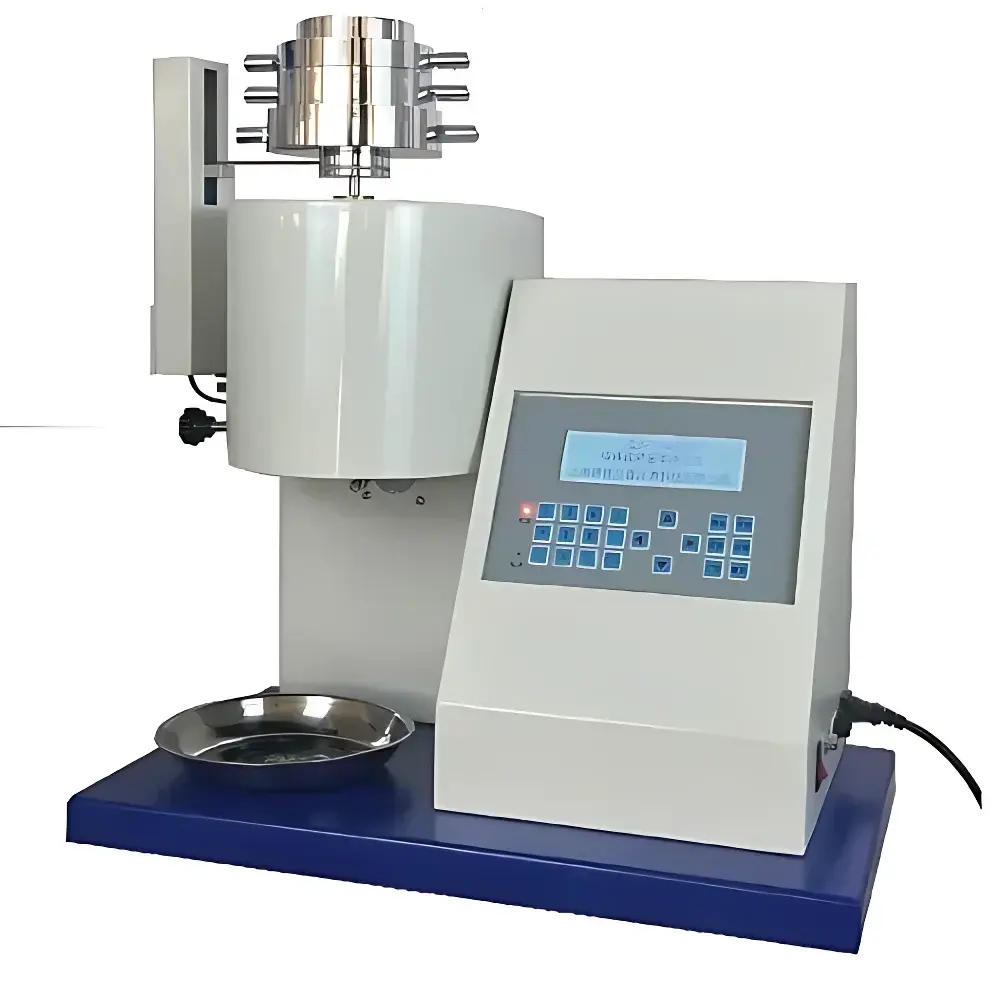
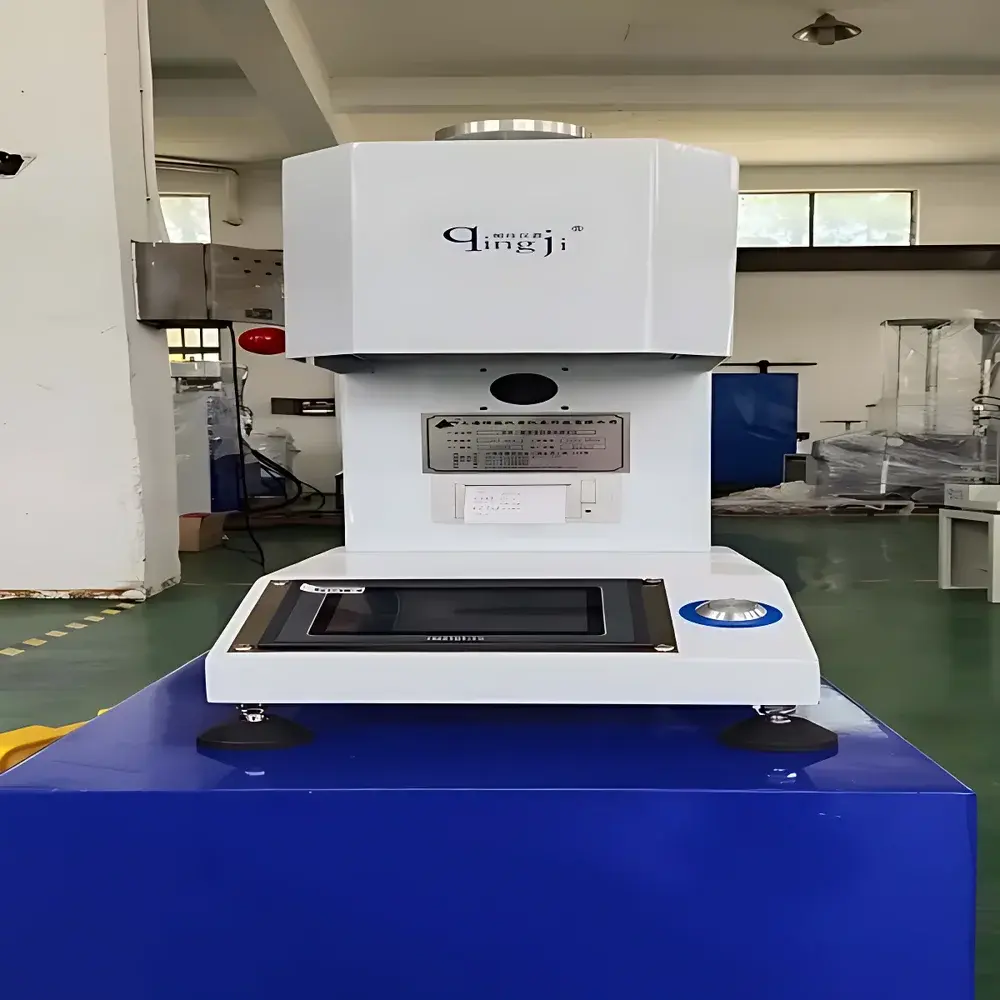
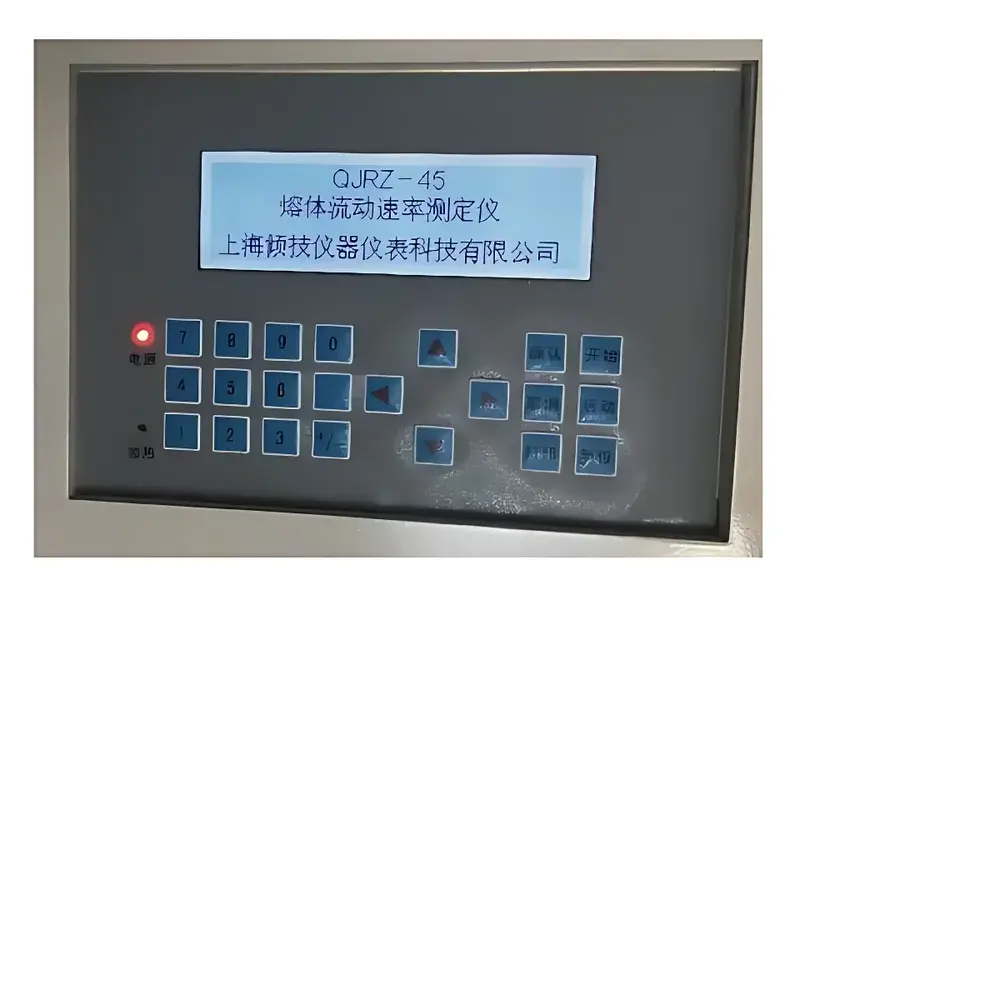
Qinji QJRZ45 Melt Flow Indexer
| Brand | Qinji |
|---|---|
| Origin | Shanghai, China |
| Manufacturer Type | Authorized Distributor |
| Region of Manufacture | Domestic (China) |
| Model | QJRZ45 |
| Price Range | USD 1,050 – 2,100 |
| Test Method | Gravimetric (Mass Flow Rate) |
| Type | Standard-Configuration Melt Flow Indexer |
| Temperature Range | 100–450 °C |
| Temperature Accuracy | ±0.1 °C |
| Temperature Stability | ±0.5 °C |
| Temperature Resolution | 0.1 °C |
| Barrel Diameter | Φ9.55 mm ±0.025 mm |
| Die Orifice Diameters | Φ2.095 mm ±0.005 mm and Φ1.180 mm ±0.010 mm |
| Power Supply | AC 220 V, 50 Hz |
| Dimensions (W×D×H) | 250 mm × 400 mm × 500 mm |
| Net Weight | 35 kg |
| Compliance | GB/T 3682–2000 & ISO 1133:2005 |
Overview
The Qinji QJRZ45 Melt Flow Indexer is a gravimetric melt flow rate (MFR) testing instrument engineered for precision and repeatability in thermoplastic polymer characterization. It operates on the principle of extrusion rheometry under controlled thermal and mechanical conditions: a pre-dried polymer sample is loaded into a heated barrel, melted at a specified temperature (100–450 °C), and extruded through a standardized capillary die under a defined piston load. The mass of extrudate collected over a fixed time interval (typically 10 minutes) is measured to calculate MFR (g/10 min), in strict accordance with ISO 1133:2005 and GB/T 3682–2000. This method provides a fundamental rheological proxy for molecular weight distribution, processability, and batch-to-batch consistency—critical parameters for quality control in compounding, extrusion, injection molding, and raw material certification.
Key Features
- High-stability temperature control system with ±0.1 °C accuracy and ±0.5 °C long-term stability across the full 100–450 °C operating range
- Dual-standard capillary dies included: Φ2.095 mm ±0.005 mm (ISO/GB default) and Φ1.180 mm ±0.010 mm (for high-viscosity or low-MFR materials)
- Precision-machined barrel with nominal inner diameter Φ9.55 mm ±0.025 mm, conforming to dimensional tolerances specified in ISO 1133 Annex A
- Automated timed cutting mechanism with programmable cut intervals (e.g., 10 s, 30 s, 60 s) to support both standard MFR and multi-cut MVR derivations
- Integrated flash memory storage for secure local retention of test metadata—including temperature setpoint, load, die ID, operator ID, timestamp, and raw mass readings
- Real-time digital temperature display with 0.1 °C resolution and auto-calibration traceability via built-in reference sensor diagnostics
- Robust cast-aluminum frame and insulated heating chamber ensure thermal uniformity and mechanical stability during extended testing cycles
Sample Compatibility & Compliance
The QJRZ45 supports a broad spectrum of thermoplastic resins, including but not limited to polyethylene (PE), polypropylene (PP), polystyrene (PS), ABS, polyoxymethylene (POM), polycarbonate (PC), polyarylsulfone (PAS), polyetherimide (PEI), and fluoropolymers (e.g., PTFE, PVDF). Its extended upper temperature limit (450 °C) enables reliable MFR determination for high-performance engineering plastics requiring elevated processing temperatures. All hardware dimensions, thermal profiles, and procedural logic comply with ISO 1133:2005 Parts 1 (MFR) and 2 (MVR), as well as GB/T 3682–2000. While not inherently 21 CFR Part 11 compliant, the device supports GLP-aligned documentation practices when paired with external LIMS or validated lab notebooks; audit trails may be generated manually from stored flash data logs.
Software & Data Management
The QJRZ45 operates as a standalone benchtop instrument with embedded firmware—no PC dependency required for basic operation. All test parameters are configured via front-panel keypad and LCD interface. Flash memory retains up to 500 complete test records with timestamped entries. Data export is supported via USB port (optional adapter) for CSV-formatted transfer to Excel or laboratory information management systems (LIMS). For regulated environments, users may implement supplementary SOPs covering calibration frequency (recommended daily pre-test verification using certified reference materials), environmental monitoring (ambient temperature/humidity logging), and manual record reconciliation per ISO/IEC 17025 Clause 7.7.
Applications
- Raw material acceptance testing in polymer manufacturing and distribution
- In-process QC for extrusion lines, blow molding, and injection molding facilities
- Batch release verification against technical data sheets (TDS) and contractual MFR specifications
- Stability assessment of recycled or regrind fractions prior to reprocessing
- R&D screening of polymer blends, filler-loaded composites, and thermally degraded samples
- Supporting ASTM D1238 (equivalent to ISO 1133) compliance in North American regulatory submissions
FAQ
What standards does the QJRZ45 fully comply with?
It meets the dimensional, thermal, and procedural requirements of ISO 1133:2005 and GB/T 3682–2000 for gravimetric MFR determination.
Can it measure melt volume flow rate (MVR)?
Yes—MVR (cm³/10 min) can be derived mathematically from MFR and material density, or estimated via multi-cut timing if volumetric collection accessories are added externally.
Is calibration traceable to national standards?
The unit includes internal temperature sensor diagnostics; external calibration using NIST-traceable PT100 probes and certified weights is recommended annually or per internal QA schedule.
What maintenance is required to sustain accuracy?
Routine cleaning of the barrel and die with brass brushes and solvent (e.g., xylene), periodic verification of piston alignment, and annual recalibration of temperature and load sensors.
Does it support automated reporting or network connectivity?
No native Ethernet/Wi-Fi or reporting software is integrated; however, exported CSV files are compatible with common statistical process control (SPC) platforms and custom Python/R scripts for trend analysis.






