
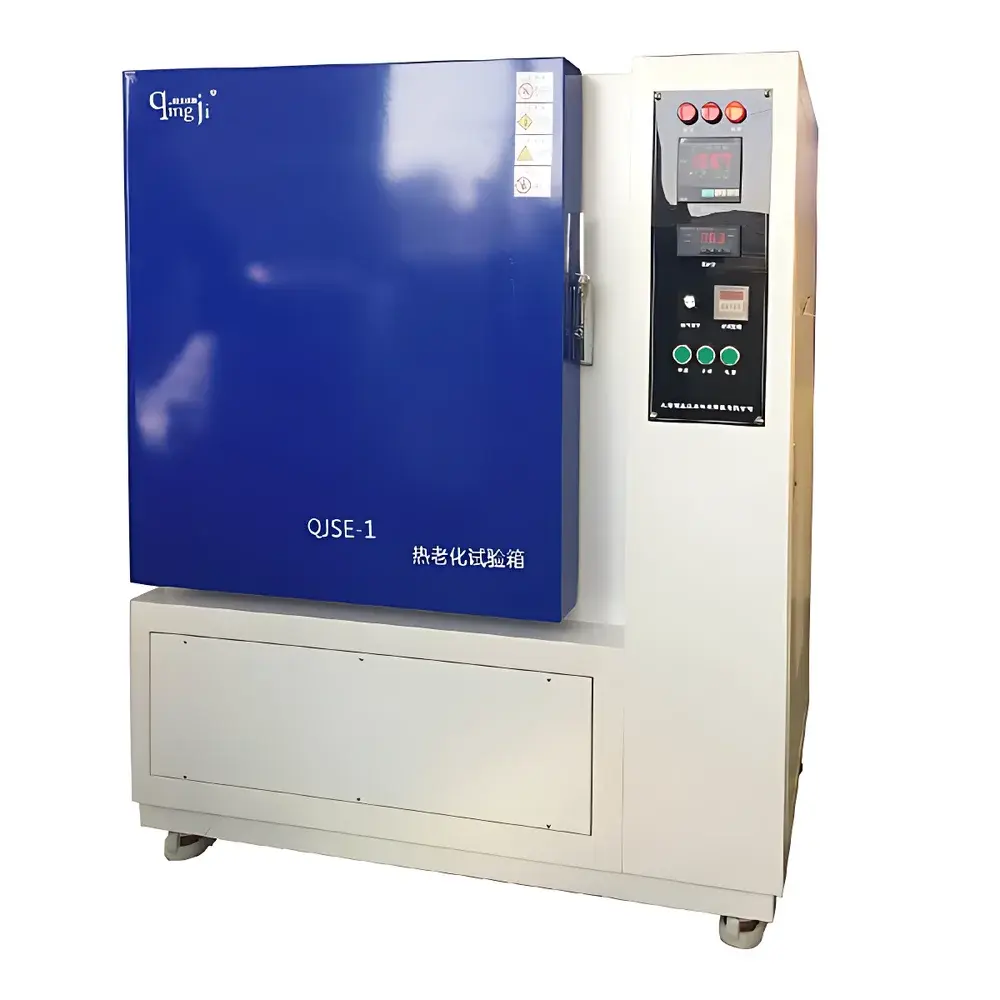
Qinji QJSE-1 Rubber Thermal Aging Test Chamber
| Brand | Qinji |
|---|---|
| Origin | Shanghai, China |
| Model | QJSE-1 |
| Temperature Range | RT+20 °C to 300 °C |
| Temperature Uniformity | ≤±2 °C (at steady state) |
| Temperature Fluctuation | ≤±0.5 °C |
| Heating Rate | RT+20 °C to 200 °C in ≤60 min |
| Air Exchange Rate | Adjustable, compliant with IEC 60540 requirements |
| Chamber Dimensions | Customizable (W×H×D) |
| Total Power Consumption | ~6.7 kW (Heating: 6 kW |
| Auxiliary Systems | 0.7 kW) |
| Noise Level | ≤65 dB(A) |
| Compliance | IEC 60540, ASTM D573, ISO 188, GB/T 3512 |
Overview
The Qinji QJSE-1 Rubber Thermal Aging Test Chamber is an engineered environmental test system designed specifically for accelerated thermal aging evaluation of elastomeric materials, polymer-insulated cables, and thermoplastic compounds under controlled, reproducible high-temperature conditions. Based on the principle of oxidative degradation kinetics, the chamber subjects specimens to elevated temperatures—up to 300 °C—to simulate long-term service life effects in a compressed timeframe. Its dual-airflow circulation architecture ensures uniform thermal distribution across the working space, minimizing radial and axial temperature gradients that could otherwise compromise test validity. The chamber operates in accordance with internationally recognized standards governing rubber and cable material aging, including IEC 60540 (Methods of test for insulating and sheathing materials of electric cables), ASTM D573 (Rubber—Deterioration by Heat Aging), ISO 188 (Rubber, vulcanized or thermoplastic—Accelerated ageing and heat resistance tests), and GB/T 3512 (Chinese national standard equivalent to ISO 188). This enables laboratories to generate data suitable for regulatory submissions, quality control release testing, and comparative material qualification.
Key Features
- High-precision digital temperature controller with imported PID algorithm, enabling stable setpoint maintenance and minimal overshoot during ramping phases
- Dual independent air circulation channels with adjustable baffle design to enhance thermal homogeneity across custom-sized workspaces
- Redundant safety architecture: dual-limit mechanical overtemperature cut-off, audible/visual alarm, and automatic power disconnection upon sensor failure or exceedance of preset thresholds
- Stainless steel inner chamber construction (SUS304) with seamless welding and electrostatically applied insulation layer for thermal efficiency and corrosion resistance
- Programmable heating profile capability supporting multi-step temperature ramps and dwell periods per test protocol requirements
- Low-noise operation (<65 dB[A]) achieved via optimized fan motor selection and acoustic damping within the enclosure housing
Sample Compatibility & Compliance
The QJSE-1 accommodates standardized test specimens—including dumbbell-shaped tensile strips (per ISO 37), insulated wire segments (IEC 60540), and molded compression sets—as well as user-defined geometries within its customizable chamber dimensions. All internal surfaces are inert to common elastomer formulations and do not catalyze unintended oxidation pathways. Calibration traceability follows ISO/IEC 17025 guidelines, with optional NIST-traceable temperature mapping reports available upon request. The system supports GLP-compliant documentation workflows when integrated with external data acquisition systems. It meets essential requirements for compliance with FDA 21 CFR Part 11 when paired with validated electronic record software (not included), and its thermal performance aligns with audit expectations for ISO 9001-certified QC laboratories.
Software & Data Management
While the QJSE-1 operates via a standalone microprocessor-based controller with local display and keypad interface, it features RS485 communication ports compatible with Modbus RTU protocol for integration into centralized laboratory information management systems (LIMS) or SCADA platforms. Real-time temperature logging at user-configurable intervals (1–60 sec) can be exported via USB storage or serial transfer. Optional PC-based software packages provide trend visualization, deviation alerts, and automated report generation—including pass/fail status against tolerance bands defined per ASTM D573 Annex A or ISO 188 Clause 7. Audit trails for parameter changes, operator logins, and calibration events are retained for ≥12 months in non-volatile memory, supporting GMP-aligned review processes.
Applications
- Accelerated aging studies of natural rubber (NR), styrene-butadiene rubber (SBR), ethylene propylene diene monomer (EPDM), and silicone elastomers
- Evaluation of thermal stability and service life prediction for low- and medium-voltage power cable insulation systems
- Comparative assessment of antioxidant package efficacy in compounded rubber formulations
- Pre-qualification screening of thermoplastic elastomers (TPEs) and halogen-free flame-retardant (HFFR) compounds
- Supporting R&D activities related to automotive sealing systems, aerospace gaskets, and medical-grade tubing materials
- Conformance testing for OEM specifications requiring adherence to SAE J2045, UL 1581, or EN 50306-2
FAQ
What standards does the QJSE-1 explicitly support for rubber aging validation?
The chamber satisfies thermal control and exposure requirements outlined in ISO 188, ASTM D573, IEC 60540, and GB/T 3512, with documented temperature uniformity and stability performance verified per Clause 6 of ISO 188.
Can the chamber be configured for continuous monitoring and remote access?
Yes—via optional RS485-to-Ethernet gateway and third-party SCADA integration, enabling real-time telemetry, email/SMS alerts, and historical data retrieval from offsite locations.
Is temperature mapping required prior to routine use?
Per ISO 188 and GLP best practices, initial qualification (IQ/OQ) including 9-point temperature mapping across the usable volume is recommended before first use and repeated annually or after major maintenance.
Does the system include provisions for exhaust gas handling during extended high-temperature operation?
A dedicated exhaust port (DN50) is provided on the rear panel; connection to facility fume hoods or activated carbon scrubbers is advised when testing volatile-compound-rich formulations above 200 °C.
What maintenance intervals are recommended for sustained accuracy?
Annual recalibration of the primary PT100 sensor and verification of airflow balance are advised; door gasket integrity and heater element resistance should be inspected quarterly.



