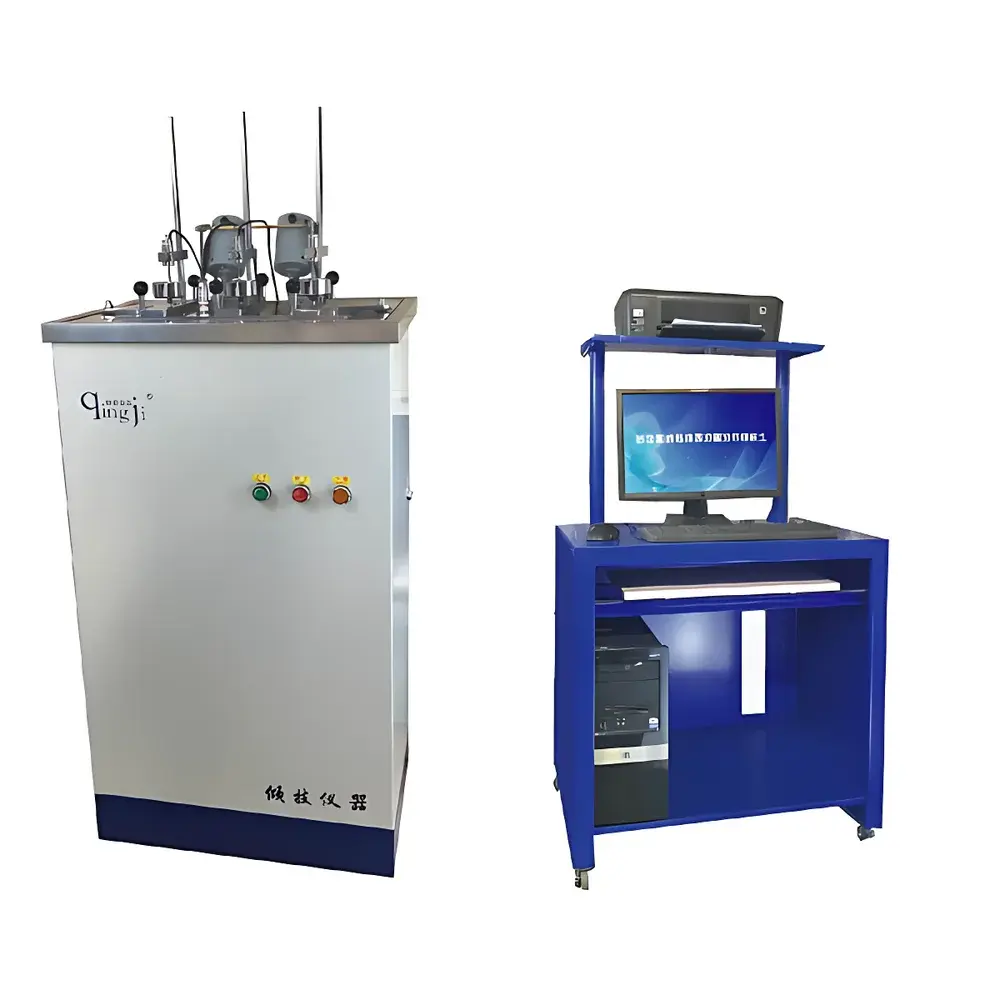
Qinji QJWK-507 Heat Deflection Temperature (HDT) and Vicat Softening Temperature (VST) Tester
| [Brand | Qinji |
|---|---|
| Model | QJWK-507 |
| Temperature Range | Ambient to 300 °C |
| Heating Rate Options | (12 ±1) °C/6 min or (5 ±0.5) °C/6 min |
| Temperature Accuracy | ±1 °C |
| Deformation Measurement Range | 0–1 mm |
| Deformation Resolution | 0.01 mm |
| Heating Medium | Methyl Silicone Oil |
| Heating Power | 4 kW |
| Cooling Method | Natural cooling above 150 °C |
| Power Supply | AC 220 V, 20 A, 50 Hz |
| Dimensions (L×W×H) | 540 × 520 × 1360 mm |
| Compliance | GB/T 1633, GB/T 1634, GB 8802, ISO 75, ISO 306, ISO 2507] |
Overview
The Qinji QJWK-507 Heat Deflection Temperature (HDT) and Vicat Softening Temperature (VST) Tester is a precision-controlled thermal analysis instrument engineered for standardized determination of two critical thermomechanical properties of rigid polymeric materials: the heat deflection temperature under load (HDT) and the Vicat softening temperature (VST). HDT is measured per ASTM D648 / ISO 75 by applying a specified bending stress (0.45 MPa or 1.80 MPa) while uniformly heating a rectangular test specimen until a defined deflection (0.25 mm) is reached. VST, governed by ASTM D1525 / ISO 306, determines the temperature at which a flat-ended needle (1 mm² cross-section) penetrates 1 mm into a conditioned specimen under a fixed load (10 N or 50 N) during linear heating. Both tests provide essential data for material selection, quality control, comparative benchmarking, and regulatory documentation in polymer development, cable manufacturing, and electrical insulation applications.
Key Features
- Programmable dual heating rate profiles: (12 ± 1) °C/6 min (120 ± 10) °C/h for VST and (5 ± 0.5) °C/6 min (50 ± 5) °C/h for HDT — compliant with ISO 75-2 and ISO 306 requirements.
- High-stability temperature control via PID phase-angle regulated output, with adjustable upper temperature limit to prevent overshoot and ensure test repeatability.
- Dual-mode deformation sensing: supports analog LED displacement indicators or digital computer-based acquisition with 0.01 mm resolution over a 0–1 mm range.
- Robust thermal bath design using methyl silicone oil (flash point >300 °C) as the uniform heating medium, enabling stable operation up to 300 °C.
- Intelligent cooling management: automatic transition between natural convection cooling above 150 °C and optional water-assisted cooling below 150 °C to accelerate cycle time without compromising thermal gradient integrity.
- Modular mechanical frame with precise alignment fixtures for specimen support, loading rods, and penetration needles — minimizing parasitic bending and ensuring consistent load application per ISO 2507-2.
Sample Compatibility & Compliance
The QJWK-507 accommodates standard test specimens per ISO 75-2 (80 × 10 × 4 mm for HDT), ISO 306 (10 × 10 × ∼3–5 mm for VST), and GB/T 1634/1633. It is validated for use with thermoplastics (e.g., PP, ABS, PC), thermosets (e.g., phenolics, epoxies), fiber-reinforced composites, rigid PVC pipe materials (per GB 8802), and electrically insulating polymers. The system fully satisfies the metrological and procedural requirements of GB/T 1633, GB/T 1634, GB 8802, ISO 75-1/2/3, ISO 306, ISO 2507-1/2, and ASTM D648/D1525. Its mechanical stability, temperature uniformity, and deformation measurement traceability support GLP-compliant testing environments and are suitable for inclusion in FDA 21 CFR Part 11–aligned quality systems when paired with validated software.
Software & Data Management
When integrated with optional PC-based acquisition software, the QJWK-507 enables real-time temperature–deformation curve logging, automatic endpoint detection (VST penetration depth or HDT deflection threshold), and export of ASCII/CSV datasets for post-processing. Software features include user-defined test templates, multi-sample batch sequencing, audit-trail-enabled operator login, and timestamped result reports with embedded calibration status. All data files retain full metadata (specimen ID, load condition, heating rate, ambient conditions) to support ISO/IEC 17025 technical record requirements and internal quality audits.
Applications
- Quality assurance of thermoplastic compounds used in automotive interior trim, where HDT correlates with dimensional stability under under-hood thermal exposure.
- Verification of PVC-U pipe material compliance with GB 8802 for cold-water pressure applications.
- Comparative thermal performance screening during R&D of high-heat nylon variants for electrical connectors.
- Regulatory submission support for medical device housing materials requiring documented VST values per ISO 10993-1 biocompatibility assessments.
- Teaching laboratories in polymer science curricula, providing hands-on instruction on thermomechanical transitions and standardized test methodology.
FAQ
What standards does the QJWK-507 explicitly support?
It meets all mechanical, thermal, and procedural requirements of GB/T 1633, GB/T 1634, GB 8802, ISO 75-1/2/3, ISO 306, ISO 2507-1/2, and ASTM D648/D1525.
Can the instrument perform both HDT and VST tests without hardware reconfiguration?
Yes — interchangeable test fixtures (bending supports vs. flat-base VST platens), calibrated load weights (10 N / 50 N / 4.905 N / 19.62 N), and programmable heating profiles enable seamless switching between test modes.
Is third-party calibration certification available?
Yes — optional NIST-traceable calibration services for temperature sensors and displacement transducers are provided, including uncertainty budgets per ISO/IEC 17025 Annex A.
What maintenance is required for long-term accuracy?
Routine verification includes annual recalibration of PT100 sensors, periodic replacement of methyl silicone oil (every 12–18 months depending on usage), and mechanical inspection of loading rods and specimen supports for wear or misalignment.
Does the system support automated reporting for ISO 17025 compliance?
When used with validated software, it generates PDF/CSV reports containing operator ID, equipment ID, calibration due dates, raw curves, pass/fail flags against specification limits, and electronic signatures — fulfilling documentation requirements for accredited testing labs.
Related Products