
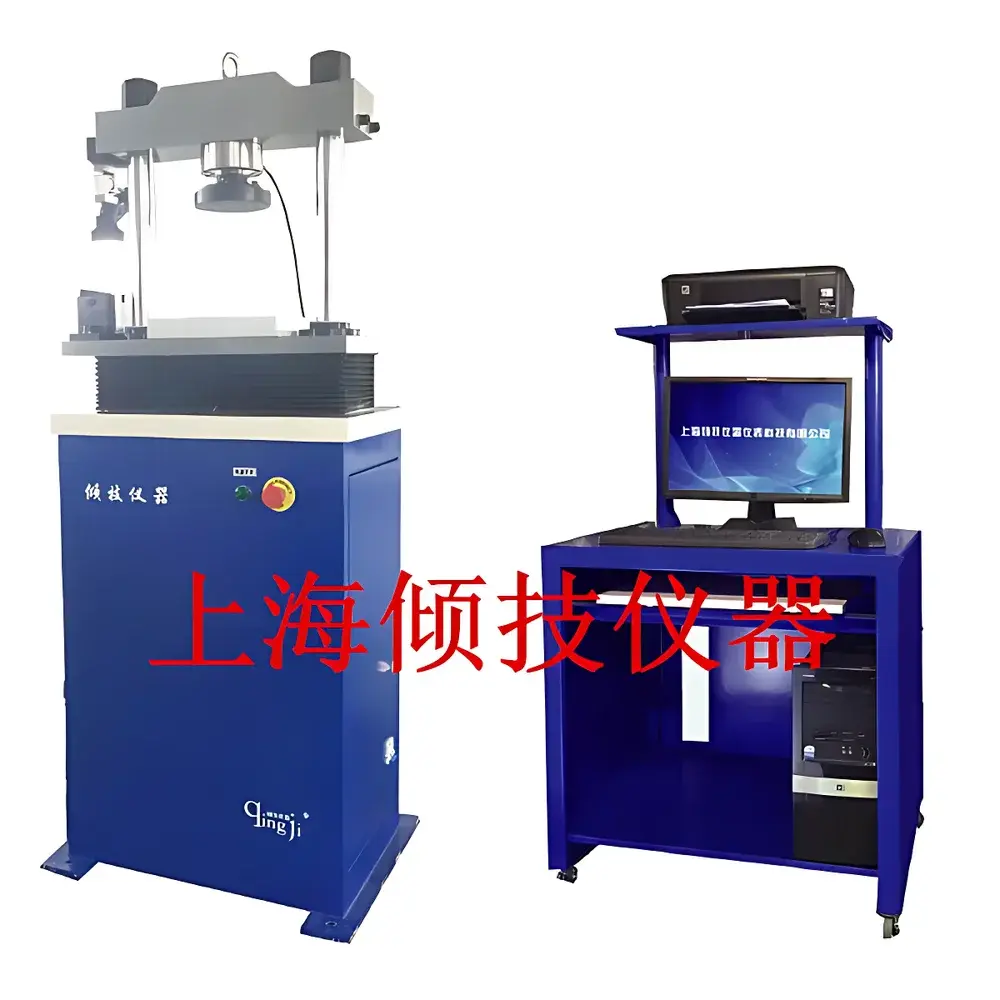
Qinji QJYL Series Concrete and Brick Compression-Flexural Testing Machine
| Brand | Qinji |
|---|---|
| Origin | Shanghai, China |
| Manufacturer Type | Authorized Distributor |
| Country of Origin | China |
| Model | QJYL-2000 / QJYL-3000 |
| Max Test Load | 2000 kN / 3000 kN |
| Load Accuracy Class | Class I (ISO 7500-1) |
| Force Measurement Range | 20–2000 kN / 10–3000 kN |
| Loading Speed | 1–15 mm/s (adjustable) |
| Internal Clearance | 320 mm |
| Platen Dimensions | 320 × 260 mm or 350 × 300 mm |
| Motor Power | 0.75 / 1.1 / 1.5–2.2 kW |
| Net Weight | ~800 kg |
| Overall Dimensions | ~850 × 500 × 1480 mm |
| Relative Indicated Error | ±0.5% FS |
Overview
The Qinji QJYL Series Concrete and Brick Compression-Flexural Testing Machine is a dual-function universal testing system engineered for standardized mechanical characterization of construction materials under compressive and flexural loading conditions. Based on the principles of controlled displacement-driven hydraulic actuation and high-stiffness load frame architecture, it complies with core international test standards including ASTM C109/C348/C349, ISO 679, EN 12390-3, and GB/T 17671. Designed specifically for quality control laboratories in cement production, precast concrete manufacturing, civil engineering R&D, and national building materials inspection institutes, the machine delivers repeatable, traceable force application across its full rated capacity—enabling precise determination of compressive strength (MPa), flexural modulus, and load-deflection behavior of standard mortar cubes (40 × 40 × 160 mm), concrete cylinders (Ø150 × 300 mm), fired clay bricks (240 × 115 × 53 mm), and natural stone specimens. Its rigid C-frame construction minimizes deflection-induced measurement error, while integrated digital load cell feedback ensures real-time compliance with ISO 7500-1 Class I accuracy requirements.
Key Features
- Hydraulically actuated dual-mode operation supporting both compression and three-point bending tests without mechanical reconfiguration
- Automated platen height adjustment via programmable motorized crosshead, enabling rapid specimen alignment and consistent contact geometry
- Digital load display with real-time graphical output, resolution ≤0.1 kN, and automatic peak-hold functionality
- Adjustable loading rate (1–15 mm/min) maintained within ±5% deviation per ISO 178 and ASTM D790 specifications
- Interchangeable platens: standard 320 × 260 mm steel compression plates and optional 350 × 300 mm reinforced platens for large-format masonry units
- Integrated thermal management system to stabilize hydraulic oil temperature during extended test sequences
- RS232 and USB interfaces for direct data export to external PCs; optional Ethernet module supports networked lab integration
Sample Compatibility & Compliance
The QJYL series accommodates standard and non-standard specimens defined in major regional codes: ASTM C67 (brick), ASTM C140 (concrete masonry units), EN 772-1 (clay and calcium silicate bricks), and GB/T 2542 (fired common bricks). Specimen height tolerance is maintained within ±0.5 mm using precision-ground platens with parallelism ≤0.02 mm/m. All force measurements are traceably calibrated against NIST-traceable deadweight standards at accredited third-party laboratories prior to shipment. The system meets ISO/IEC 17025 requirements for calibration validity and supports audit-ready documentation—including calibration certificates, uncertainty budgets, and verification reports—for GLP-compliant environments.
Software & Data Management
A Windows-based control and analysis suite (Qinji TestSuite v4.2) provides full test sequencing, real-time curve plotting (load vs. displacement), and automated report generation in PDF/Excel formats. Software features include multi-user access control, electronic signature support, and configurable audit trails compliant with FDA 21 CFR Part 11 Annex 11 requirements. Raw data files are stored in encrypted binary format with timestamped metadata (operator ID, environmental conditions, calibration status), and all modifications are logged with user attribution and reason codes. Export modules support CSV, XML, and LIMS-compatible HL7 messaging protocols for seamless integration into enterprise laboratory information systems.
Applications
- Compressive strength evaluation of cement mortar cubes per ISO 679 and GB/T 17671
- Flexural strength testing of concrete beams (EN 12390-5) and ceramic tiles (ISO 10545-4)
- Quality assurance of fired clay bricks, autoclaved aerated concrete (AAC) blocks, and refractory ceramics
- R&D validation of novel binders, geopolymer formulations, and recycled aggregate concretes
- Third-party certification testing for CE marking (EN 772 series) and CCC certification (China Compulsory Certification)
- Periodic verification of in-house calibration standards in metrology labs
FAQ
What standards does this machine fully support for brick compressive testing?
ASTM C67, EN 772-1, GB/T 2542, and ISO 3070 — including specimen preparation, loading geometry, and pass/fail criteria.
Is remote calibration verification possible without on-site technician intervention?
Yes — the system supports remote diagnostic mode via secure VPN; certified calibration engineers can validate sensor linearity and zero drift using internal reference checks and digital log review.
Can the machine be integrated into an existing LIMS infrastructure?
Fully supported via HL7, ASTM E1384, and custom API endpoints — validated with Thermo Fisher SampleManager, LabVantage, and Siemens STARLIMS deployments.
What maintenance intervals are recommended for hydraulic system longevity?
Oil filtration every 500 operational hours; full hydraulic fluid replacement every 2,000 hours or biannually — documented in the included maintenance logbook and accessible via embedded service portal.
Does the software meet regulatory requirements for electronic records in GMP environments?
Yes — TestSuite v4.2 includes role-based permissions, immutable audit trails, electronic signatures, and 21 CFR Part 11-compliant configuration management.



