
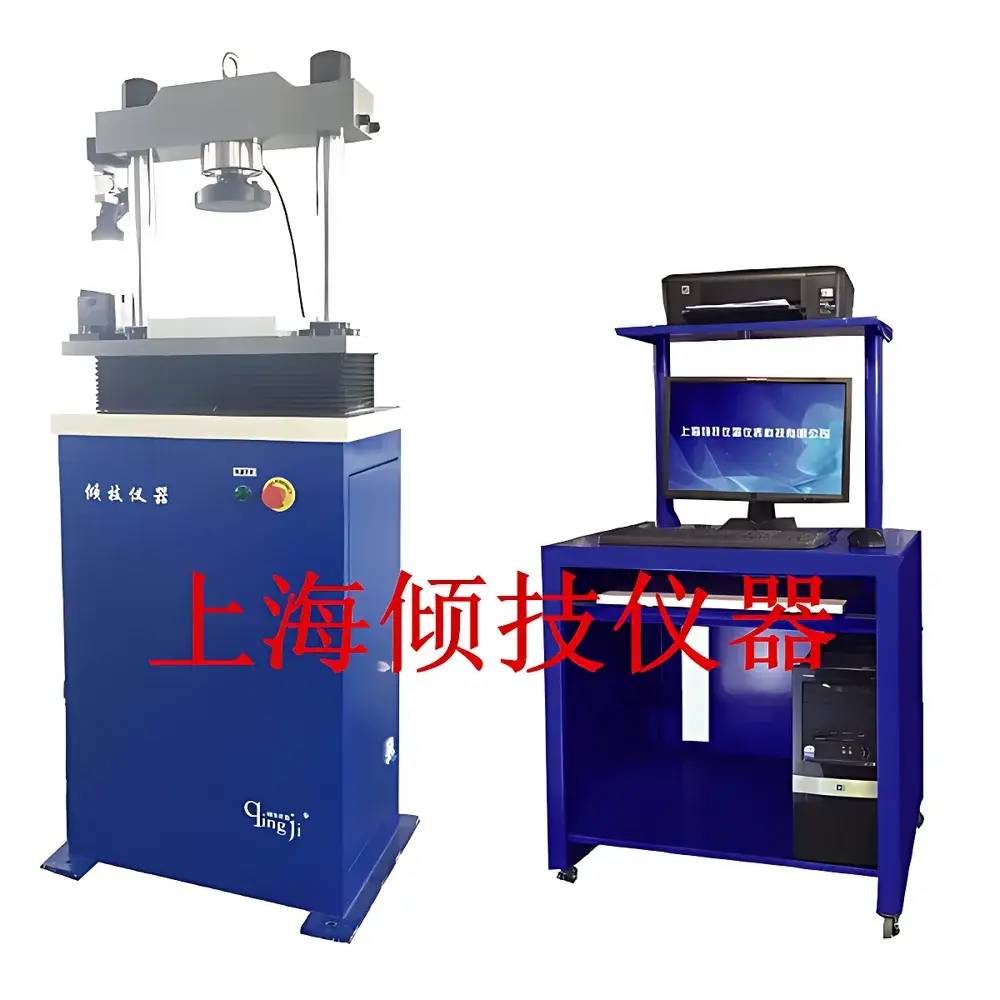
Qinji QJYL872 Advanced Compression Testing Machine
| Brand | Qinji |
|---|---|
| Origin | Shanghai, China |
| Model | QJYL872 |
| Maximum Test Force | 200 kN |
| Compressive Force Range | 0–200 kN |
| Flexural (3-Point Bending) Force Capacity | 10 kN |
| Load Rate Control Range (Compression) | 0–10 kN/s |
| Load Rate Control Range (Flexure) | 0–0.075 kN/s |
| Indicated Relative Error | ±1% |
| Compliance Standards | GB/T 17671–1999, GB 13544–2000, GB/T 50081–2002 |
| Application Scope | Cement mortar, concrete cubes, fired bricks, autoclaved aerated concrete blocks, structural ceramics, and metallic components |
Overview
The Qinji QJYL872 Advanced Compression Testing Machine is a dual-mode electromechanical testing system engineered for precision compressive and flexural strength evaluation of construction materials under controlled loading conditions. Based on the principle of servo-controlled hydraulic or electromechanical force application—depending on configuration—the instrument applies axial compressive loads to standardized specimens (e.g., 40 mm × 40 mm × 160 mm cement mortar prisms, 150 mm concrete cubes, or 240 mm × 115 mm × 53 mm clay bricks) while continuously measuring load-displacement response in accordance with quasi-static ASTM E9 and ISO 3310-1 methodologies. Its rigid C-frame architecture ensures minimal frame deflection (< 0.02 mm/kN), enabling high reproducibility in modulus-of-rupture (MOR) determination during three-point bending tests and accurate peak-load capture during uniaxial compression failure analysis. Designed explicitly for routine quality control in cement production facilities, precast concrete plants, third-party inspection laboratories, and academic civil engineering departments, the QJYL872 delivers traceable, standards-compliant mechanical property data without requiring operator calibration intervention between test cycles.
Key Features
- Electromechanical actuation system with closed-loop PID load control, ensuring stable force ramping across full 0–200 kN range
- Dual-test capability: integrated compression platens (150 mm diameter) and adjustable three-point bending fixture with roller spacing up to 100 mm
- Real-time digital load cell with ±1% indicated relative error (per GB/T 7722–2008) and 1/10000 resolution
- Programmable load rate profiles: compression mode (0–10 kN/s), flexural mode (0–0.075 kN/s), supporting both constant-rate-of-loading (CRL) and constant-rate-of-crosshead-motion (CRCM) protocols
- Stainless-steel load train components and hardened steel platens (HRC ≥ 58) for long-term dimensional stability and wear resistance
- Integrated safety interlocks including emergency stop, overload cutoff (>105% F.S.), and automatic crosshead return after test completion
Sample Compatibility & Compliance
The QJYL872 accommodates standard and non-standard specimens per national and international material testing conventions. It supports compression testing of cement mortar (GB/T 17671–1999), sintered bricks (GB 13544–2000), autoclaved aerated concrete (GB 11968–2020), and normal-strength concrete (GB/T 50081–2002). For flexural assessment, it complies with GB/T 17671 Annex A for cement mortar beams and ISO 10190 for ceramic tile MOR. All test procedures are fully documented and support audit-ready reporting aligned with GLP requirements. While not certified to ISO/IEC 17025 by default, the system is compatible with laboratory accreditation workflows when paired with validated calibration certificates from CNAS-accredited providers.
Software & Data Management
The embedded controller features a 7-inch capacitive touchscreen HMI with intuitive test setup wizard, real-time curve visualization (load vs. displacement), and automatic pass/fail flagging based on user-defined acceptance criteria (e.g., minimum compressive strength ≥ 42.5 MPa for P.O 42.5 cement). Test records—including timestamp, operator ID, specimen ID, environmental temperature/humidity inputs, raw load-displacement arrays, and calculated parameters (compressive strength in MPa, flexural strength in MPa)—are stored locally in CSV and PDF formats. Optional USB export enables integration into LIMS environments. The firmware supports optional 21 CFR Part 11-compliant audit trail modules (user login, electronic signature, change history) upon request—subject to site-specific validation protocol execution.
Applications
- Routine compressive strength verification of cementitious binders and hardened concrete in QC labs
- Batch conformity assessment of fired clay bricks, concrete masonry units (CMUs), and lightweight aggregate blocks
- Research-grade flexural behavior characterization of thin-section ceramic tiles and fiber-reinforced mortars
- Educational demonstration of stress–strain relationships, elastic modulus estimation, and fracture energy quantification
- Pre-qualification testing of novel construction composites (e.g., geopolymer pastes, recycled aggregate concretes) prior to field deployment
FAQ
Does the QJYL872 comply with ASTM C109/C39 equivalents?
Yes—the machine’s force accuracy, platen parallelism, and loading rate control meet the metrological requirements specified in ASTM C109 (for mortar) and C39 (for concrete), though formal ASTM certification requires independent verification by an accredited body.
Can I perform tensile tests with this system?
No—the QJYL872 is configured exclusively for compression and three-point bending; tensile testing requires a universal testing machine with appropriate grips and extensometry.
Is software upgrade support available beyond the warranty period?
Yes—Qinji provides firmware updates and HMI interface enhancements for registered users via secure download portal, subject to compatibility review and optional annual technical support subscription.
What calibration documentation is supplied at delivery?
A factory calibration certificate traceable to NIM (National Institute of Metrology, China) is included, covering load cell linearity, zero drift, and repeatability across five points within the 10–200 kN range.
How often should periodic verification be performed?
Per GB/T 50081–2002 and ISO 7500-1:2018, verification using certified reference load cells is recommended every six months—or before each new project phase—when used in accredited testing environments.



