
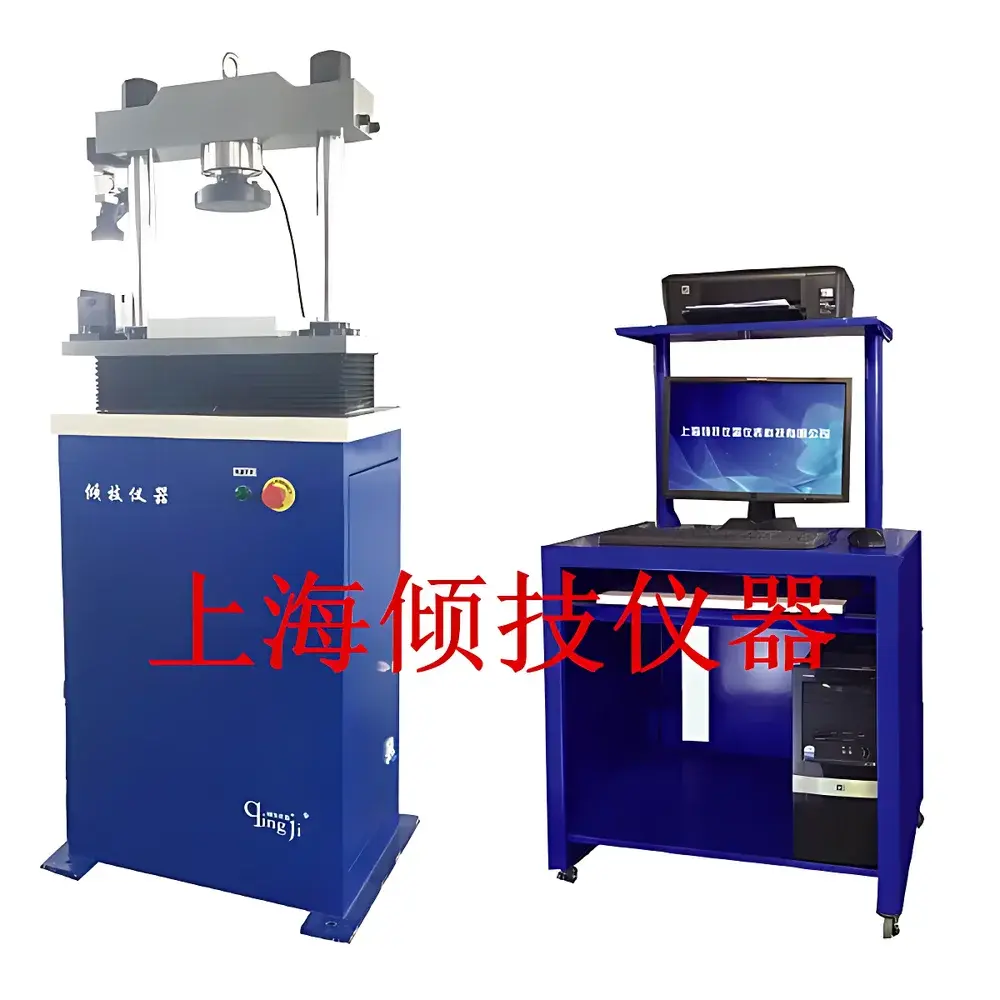
Qinji QJYL872 Dual-Function Flexural & Compressive Strength Testing Machine
| Brand | Qinji |
|---|---|
| Origin | Shanghai, China |
| Model | QJYL872 |
| Max. Compressive Load | 300 kN |
| Max. Flexural Load | 10 kN |
| Load Indication Relative Error | ±1% |
| Compressive Loading Rate Range | 0–10 kN/s |
| Flexural Loading Rate Range | 0–0.075 kN/s |
Overview
The Qinji QJYL872 Dual-Function Flexural & Compressive Strength Testing Machine is a statically loaded, servo-controlled universal testing system engineered for standardized mechanical evaluation of construction materials under bending (three-point flexure) and axial compression. It operates on the principle of force-controlled displacement actuation, where hydraulic or electromechanical loading is precisely regulated via closed-loop feedback to maintain programmed load-rate profiles per ASTM C78, ASTM C39, ISO 679, and GB/T 17671–1999 (Cement Mortar), GB/T 50081–2002 (Concrete), and GB 13544–2000 (Burnt Clay Bricks). The machine integrates a rigid C-frame architecture with high-stiffness load train components, ensuring minimal deflection during high-force compression tests up to 300 kN and accurate low-force flexural measurements down to 0.075 kN/s — critical for brittle material characterization where fracture initiation must be captured without inertial overshoot.
Key Features
- Integrated dual-mode operation: seamless switching between compressive strength testing (up to 300 kN) and three-point flexural strength testing (up to 10 kN) using interchangeable fixtures and calibrated load cells.
- High-precision load measurement system with ±1% relative error across full scale, traceable to national metrological standards and validated per ISO 7500-1 Class 1 requirements.
- Programmable loading rate control: independent digital regulation of compression rate (0–10 kN/s) and flexural rate (0–0.075 kN/s), enabling compliance with ramp-rate-sensitive standards such as GB/T 50081 and ASTM C78.
- Robust C-frame construction with reinforced steel crosshead and guided platen alignment, minimizing eccentric loading and ensuring repeatability in multi-cycle testing protocols.
- Human-centered interface: tactile push-button console with real-time load/displacement display, emergency stop circuitry, and overload protection thresholds pre-configured per ISO 14122-3 safety guidelines.
Sample Compatibility & Compliance
The QJYL872 accommodates standard prismatic cement mortar beams (40 mm × 40 mm × 160 mm), cylindrical concrete specimens (Φ150 mm × 300 mm), solid clay bricks (240 mm × 115 mm × 53 mm), and metallic coupons per ASTM E8/E8M. Fixture sets include adjustable roller supports for three-point bending, spherical seating platens for uniform compressive stress distribution, and centering guides compliant with GB/T 2611–2007 mechanical testing equipment specifications. All test procedures align with mandatory regulatory frameworks for construction material certification in China (CNCA-C13-01:2023), and support documentation generation required for CNAS-accredited laboratory audits (ISO/IEC 17025:2017).
Software & Data Management
While the base configuration includes standalone hardware control, optional PC-based software enables automated test sequencing, real-time curve plotting (load vs. displacement), peak load capture, modulus calculation (flexural modulus per ISO 178), and export to CSV/PDF formats. Audit-trail functionality logs operator ID, timestamp, calibration status, and environmental conditions — supporting GLP-compliant recordkeeping. Data files are structured for interoperability with LIMS platforms and satisfy traceability requirements under GB/T 19022–2003 (Measurement Control Systems).
Applications
- Quality assurance testing of Portland cement mortars and blended cements per GB/T 17671–1999 and ISO 679.
- Mechanical validation of autoclaved aerated concrete (AAC) blocks, fired clay bricks, and concrete masonry units (CMUs) per GB 13544–2000 and EN 772-1.
- R&D-level flexural performance assessment of fiber-reinforced cementitious composites and ultra-high-performance concrete (UHPC).
- Educational use in civil engineering laboratories for teaching fundamental concepts of bending moment diagrams, section modulus, and failure mode analysis.
- Third-party inspection agencies conducting statutory conformity testing for building material certification under China Compulsory Certification (CCC) scope.
FAQ
Does the QJYL872 meet international calibration traceability requirements?
Yes — load cell calibration certificates are issued with NIM (National Institute of Metrology, China) traceability and comply with ISO/IEC 17025 clause 6.5.2.
Can the machine perform four-point bending tests?
No — it is configured exclusively for standardized three-point flexure per GB/T 17671 and ASTM C78; four-point fixtures are not supported.
Is remote diagnostics or firmware update capability available?
Firmware updates require local USB connection and authorized service technician access; no cloud-based remote maintenance is implemented.
What is the recommended maintenance interval for hydraulic components?
Hydraulic oil and filter replacement is advised every 1,500 operating hours or biannually, whichever occurs first, per GB/T 9239.1–2006 maintenance guidelines.
Are test reports generated by this system acceptable for CNAS accreditation submissions?
Yes — when used with optional software-enabled audit trails and signed electronic records, reports meet CNAS-CL01:2018 clause 7.8.2 data integrity requirements.



