
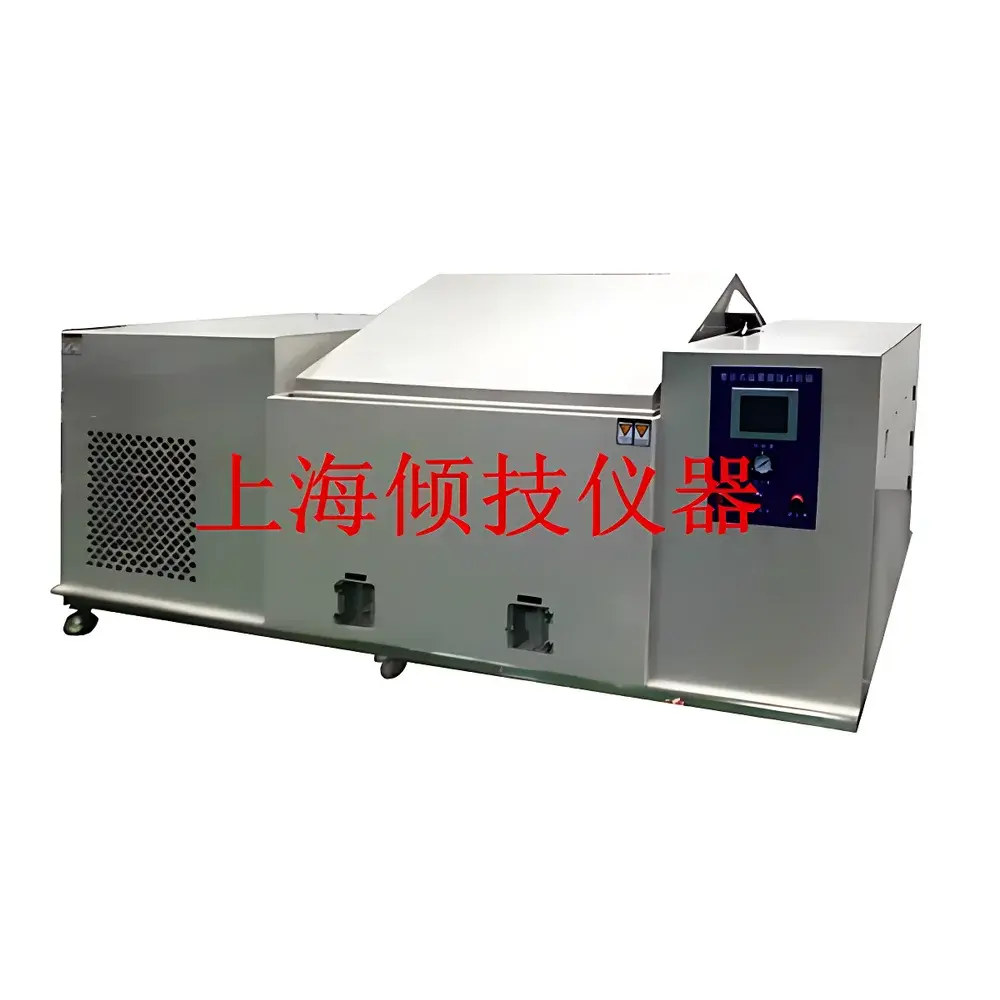
Qinji QJYS-70 Salt Spray Test Chamber
| Brand | Qinji |
|---|---|
| Origin | Shanghai, China |
| Manufacturer Type | Authorized Distributor |
| Country of Origin | China |
| Model | QJYS-70 |
| Price | USD 7,300 (approx.) |
| Internal Chamber Dimensions (Min) | 600 × 450 × 400 mm |
| Internal Chamber Dimensions (Max) | 1600 × 1000 × 500 mm |
| External Dimensions (Min) | 1075 × 630 × 1185 mm |
| External Dimensions (Max) | 2300 × 1200 × 1485 mm |
| Chamber Volume (Min) | 108 L |
| Chamber Volume (Max) | 800 L |
| Salt Solution Tank Capacity (Min) | 15 L |
| Salt Solution Tank Capacity (Max) | 40 L |
| Test Temperature Range | Up to 65 °C |
| Compliant Standards | GB/T 2423.17 (Neutral Salt Spray), ASTM B117, ISO 9227, JIS Z2241 |
Overview
The Qinji QJYS-70 Salt Spray Test Chamber is a precision-engineered environmental simulation system designed for accelerated corrosion testing of metallic and coated materials under controlled saline atmospheric conditions. Based on the fundamental principle of continuous or cyclic salt fog exposure—where atomized sodium chloride solution is introduced into a temperature-regulated test chamber—the QJYS-70 replicates aggressive coastal, industrial, or de-icing salt environments to assess material degradation kinetics, coating adhesion integrity, and long-term corrosion resistance. As a core component of the “Three-Defense” (humidity-heat, salt spray, mold) suite of environmental test equipment, it serves critical validation functions across aerospace structural components, automotive under-hood assemblies, marine hardware, electroplated fasteners, printed circuit board finishes, and protective organic coatings. Its design adheres to internationally recognized test methodologies including ASTM B117 (Standard Practice for Operating Salt Spray (Fog) Apparatus), ISO 9227 (Corrosion tests in artificial atmospheres — Salt spray tests), JIS Z2241, and GB/T 2423.17 (China’s national standard for neutral salt spray testing of electronic and electrical products).
Key Features
- Modular chamber architecture supporting seven standardized internal volume configurations—from compact 108 L (600 × 450 × 400 mm) to large-capacity 800 L (1600 × 1000 × 500 mm)—enabling flexible specimen loading for R&D labs and production QA facilities alike.
- Precision-controlled saturated air heater and preheating chamber ensuring stable chamber temperature up to 65 °C with ±2 °C uniformity across the working zone, critical for reproducible NaCl crystallization behavior and corrosion morphology development.
- High-efficiency glass nozzle atomization system delivering consistent fog density (1.0–2.0 mL/80 cm²/h) with adjustable spray angle and pressure, compliant with ASTM B117 fog collection requirements.
- Corrosion-resistant PVC-coated steel frame and sealed acrylic viewing window with anti-fog treatment for real-time visual monitoring without compromising chamber integrity.
- Dual-tank configuration: separate 15–40 L polypropylene salt solution reservoir and overflow-recovery tank to minimize operator intervention and maintain stable pH and concentration during extended tests (up to 1,000+ hours).
- Integrated digital controller with programmable test cycles (NSS, ASS, CASS), data logging capability, and password-protected parameter locking—supporting GLP-compliant operation in regulated quality systems.
Sample Compatibility & Compliance
The QJYS-70 accommodates flat panels, machined parts, assembled subassemblies, and coated substrates up to maximum dimensions of 1600 × 1000 × 500 mm. Specimen racks are configurable with non-metallic, acid-resistant supports to prevent galvanic interference. The chamber meets mechanical and procedural requirements for GB/T 2423.17 (Ka test), ASTM B117 (neutral salt spray), ASTM G85 Annex A2 (acidified salt spray), and ISO 9227 (NSS, AASS, CASS). It is routinely deployed in laboratories seeking ISO/IEC 17025 accreditation and supports audit-ready documentation for FDA-regulated medical device coating validation (per 21 CFR Part 820) and automotive PPAP submissions (AIAG CQI-15).
Software & Data Management
While the base QJYS-70 operates via embedded microprocessor control with LCD interface, optional RS485/Modbus RTU or Ethernet connectivity enables integration into centralized laboratory information management systems (LIMS). Logged parameters—including chamber temperature, elapsed test time, spray duration, and cycle phase—are timestamped and exportable as CSV files. Optional software packages provide automated report generation aligned with ISO 17025 record retention guidelines, including electronic signatures, change history, and user access logs compliant with FDA 21 CFR Part 11 principles.
Applications
- Corrosion performance benchmarking of zinc-nickel, electroless nickel, chromate conversion coatings, and powder-coated aluminum extrusions.
- Qualification testing of automotive brake calipers, exhaust hangers, and battery enclosures per SAE J2334 and VW PV1210.
- Validation of solder mask integrity and conformal coating durability on PCBAs used in outdoor telecom infrastructure.
- Comparative evaluation of stainless steel grades (e.g., 304 vs. 316) and duplex alloys under simulated marine splash-zone conditions.
- Supporting failure analysis investigations by correlating surface pitting depth (measured post-test via profilometry or SEM-EDS) with exposure duration and environmental variables.
FAQ
What standards does the QJYS-70 support out-of-the-box?
It natively complies with GB/T 2423.17 (NSS), ASTM B117, ISO 9227, and JIS Z2241. Optional firmware upgrades enable AASS and CASS protocols.
Is temperature uniformity validated per ASTM D2244 or IEC 60068-3-5?
Yes—chamber temperature mapping reports (per IEC 60068-3-5) are provided upon commissioning, confirming ≤ ±2 °C deviation across the working volume.
Can the unit be integrated into an existing factory MES or SCADA system?
Via optional Modbus TCP or OPC UA gateway modules, enabling real-time status telemetry and remote alarm notification.
What maintenance intervals are recommended for long-term reliability?
Nozzle inspection every 200 operational hours; saturation chamber cleaning quarterly; full calibration verification annually per ISO/IEC 17025 Clause 6.5.
Does Qinji supply certified reference materials or third-party calibration certificates?
Yes—NIST-traceable temperature sensors and fog collection funnels are available with UKAS- or CNAS-accredited calibration certificates upon request.



