
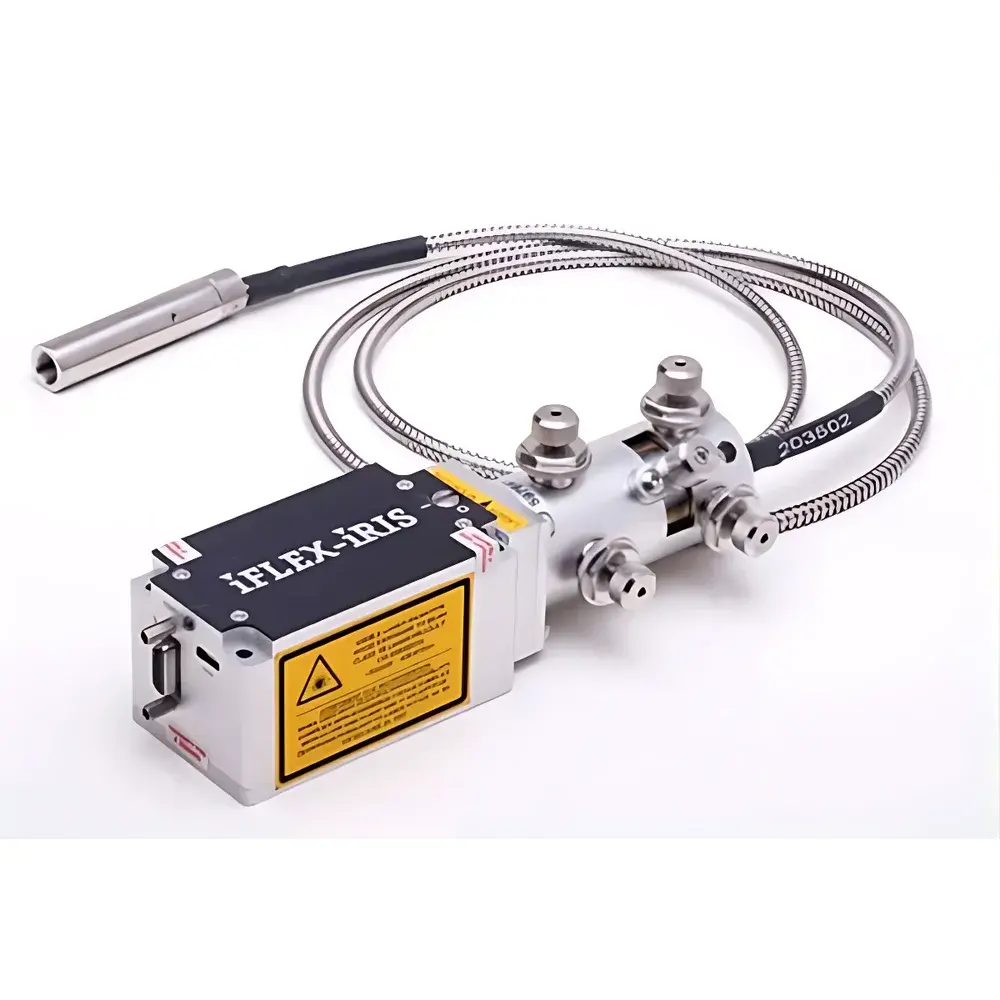
Qioptiq iFLEX-IRIS 375 nm Compact Diode Laser Module
| Brand | Qioptiq |
|---|---|
| Origin | United Kingdom |
| Model | iFLEX-IRIS 375 nm |
| Wavelength | 375 nm |
| Output Type | Single-mode polarization-maintaining fiber-coupled (SM PMF) |
| Beam Profile | TEM₀₀, M² < 1.1 |
| Beam Diameter (1/e²) | 0.7 ± 0.2 mm |
| Pointing Stability | < 1 µrad/°C |
| Polarization Ratio | ≥ 200:1 (vertical ± 2°) |
| Power Stability (8 h) | < 0.5 % RMS |
| Intensity Noise (20 Hz – 20 MHz) | < 0.05 % RMS |
| Peak-to-Peak Noise (20 Hz – 1 MHz) | < 0.5 % |
| Digital Modulation Bandwidth | DC to 5 MHz |
| Extinction Ratio | 1,000,000:1 |
| Rise/Fall Time | < 100 ns |
| Analog Modulation | 0–5 V input, DC to 5 MHz |
| Dual-Mode Modulation | Independent digital fast-switching and analog power control inputs |
| Communication Interface | micro-USB, RS232 |
| Dimensions (L×W×H) | 70 × 40 × 38 mm |
| Cooling | Active temperature stabilization with CLM™ technology |
| Compliance | Designed for integration into ISO/IEC 17025-compliant instrumentation |
Overview
The Qioptiq iFLEX-IRIS 375 nm Compact Diode Laser Module is a high-stability, fiber-coupled ultraviolet semiconductor laser engineered for precision optical instrumentation requiring exceptional beam quality, low temporal noise, and long-term pointing stability. Operating at a fixed wavelength of 375 nm—strategically positioned within the near-UV spectral range—it leverages Qioptiq’s proprietary Closed-Loop Monitoring (CLM™) architecture combined with active thermal regulation to deliver robust performance in demanding OEM and laboratory environments. Unlike conventional free-space diode lasers, the iFLEX-IRIS integrates collimation optics and polarization-maintaining single-mode fiber coupling directly into its compact housing, minimizing alignment sensitivity and enabling seamless integration into space-constrained platforms such as confocal microscopes, flow cytometers, and dynamic light scattering (DLS) systems. Its TEM₀₀ output (M² < 1.1) ensures diffraction-limited divergence and Gaussian intensity distribution—critical for applications where spatial coherence, signal-to-noise ratio, and optical throughput must be maximized without introducing systematic artifacts from multimodal interference or thermal lensing.
Key Features
- Ultra-low intensity noise: < 0.05 % RMS (20 Hz – 20 MHz), enabling high-fidelity photon counting and fluorescence lifetime measurements
- Exceptional pointing stability: < 1 µrad/°C, mitigating drift-induced misalignment in multi-axis scanning systems
- Polarization-maintaining SM fiber output with ≥ 200:1 extinction ratio and vertical orientation tolerance of ±2°, supporting polarization-sensitive assays
- Active thermal stabilization using CLM™ feedback loop, ensuring consistent mode structure and power output across ambient temperature fluctuations
- Dual modulation capability: Independent digital TTL switching (DC–5 MHz, extinction ratio > 10⁶:1, rise/fall < 100 ns) and analog 0–5 V power control (same bandwidth), facilitating synchronized excitation and intensity ramping
- Configurable output: Factory-set or field-adjustable CW power from 0.1% to 100%, with optional off-state and programmable preset levels
- OEM-optimized mechanical footprint: 70 × 40 × 38 mm housing compatible with standard optical breadboards and instrument chassis
Sample Compatibility & Compliance
The iFLEX-IRIS 375 nm laser is designed for integration into regulated analytical instrumentation used in life sciences, materials characterization, and pharmaceutical development. Its stable UV output enables reliable excitation of common fluorophores including DAPI, Hoechst stains, and quantum dots with absorption maxima near 375 nm. The module complies with IEC 60825-1:2014 Class 3B laser safety requirements when properly installed with interlocks and beam containment. Its firmware and communication protocols support configuration logging, parameter timestamping, and user-accessible calibration history—features aligned with FDA 21 CFR Part 11 electronic record integrity expectations. When deployed in ISO/IEC 17025-accredited laboratories, the laser’s documented power stability (< 0.5 % over 8 hours) and pointing reproducibility contribute directly to measurement uncertainty budgets required for accredited testing.
Software & Data Management
Control and monitoring are implemented via bidirectional micro-USB or RS232 interfaces, supporting ASCII command sets for full remote configuration—including power level, modulation mode, and internal diagnostics. Firmware includes non-volatile memory for storing user-defined presets and operational logs with UTC timestamps. Optional SDKs provide C/C++, Python, and LabVIEW drivers compatible with Windows, Linux, and macOS environments. All communication events—including power changes, error flags, and thermal status—are logged with millisecond resolution and exportable in CSV format. Audit trail functionality meets GLP/GMP documentation standards, allowing traceability of laser operational parameters throughout instrument validation and routine use.
Applications
- Confocal and multiphoton microscopy: Stable 375 nm excitation improves nuclear stain contrast and reduces photobleaching variability
- Flow cytometry: Enables simultaneous UV-excited DNA content analysis and viability assessment with high pulse-to-pulse consistency
- Dynamic light scattering (DLS): Low-noise output minimizes baseline fluctuations, enhancing sub-10 nm particle sizing accuracy
- Holographic interferometry: Diffraction-limited beam quality supports high-resolution phase reconstruction
- DNA sequencing platforms: Serves as excitation source for UV-absorbing nucleotide labels in capillary and microfluidic systems
- Optical trapping and manipulation: Precise power control and minimal pointing drift ensure repeatable trap stiffness calibration
FAQ
Is the 375 nm output delivered free-space or fiber-coupled?
The standard configuration delivers collimated, polarization-maintaining single-mode fiber output (PM980 or equivalent). Free-space variants are available under OEM customization.
What is the typical power output range for the 375 nm iFLEX-IRIS module?
Output power is model-dependent and specified per unit; standard units range from 10 mW to 100 mW at the fiber output. Exact values are provided in the calibration certificate shipped with each module.
Can this laser be integrated into a system requiring FDA 21 CFR Part 11 compliance?
Yes—when paired with appropriate host software implementing electronic signatures, audit trails, and role-based access control, the iFLEX-IRIS supports Part 11–compliant workflows through its timestamped parameter logging and secure configuration interface.
Does the laser require external water cooling or forced air?
No—integrated thermoelectric coolers and CLM™ feedback enable stable operation with passive heatsinking or low-flow fan cooling, simplifying system-level thermal management.
Are custom wavelengths or beam profiles available?
While the iFLEX-IRIS platform supports multiple discrete wavelengths (375–852 nm), 375 nm is a fixed-wavelength variant. Beam shaping (e.g., top-hat, line generation) is supported via external optics or factory-integrated micro-optics upon request.





