
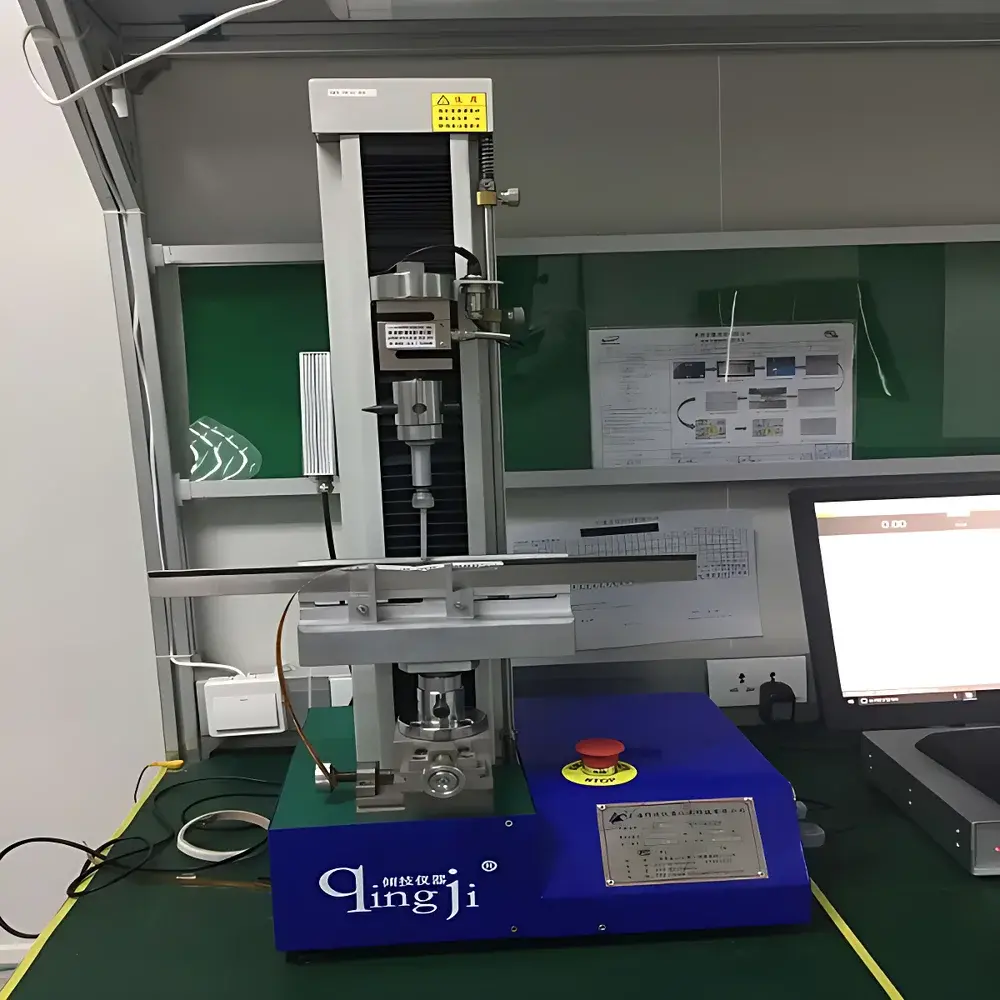
QJ210 Semiconductor Push-Pull Bond Tester
| Origin | Shanghai, China |
|---|---|
| Manufacturer Type | Authorized Distributor |
| Origin Category | Domestic (PRC) |
| Model | QJ210 |
| Quotation | USD 4,200 (FOB Shanghai) |
| Instrument Type | Dedicated Bond Strength Tester |
| Max Test Load | 2500 N |
| Force Measurement Range | 0.2–100% of Full Scale |
| Force Accuracy | ±0.5% FS |
| Stroke | 300 mm |
| Displacement Resolution | ±0.5% of reading |
| Effective Test Width | 150 mm |
| Crosshead Speed Range | 0.01–1000 mm/min |
| Speed Accuracy | ±0.5% of set value |
| Load Cell Resolution | 500,000 counts (single-range, no auto-ranging) |
| Dimensions (L×W×H) | 430 × 315 × 855 mm |
| Weight | 40 kg |
| Motor Power | 200 W |
| Safety Features | Electronic travel limit, overload protection (110% FS), manual/auto return, dual-speed lift control |
Overview
The QJ210 Semiconductor Push-Pull Bond Tester is a precision-engineered mechanical testing system designed specifically for quantitative evaluation of interfacial adhesion strength in microelectronic packaging and semiconductor assembly processes. Unlike general-purpose tensile testers, the QJ210 implements a calibrated shear- and pull-mode transduction architecture compliant with JEDEC JESD22-B116 (bond strength), JESD22-B117 (wire pull), and MIL-STD-883 Method 2011.1 (die shear). It operates on a closed-loop servo-controlled electromechanical principle, where load is applied via a high-stiffness crosshead driven by a 200 W brushless DC motor and measured in real time using a 2500 N load cell with 500,000 internal resolution counts. Force data acquisition is synchronized with sub-millisecond timestamping to support traceable, repeatable bond strength quantification under ISO/IEC 17025-accredited laboratory conditions.
Key Features
- Dedicated semiconductor bond test configuration supporting wire pull, die shear, ball shear, stud pull, and solder joint push tests per industry-standard geometries.
- Single-range, high-resolution load measurement (2500 N full scale) with ±0.5% FS accuracy across 0.2–100% of capacity—no range switching required, eliminating hysteresis or zero-shift errors.
- Programmable crosshead speed from 0.01 to 1000 mm/min, with ±0.5% speed fidelity verified per ASTM E4 calibration protocols.
- Integrated electronic travel limits and overload cutoff (110% FS) ensure operator safety and prevent damage to delicate bond samples or tooling fixtures.
- Optimized mechanical architecture: rigid C-frame construction (40 kg mass), low-noise operation (<65 dB(A)), and zero-emission design suitable for cleanroom-adjacent environments (Class 10,000 compatible).
- Quick-change modular tooling interface accommodating standard 100 µm–500 µm bond capillaries, shear blades, and pull hooks per IPC-9701A specifications.
Sample Compatibility & Compliance
The QJ210 accommodates wafer-level, package-level, and discrete component specimens including flip-chip bumps (SnAg, Cu pillar), gold/aluminum wire bonds (15–500 µm diameter), solder joints (lead-free SAC305, SnPb), die attach adhesives (epoxy, polyimide), and underfill materials. Its 150 mm effective test width and 300 mm vertical stroke permit multi-die array testing without repositioning. The system meets mechanical and metrological requirements of GB/T 17200 (tensile testing machines), ASTM E4 (load verification), ISO 7500-1 (static calibration), and supports GLP/GMP audit readiness through optional digital signature-enabled test report generation. All force and displacement measurements are traceable to NIM (National Institute of Metrology, China) certified standards.
Software & Data Management
The QJ210 operates with Windows-based test control software featuring real-time force-displacement curve visualization, automatic peak detection, and pass/fail threshold assignment per user-defined criteria (e.g., minimum pull force ≥ 50 mN for 25 µm Au wire). Raw data export is supported in CSV, XML, and PDF formats with embedded metadata (operator ID, timestamp, environmental conditions, calibration certificate ID). Audit trail functionality records all parameter modifications, test executions, and report generations in compliance with FDA 21 CFR Part 11 requirements when configured with user authentication and electronic signature modules. Data integrity is preserved via write-once storage options and SHA-256 hash logging.
Applications
- Qualification and routine monitoring of wire bonding process stability in OSAT facilities.
- Failure analysis of interconnect delamination in advanced packaging (Fan-Out WLP, 2.5D/3D ICs).
- Adhesion strength validation of die attach materials under thermal cycling preconditioning.
- Process window development for thermosonic and ultrasonic bonding parameters.
- Quality assurance testing per AEC-Q200 (automotive) and IEC 60749 (semiconductor reliability) standards.
- Educational use in university microelectronics labs for hands-on bond mechanics instruction.
FAQ
What standards does the QJ210 comply with for semiconductor bond testing?
It supports JEDEC JESD22-B116/B117, MIL-STD-883 Method 2011.1, IPC-9701A, and ASTM F459 for wire pull and die shear testing.
Can the system be integrated into an automated production line?
Yes—via RS-232, Ethernet TCP/IP, or optional PLC-compatible digital I/O, enabling trigger synchronization and pass/fail signal output to MES systems.
Is calibration documentation included with shipment?
Each unit ships with a factory calibration certificate traceable to NIM, plus a blank calibration logbook for user-maintained periodic verification per ISO/IEC 17025 Clause 6.5.
What is the recommended maintenance interval?
Load cell and encoder verification every 6 months; mechanical inspection and lubrication annually—full service kits and OEM spare parts are available under extended support contracts.
Does the software support multi-user role-based access control?
Yes—administrator, technician, and viewer roles can be assigned with configurable permissions for test method editing, result approval, and report generation.



