
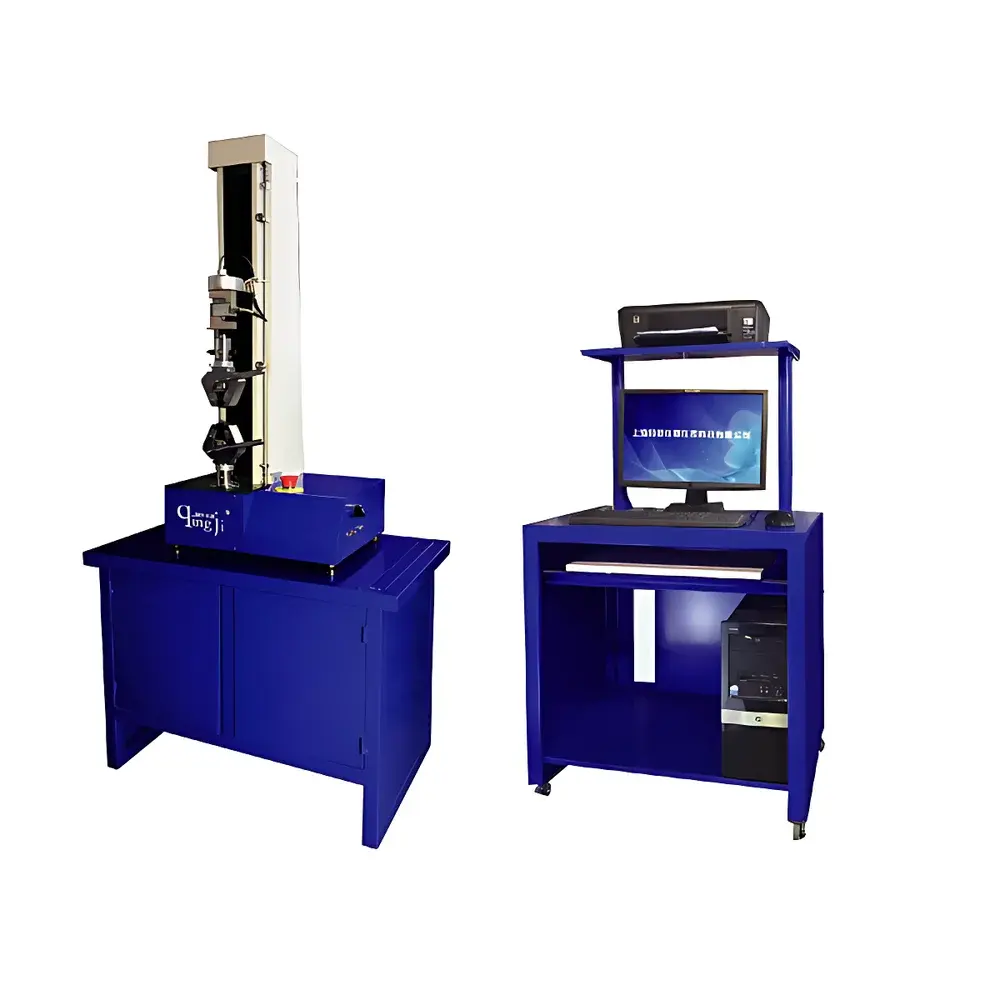
QJ210A Computer-Controlled Universal Tensile Testing Machine
| Origin | Shanghai, China |
|---|---|
| Manufacturer Type | Authorized Distributor |
| Origin Category | Domestic (PRC) |
| Model | QJ210A |
| Quotation | USD 6,300 (FOB Shanghai) |
| Instrument Type | Electromechanical Universal Testing Machine |
| Maximum Test Load | 100 kN |
| Load Range | 0.4%–100% FS |
| Load Accuracy | ±0.5% of reading |
| Crosshead Travel | 200 mm |
| Displacement Resolution | 0.001 mm |
| Load Cell Accuracy | ±0.01% of full scale |
| Speed Range | 0.001–1000 mm/min |
| Speed Accuracy | ±0.5% |
| Displacement Measurement Accuracy | ±0.5% |
| Strain Measurement Accuracy | ±0.5% |
| Effective Test Width | 150 mm |
| Extended Stroke Option | Available (up to 300 mm) |
| Safety Features | Dual electronic limit switches, emergency stop button, stroke safeguard logic |
| Net Weight | ~45 kg |
Overview
The QJ210A Computer-Controlled Universal Tensile Testing Machine is an electromechanical materials testing system engineered for precision mechanical property evaluation under uniaxial loading conditions. It operates on the principle of controlled displacement actuation via a servo-motor-driven crosshead, with real-time force feedback from high-stability strain-gauge load cells. Designed in accordance with fundamental metrological requirements for static mechanical testing, the system supports standardized tensile, compression, flexural, peel, and bend tests per ASTM E4, ISO 7500-1, and GB/T 228.1. Its modular architecture enables rapid reconfiguration for diverse specimen geometries and test protocols without hardware modification—making it suitable for QC laboratories, R&D departments, and academic materials science facilities requiring traceable, repeatable mechanical characterization.
Key Features
- High-fidelity dual-closed-loop control: Simultaneous regulation of crosshead position and load output ensures compliance with ISO 5893 linearity and hysteresis specifications.
- Full-digital parameter configuration: All test parameters—including target load, displacement rate, hold duration, and break detection thresholds—are programmable via front-panel LCD or host PC interface.
- Real-time multi-channel data visualization: Force–displacement, stress–strain, and time-based curves are rendered dynamically during testing with user-selectable scaling and annotation.
- Modular fixture compatibility: Standardized T-slot base plate accepts interchangeable grips (pneumatic, wedge, vise-type), compression platens, and bending fixtures—certified for use across ASTM D638, D790, D903, and ISO 527 series standards.
- Rugged industrial enclosure: Extruded aluminum frame with electrostatically applied epoxy-polyester coating provides corrosion resistance and structural stability under continuous operation.
- Integrated safety architecture: Redundant hardware-based travel limits, software-enforced soft stops, and a dedicated emergency stop circuit meet IEC 61800-5-2 functional safety guidelines.
Sample Compatibility & Compliance
The QJ210A accommodates specimens ranging from thin polymer films (≥0.05 mm thickness) to metallic rods (≤12 mm diameter) and composite laminates (≤150 mm wide × 300 mm long). Grip options include pneumatic self-tightening clamps (for elastomers), serrated wedge grips (for high-strength metals), and low-force spring-loaded jaws (for brittle ceramics and foams). The system conforms to calibration traceability requirements under ISO/IEC 17025:2017 when operated with certified reference load cells and verified displacement transducers. Routine verification follows ASTM E251 procedures; annual recalibration is recommended per GLP/GMP laboratory practice.
Software & Data Management
The embedded control firmware supports bidirectional communication with Windows-based test software (v3.2+), enabling script-driven test sequences, automated report generation (PDF/Excel), and raw data export in CSV format. Audit trail functionality logs all operator actions, parameter changes, and calibration events with timestamp and user ID—fully compliant with FDA 21 CFR Part 11 requirements when deployed with electronic signature modules. Data integrity safeguards include write-once storage mode, encrypted database backups, and configurable retention policies aligned with ISO 15189 documentation standards.
Applications
- Tensile strength and elongation-at-break measurement of thermoplastics, elastomers, textiles, and adhesives per ISO 527 and ASTM D638.
- Compressive yield strength and modulus determination of rigid foams, concrete cores, and biomedical hydrogels per ISO 844 and ASTM D1621.
- Flexural modulus and interlaminar shear strength assessment of fiber-reinforced composites per ISO 178 and ASTM D7264.
- Peel adhesion quantification of pressure-sensitive tapes and laminated packaging per ASTM D903 and ISO 8510-2.
- Creep and stress-relaxation profiling under constant-load or constant-strain conditions using optional time-controlled hold routines.
FAQ
What standards does the QJ210A comply with for calibration and verification?
It meets ISO 7500-1 Class 1 accuracy requirements for force measurement and ISO 204 for displacement verification when equipped with factory-calibrated transducers.
Can the system be integrated into a LIMS or enterprise QA platform?
Yes—via TCP/IP or RS-232 serial protocol, supporting HL7 and ASTM E1384 message structures for seamless data ingestion into validated laboratory informatics systems.
Is third-party certification available for GMP-regulated environments?
Upon request, IQ/OQ documentation packages and on-site performance qualification support can be provided by authorized service partners accredited to ISO 13485 and ISO 9001.
What maintenance intervals are recommended for sustained accuracy?
Load cell zero-check and crosshead alignment verification every 200 operational hours; full mechanical inspection and transducer recalibration annually or after 5,000 test cycles.
Does the system support custom test method development?
Yes—the software SDK permits creation of proprietary test routines with conditional logic, multi-stage ramping, and real-time pass/fail decision trees based on user-defined criteria.



