
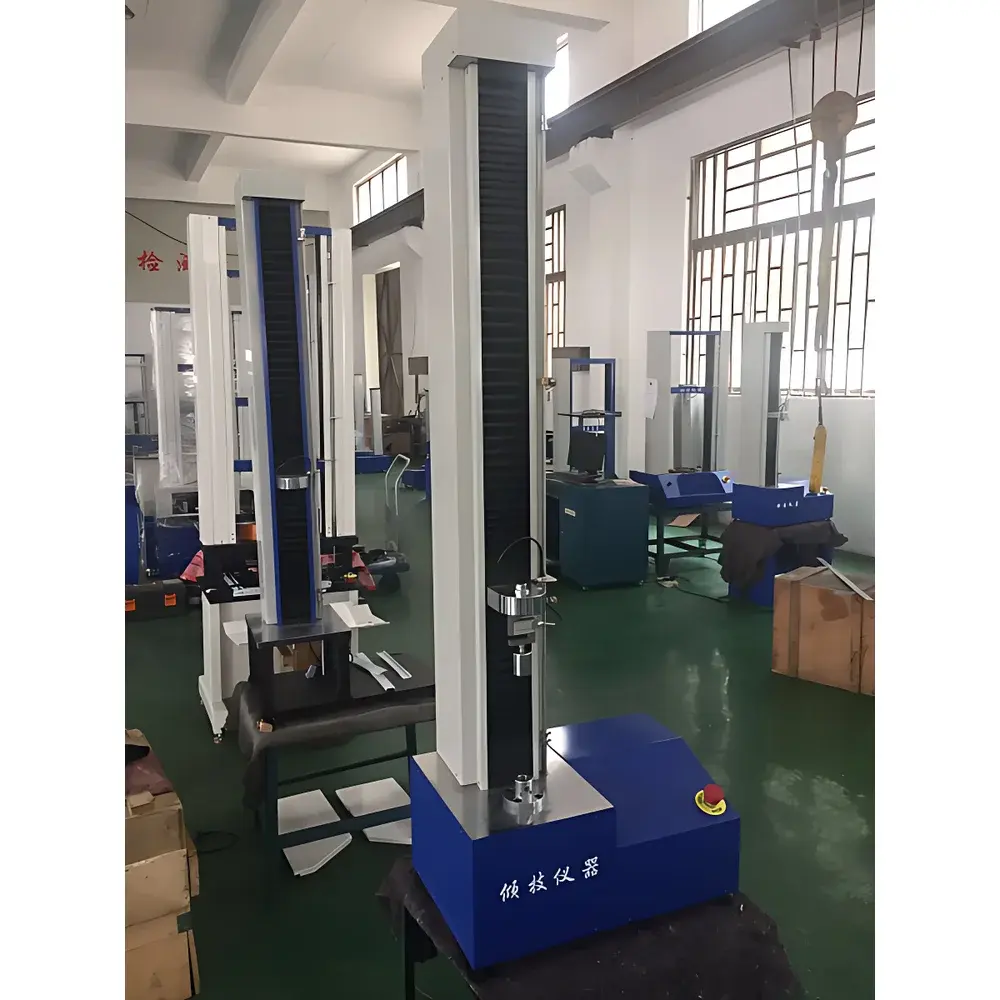
QJ210A Electronic Tensile Testing Machine for Rubber and Elastomeric Materials
| Origin | Shanghai, China |
|---|---|
| Manufacturer Type | Authorized Distributor |
| Origin Category | Domestic (PRC) |
| Model | QJ210A |
| Quotation | USD 4,200 (FOB Shanghai) |
| Instrument Type | Electromechanical Universal Testing Machine |
| Maximum Test Load | 5 kN |
| Force Measurement Range | 0.2%–100% of Full Scale (FS) |
| Force Accuracy | ±0.5% of reading (per ISO 7500-1 Class 0.5) |
| Crosshead Travel | 800 mm |
| Effective Test Width | 150 mm |
| Displacement Resolution | ±0.5% of indicated value |
| Test Speed Range | 0.01–500 mm/min (adjustable in real time) |
| Speed Accuracy | ±0.5% of set value |
| Position Feedback | High-precision encoder coupled with servo-controlled actuation |
| Load Cell | Imported U.S.-made precision strain-gauge sensor |
| Controller | Panasonic全数字交流伺服控制系统 (Panasonic digital AC servo drive & controller) |
| Safety Protection | Dual-mode—software-based overload diagnosis + hardware electronic limit switches |
| Power Supply | 200 V AC, 400 W |
| Dimensions (L×W×H) | 590 × 355 × 1640 mm |
| Net Weight | 85 kg |
| Compliance | Fully configurable to ASTM D412, ISO 37, GB/T 528, JIS K6251, DIN 53504, and other elastomer-specific tensile standards |
Overview
The QJ210A Electronic Tensile Testing Machine is an electromechanical universal testing system engineered for high-reproducibility mechanical characterization of rubber compounds, thermoplastic elastomers, vulcanized sheets, and related polymeric materials. It operates on the principle of controlled uniaxial force application via a precision servo-driven crosshead, enabling accurate measurement of tensile strength, elongation at break, modulus (e.g., M100, M300), yield point, and stress–strain behavior per standardized test protocols. Designed to meet ISO 7500-1 Class 0.5 accuracy requirements, the system delivers traceable force measurement across its full 5 kN capacity—achieving resolution down to 0.01 N without internal range switching. Its modular architecture supports rapid reconfiguration for tension, compression, tear, shear, and puncture tests through interchangeable fixtures, making it suitable for R&D labs, QC departments, and third-party certification facilities requiring multi-standard compliance.
Key Features
- Class 0.5 force accuracy certified per ISO 7500-1, supported by a calibrated U.S.-sourced load cell and real-time digital signal processing
- Wide dynamic speed range (0.01–500 mm/min) with ±0.5% speed fidelity, enabling low-strain-rate creep analysis and high-speed rupture testing
- Full-scale displacement resolution maintained at ±0.5% of reading across 800 mm travel, eliminating interpolation error in elongation calculation
- Panasonic digital AC servo control system ensures smooth acceleration/deceleration profiles and zero-load drift < 0.02% FS/hour
- Dual-safety architecture: software-based overload detection (110% FS threshold) and independent hardware limit switches prevent mechanical overtravel
- Integrated LCD interface with real-time plotting of force–displacement curves; optional PC connectivity via RS232/USB for automated data logging
- Structural frame fabricated from reinforced aluminum extrusions with electrostatic powder coating—optimized for long-term dimensional stability and ESD-safe operation
Sample Compatibility & Compliance
The QJ210A accommodates standard dumbbell-shaped specimens (Type I–IV per ASTM D412), ring specimens (ISO 37), and custom geometries up to 150 mm wide. Fixture options include pneumatic grips, wedge-action clamps, roller-type holders for soft elastomers, and specialized tear fixtures (e.g., trouser, angle, crescent). The system supports full implementation of international standards including ASTM D412 (tensile properties of vulcanized rubber), ISO 37 (rubber—determination of tensile strength and elongation at break), GB/T 528 (Chinese national standard for vulcanized rubber), JIS K6251, and DIN 53504. All test methods are pre-configured in the control software with editable parameters—enabling seamless audit readiness under GLP and ISO/IEC 17025 frameworks.
Software & Data Management
The embedded firmware enables real-time display of force, displacement, strain, and calculated metrics (e.g., Young’s modulus, breaking energy) on the front-panel LCD. Optional PC software provides advanced capabilities: automatic report generation compliant with ASTM E1434 templates; raw data export in CSV, XML, or PDF formats; multi-curve overlay for batch comparison; user-level access control with password-protected method libraries; and audit-trail logging of all parameter changes and test executions. The software meets FDA 21 CFR Part 11 requirements when deployed with Windows-based systems configured for electronic signatures and secure authentication.
Applications
- Quality control of raw rubber compounds and finished products (tires, seals, hoses, gaskets)
- R&D evaluation of filler dispersion effects on tensile modulus and hysteresis
- Accelerated aging studies assessing mechanical degradation after thermal/ozone exposure
- Validation of adhesion strength in rubber-to-metal bonded assemblies
- Comparative testing of bio-based elastomers versus conventional SBR/NR formulations
- Supporting regulatory submissions for medical-grade elastomers (ISO 10993-12, YY/T 0149)
FAQ
What standards does the QJ210A support out-of-the-box?
Pre-loaded test templates cover ASTM D412, ISO 37, GB/T 528, JIS K6251, DIN 53504, and EN 15306. Custom methods can be defined using programmable step sequences.
Can the system perform cyclic loading or stress relaxation tests?
Yes—via optional software module supporting multi-step load/displacement control, dwell periods, and ramp-hold-ramp profiles.
Is calibration documentation included with shipment?
Each unit ships with a factory calibration certificate traceable to NIM (China National Institute of Metrology), including as-found/as-left data for force and displacement channels.
What maintenance is required during routine operation?
Biannual verification of load cell linearity and crosshead alignment is recommended; no lubrication or consumable replacement is needed within the first 12 months of normal use.
Does the machine comply with CE or UL safety directives?
The QJ210A conforms to IEC 61000-6-2 (EMC immunity) and IEC 61000-6-4 (EMC emissions); CE marking applies to the control cabinet subsystem when installed per manufacturer instructions.



