
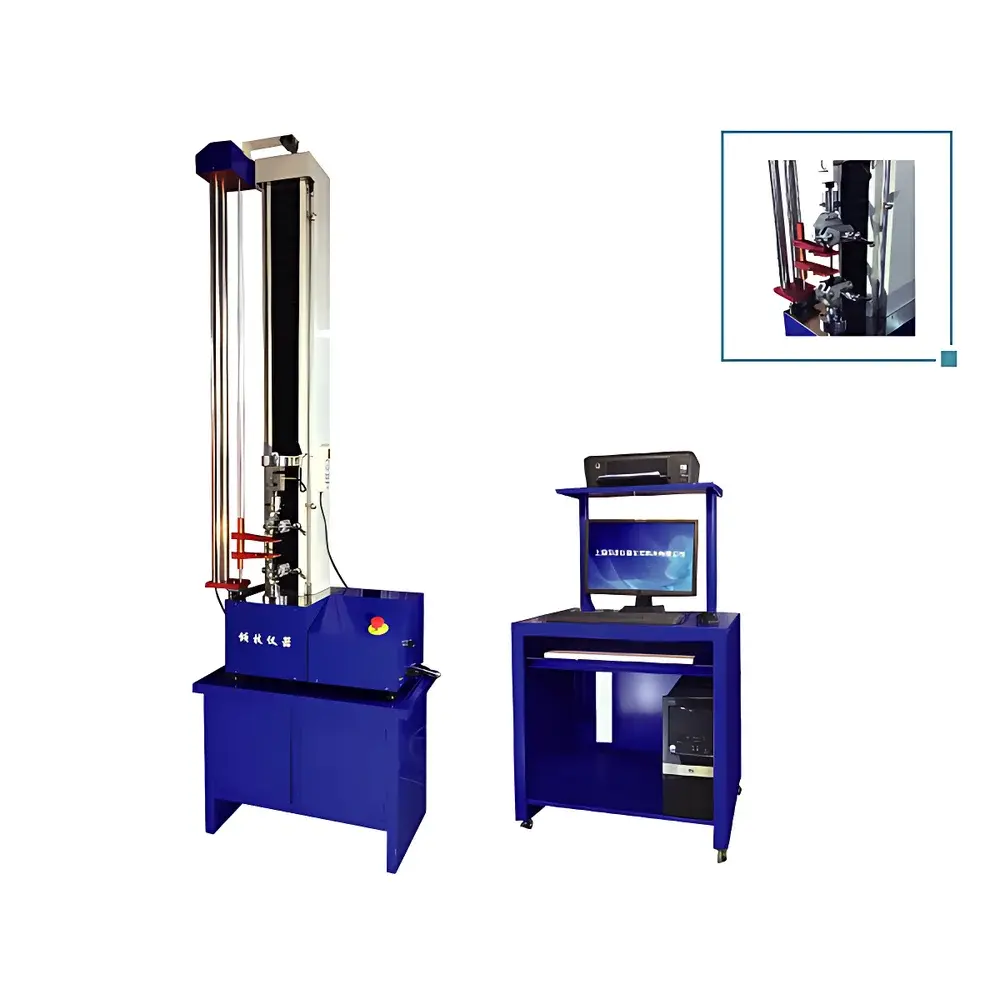
QJ210A Smartphone Lithium Battery Puncture Testing Machine
| Origin | Shanghai, China |
|---|---|
| Manufacturer Type | Authorized Distributor |
| Origin Category | Domestic (PRC) |
| Model | QJ210A |
| Instrument Type | Electromechanical Universal Testing Machine |
| Load Capacity | 5 kN |
| Accuracy Class | 0.5 |
| Effective Test Width | 150 mm |
| Max Travel Distance | 800 mm |
| Speed Range | 0.01–500 mm/min |
| Speed Accuracy | ±0.5% of reading |
| Force Resolution | 500,000 counts (full-scale, no range switching) |
| Displacement Accuracy | ±0.5% of reading |
| Deformation Accuracy | ±0.5% of reading |
| Load Cell | High-precision U.S.-sourced sensor |
| Controller | Panasonic full-digital AC servo system |
| Safety Protection | Software diagnostics, electronic limit switches, 10% overload cutoff |
| Power Supply | 200 V, 400 W |
| Dimensions (L×W×H) | 590 × 355 × 1640 mm |
| Weight | ~85 kg |
Overview
The QJ210A Smartphone Lithium Battery Puncture Testing Machine is a purpose-engineered electromechanical universal testing system designed specifically for mechanical safety evaluation of lithium-ion pouch, prismatic, and cylindrical cells used in mobile electronics. It implements controlled quasi-static penetration mechanics—applying a standardized cylindrical or conical probe at defined velocity and force to simulate internal short-circuit initiation under mechanical abuse conditions. Compliant with UN Manual of Tests and Criteria Part III, subsection 38.3.2 (mechanical testing), IEC 62133-2:2017 Clause 7.2.2, and GB/T 31241–2014 Section 7.5, the system delivers traceable, repeatable force–displacement data critical for cell design validation, quality control, and regulatory dossier preparation. Its rigid frame architecture, precision-ground ball-screw actuation, and high-fidelity load-cell feedback loop ensure minimal hysteresis and thermal drift over extended test cycles—essential for comparative analysis across production batches.
Key Features
- 0.5-class accuracy per ISO 7500-1 and ASTM E4, validated across full 5 kN capacity with single-range, 500,000-count resolution—eliminating range-switching artifacts during dynamic puncture events.
- Programmable speed control from 0.01 to 500 mm/min (±0.5% fidelity), enabling compliance with both slow-penetration (e.g., 1–10 mm/min per UL 1642 Annex A) and accelerated assessment protocols.
- Dual-mode operation: standalone LCD interface for rapid setup and real-time curve monitoring; PC-integrated mode via RS232/USB for automated sequence execution, synchronized data logging, and audit-ready reporting.
- Integrated safety architecture including hardware-based electronic limit switches, software-driven diagnostic self-checks, and automatic shutdown at 110% overload—meeting IEC 61000-6-2 EMC immunity and EN ISO 13857 guarding requirements.
- Modular fixture platform supporting customizable probe geometries (e.g., Ø3 mm stainless steel pin per UN 38.3), cell-holding clamps, and thermal chamber interfaces for combined mechanical–thermal abuse testing.
Sample Compatibility & Compliance
The QJ210A accommodates standard smartphone Li-ion formats: 30–120 mm length, ≤10 mm thickness, and ≤80 mm width—with adjustable vertical clearance up to 800 mm and lateral test zone width of 150 mm. Fixtures are machined from non-sparking 316 stainless steel to prevent galvanic coupling during electrolyte leakage events. All test methods align with internationally recognized safety standards, including but not limited to: UN 38.3 (Section 38.3.2), IEC 62133-2:2017 (Clause 7.2.2), GB/T 31241–2014 (Section 7.5), UL 1642 (Annex A), and JIS C 8714:2017. The system supports GLP-compliant operation through optional 21 CFR Part 11–enabled software modules that enforce user authentication, electronic signatures, and immutable audit trails.
Software & Data Management
The bundled PC control suite provides ISO/IEC 17025-aligned data acquisition: real-time force–displacement–time synchronization at ≥1 kHz sampling rate, automatic peak-force capture, time-to-thermal-runaway annotation (when paired with external thermocouple inputs), and export to CSV, PDF, or XML formats. Calibration certificates include NIST-traceable load-cell verification and velocity linearity reports. Raw datasets retain full metadata—operator ID, environmental conditions (optional humidity/temperature input), test method ID, and firmware version—for seamless integration into LIMS or PLM platforms. Optional report templates comply with CNAS-CL01:2018 documentation requirements.
Applications
- Cell-level mechanical abuse qualification for OEM battery procurement specifications.
- Root-cause analysis of internal short circuits induced by foreign object intrusion or swelling-related electrode deformation.
- Comparative evaluation of separator robustness (e.g., ceramic-coated vs. standard PE/PP membranes) under controlled puncture loads.
- Process validation for electrode stacking uniformity and jelly-roll integrity in high-volume manufacturing.
- Regulatory submission support for CE marking, KC certification, and CCC mandatory testing in China.
FAQ
Does the QJ210A meet UN 38.3 mechanical test requirements?
Yes—the system satisfies Section 38.3.2 for penetration testing, including probe geometry, velocity tolerance, and force monitoring specifications.
Can test parameters be locked to prevent unauthorized modification?
Yes—administrator-level password protection restricts access to calibration constants, test method definitions, and report generation settings.
Is third-party calibration service available?
Yes—certified calibration against ISO/IEC 17025-accredited reference standards is offered annually, with documented uncertainty budgets.
What is the recommended maintenance interval?
Biannual inspection of ball-screw lubrication, sensor zero-drift verification, and servo-tuning validation is advised for continuous GMP-grade operation.
Are custom fixtures for non-standard cell formats supported?
Yes—engineering drawings and dimensional specifications can be submitted for quotation on application-specific tooling, including insulated thermal barrier mounts and gas-tight containment adapters.



