
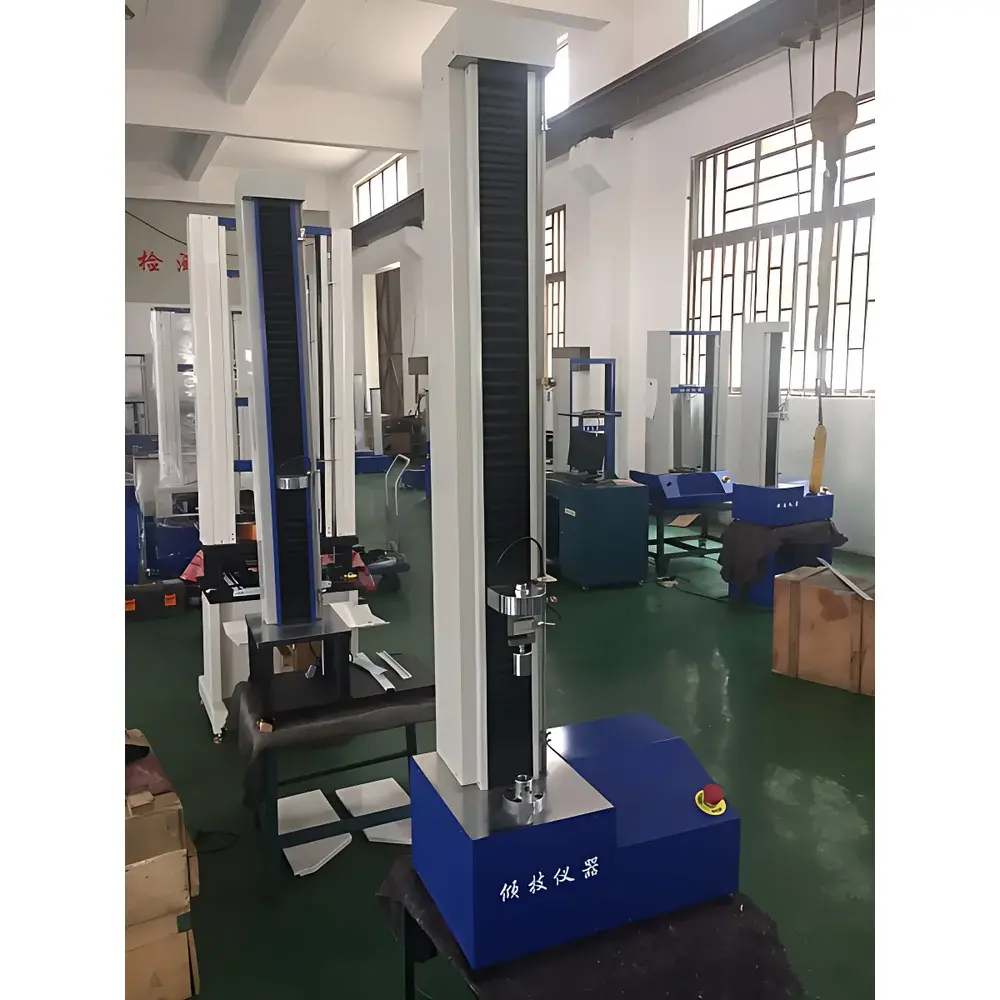
QJ210A Universal Testing Machine for Adhesive Bond Strength Evaluation of Silicone Sealants on Glass Substrates
| Origin | Shanghai, China |
|---|---|
| Manufacturer Type | Authorized Distributor |
| Origin Category | Domestic (PRC) |
| Model | QJ210A |
| Instrument Type | Electromechanical Universal Testing Machine |
| Price | USD 4,500 (FOB Shanghai) |
| Accuracy Class | 0.5 |
| Max Load Capacity | 5 kN (selectable from 5 N to 5,000 N) |
| Effective Load Range | 0.2%–100% of full scale |
| Load Resolution | 500,000 counts, single-range, constant resolution |
| Test Width | 150 mm |
| Max Travel Distance | 800 mm |
| Speed Range | 0.01–500 mm/min (programmable, closed-loop controlled) |
| Speed Accuracy | ±0.5% of set value |
| Displacement Accuracy | ±0.5% of reading |
| Strain Measurement Accuracy | ±0.5% of reading |
| Load Cell | High-precision strain-gauge sensor (USA-sourced) |
| Controller | Panasonic全数字交流伺服系统 |
| Crosshead Movement | Dual-speed (fast/slow) motorized adjustment |
| Safety Protection | Software-based overload detection, electronic limit switches, auto-stop at 110% of rated load |
| Fixture Customization | Application-specific jaw and fixture design per sample geometry and ASTM/ISO test standard |
| Optional Accessories | Lenovo LCD desktop PC with Windows OS |
| Power Supply | 200 V AC, 400 W |
| Dimensions (L×W×H) | 590 × 355 × 1640 mm |
| Net Weight | 85 kg |
Overview
The QJ210A Universal Testing Machine is an electromechanical static materials testing system engineered for precise quantification of adhesive bond strength—particularly for silicone sealants applied to glass substrates—under controlled tensile, peel, shear, and compression loading conditions. It operates on the fundamental principle of force-displacement transduction using a high-fidelity load cell and closed-loop servo-controlled actuation, enabling traceable mechanical property derivation in accordance with ISO 6722, ASTM D1002, ASTM D3164, ISO 11339, and EN 15425 standards. Designed for laboratory and QC environments where reproducibility and regulatory compliance are critical, the system delivers Class 0.5 accuracy per ISO 7500-1 and maintains full-scale linearity across its entire 5 N–5 kN dynamic range without range switching—ensuring consistent resolution and minimal hysteresis during multi-cycle adhesion durability assessment.
Key Features
- Single-range, 500,000-count load resolution with no internal range switching—guarantees uniform sensitivity from 0.2% to 100% of full scale.
- Panasonic digital AC servo drive system delivering smooth, low-noise motion control and exceptional speed stability (±0.5% accuracy over 0.01–500 mm/min).
- Integrated dual-mode crosshead actuation: fast positioning (for setup) and fine-tuned test-speed precision (for data capture).
- Real-time triple-closed-loop control: force, displacement, and strain—enabling advanced protocol execution such as creep hold, stress relaxation, and cyclic peel ramping.
- Comprehensive safety architecture: electronic travel limits, software-based overload cutoff (110% threshold), automatic return-to-start post-test, and hardware interlock-ready I/O ports.
- Modular fixture interface compliant with ISO 2041 and ASTM E4—supports custom jaw designs for glass-to-glass, glass-to-aluminum, or laminated substrate configurations per EN 13555 requirements.
Sample Compatibility & Compliance
The QJ210A accommodates rigid and semi-rigid bonded assemblies including float glass, tempered glass, low-E coated substrates, and structural silicone glazing systems. It supports standardized test geometries defined in ASTM C1135 (tensile lap shear), ISO 10123-2 (peel resistance of elastomeric sealants), and GB/T 13477.8 (Chinese national standard for building sealant adhesion). All measurement outputs—including tensile strength (MPa), elongation at break (%), peel force (N/mm), and modulus at specified strain—are traceable to NIST-calibrated reference loads. The system meets essential requirements for GLP-compliant documentation under ISO/IEC 17025 and supports audit-ready test report generation aligned with FDA 21 CFR Part 11 when paired with validated software and electronic signature modules.
Software & Data Management
Equipped with proprietary Windows-based testing software (v3.2+), the QJ210A provides real-time curve plotting, multi-channel synchronized acquisition (load, displacement, extensometer if added), and automated parameter extraction per ISO 527-2 and ASTM D638. Data export is natively supported in CSV, XLSX, and PDF formats—with embedded metadata (operator ID, timestamp, calibration certificate ID, environmental conditions). Audit trail functionality logs all user actions, method modifications, and result overrides. Optional integration with LIMS platforms via OPC UA or TCP/IP enables centralized data ingestion and long-term trending of bond performance across production batches.
Applications
- Quantitative evaluation of structural silicone adhesion strength to architectural glass façades under thermal cycling preconditioning.
- Comparative analysis of primer efficacy on low-surface-energy glass coatings (e.g., TiO₂, SiO₂ anti-reflective layers).
- Validation of sealant aging behavior per ASTM C1184 accelerated UV/weathering protocols followed by mechanical retesting.
- Development-stage optimization of cure kinetics through variable-rate tensile ramp tests.
- Quality assurance screening of incoming sealant lots against specification limits for peel initiation force and cohesive failure percentage.
- Supporting CE marking submissions for curtain wall systems requiring EN 13555 Annex B compliance evidence.
FAQ
What international standards does the QJ210A support for glass sealant testing?
ASTM D1002, ASTM D3164, ISO 11339, ISO 10123-2, EN 13555, and GB/T 13477 series—configurable via preloaded test methods.
Can the system perform peel tests on flexible glass substrates?
Yes—when equipped with roller-type peel fixtures and calibrated low-force load cells (e.g., 10 N or 50 N), it complies with ISO 8510-2 for flexible-to-rigid adherend configurations.
Is the load cell NIST-traceable and certified?
All supplied load cells include factory calibration certificates traceable to NIST or equivalent national metrology institutes (e.g., NIM China), with optional third-party certification available.
Does the software meet FDA 21 CFR Part 11 requirements?
Out-of-the-box functionality satisfies core ALCOA+ principles; full Part 11 compliance requires optional validation package, role-based access control configuration, and electronic signature implementation.
What is the recommended maintenance interval for the servo controller and load cell?
Preventive maintenance is advised every 12 months or after 2,000 test cycles—covering sensor zero-drift verification, encoder alignment check, and lubrication of lead screw assembly.



