
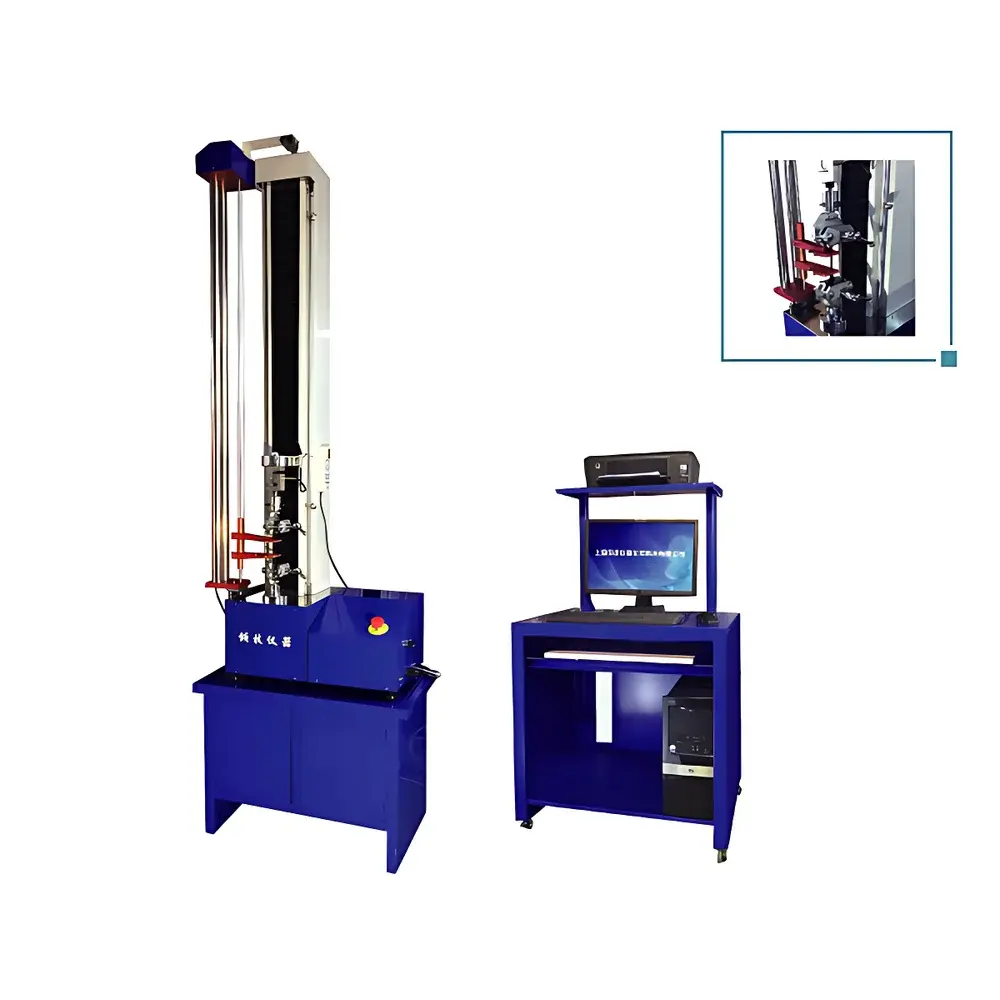
QJ210A Universal Testing Machine for Foil Tensile Strength Measurement
| Origin | Shanghai, China |
|---|---|
| Manufacturer Type | Authorized Distributor |
| Origin Category | Domestic (China) |
| Model | QJ210A |
| Price | USD 6,300 (FOB Shanghai) |
| Instrument Type | Electromechanical Universal Testing Machine |
| Load Capacity | Up to 5 kN |
| Accuracy Class | 0.5 |
| Force Resolution | 500,000 counts (full-scale, no range switching) |
| Effective Test Width | 150 mm |
| Max Travel Distance | 800 mm |
| Speed Range | 0.01–500 mm/min (adjustable) |
| Speed Accuracy | ±0.5% of indicated value |
| Displacement Accuracy | ±0.5% of indicated value |
| Strain Measurement Accuracy | ±0.5% of indicated value |
| Load Cell | High-precision U.S.-sourced strain-gauge sensor |
| Controller | Panasonic全数字 AC servo drive system |
| Safety Protection | Software-based overload diagnosis, electronic limit switches, 10% over-load auto-hold |
| Power Supply | 200 V AC, 400 W |
| Dimensions (L×W×H) | 590 × 355 × 1640 mm |
| Net Weight | ~85 kg |
Overview
The QJ210A Universal Testing Machine is an electromechanical force-testing platform engineered for high-reproducibility tensile strength evaluation of thin metallic foils—particularly copper foil used in printed circuit board (PCB) manufacturing. It operates on the principle of controlled uniaxial loading via a precision servo-driven crosshead, measuring mechanical response through calibrated load cells and linear displacement transducers. Designed to meet the stringent demands of quality control laboratories and R&D facilities in electronics, packaging, and advanced materials sectors, the system delivers traceable, repeatable results across standardized test protocols. Its modular architecture supports rapid reconfiguration for tensile, peel, tear, shear, and puncture testing—enabling comprehensive mechanical characterization of flexible thin-film substrates without requiring multiple dedicated instruments.
Key Features
- High-accuracy force measurement with 0.5-class calibration compliance per ISO 7500-1 and ASTM E4, supported by a U.S.-sourced load cell offering 500,000-count resolution across the full 5 kN range—no range switching required.
- Wide dynamic speed range (0.01–500 mm/min), digitally adjustable with ±0.5% speed accuracy, enabling precise simulation of both quasi-static and accelerated deformation conditions.
- Integrated dual-mode crosshead control: fast positioning for setup and fine-speed operation for data acquisition, minimizing test cycle time without compromising measurement fidelity.
- Real-time digital display of force, displacement, and stress–strain curves on a dedicated LCD interface; synchronized data streaming to PC via USB or RS232 for post-processing and report generation.
- Comprehensive safety architecture including software-based overload detection (10% over full scale), hardware-triggered electronic limit switches, and automatic return-to-start functionality after test completion.
- Robust structural design featuring extruded aluminum enclosure with electrostatic powder coating, ensuring long-term dimensional stability and resistance to laboratory environmental stressors.
Sample Compatibility & Compliance
The QJ210A accommodates specimens up to 150 mm wide and 800 mm in effective travel length—ideal for standard foil strips (e.g., ASTM D882-type coupons), laminated PCB substrates, and flexible packaging films. Its interchangeable fixture system—customizable per client sample geometry—supports ASTM D903 (peel), D1938 (tear), D7136 (puncture), and ISO 11339 (adhesive bond strength) configurations. The instrument complies with international metrological standards including ISO 7500-1 (static calibration), ISO 5893 (testing machine verification), and EN 10002-2 (tensile testing of metallic materials). Data integrity meets GLP/GMP documentation requirements, with optional audit-trail-enabled software supporting 21 CFR Part 11 readiness upon configuration.
Software & Data Management
The system interfaces with proprietary Windows-based testing software (v3.2+), providing intuitive test method setup, real-time curve overlay, multi-channel data logging (force, displacement, time), and automated calculation of key metrics—including tensile strength (MPa), elongation at break (%), Young’s modulus (GPa), and yield point. Export formats include CSV, XLSX, and PDF reports compliant with ISO 527 and ASTM D638 templates. Optional integration with LIMS environments is supported via ODBC drivers. All raw datasets are timestamped, user-logged, and stored with checksum validation to ensure forensic traceability during regulatory audits.
Applications
- Tensile property verification of rolled copper foil (RA/RT/ED grades) prior to lamination in HDI and flex PCB production.
- Peel strength assessment of adhesive-backed aluminum foil tapes used in HVAC and pharmaceutical barrier packaging.
- Quantification of delamination resistance in multilayer metallized polyester films (e.g., PET/Al/PE laminates).
- Mechanical screening of ultra-thin lithium-ion battery current collectors under dry and conditioned environments.
- Quality conformance testing against GB/T 228.1, ISO 6892-1, JIS Z 2241, and ASTM D882 for thin-sheet metals and polymers.
FAQ
What is the maximum specimen thickness the QJ210A can accommodate in tensile mode?
Standard configurations support specimens up to 2.5 mm thick; custom jaw inserts extend capability to 5 mm for laminated composites.
Does the system support closed-loop strain control?
Yes—when equipped with optional extensometer input (e.g., clip-on or video-based), the controller enables displacement- or strain-controlled ramp-hold profiles per ASTM E8/E21.
Can test methods be password-protected and version-controlled?
Yes—the software supports role-based access control, method revision history, and digital signature enforcement for SOP compliance.
Is calibration certification included with shipment?
Each unit ships with a factory-issued ISO/IEC 17025-accredited calibration certificate valid for 12 months; on-site recalibration services are available globally.
What maintenance intervals are recommended for routine operation?
Biannual lubrication of lead screws and annual verification of load cell linearity and crosshead alignment are advised per the maintenance logbook provided.



