
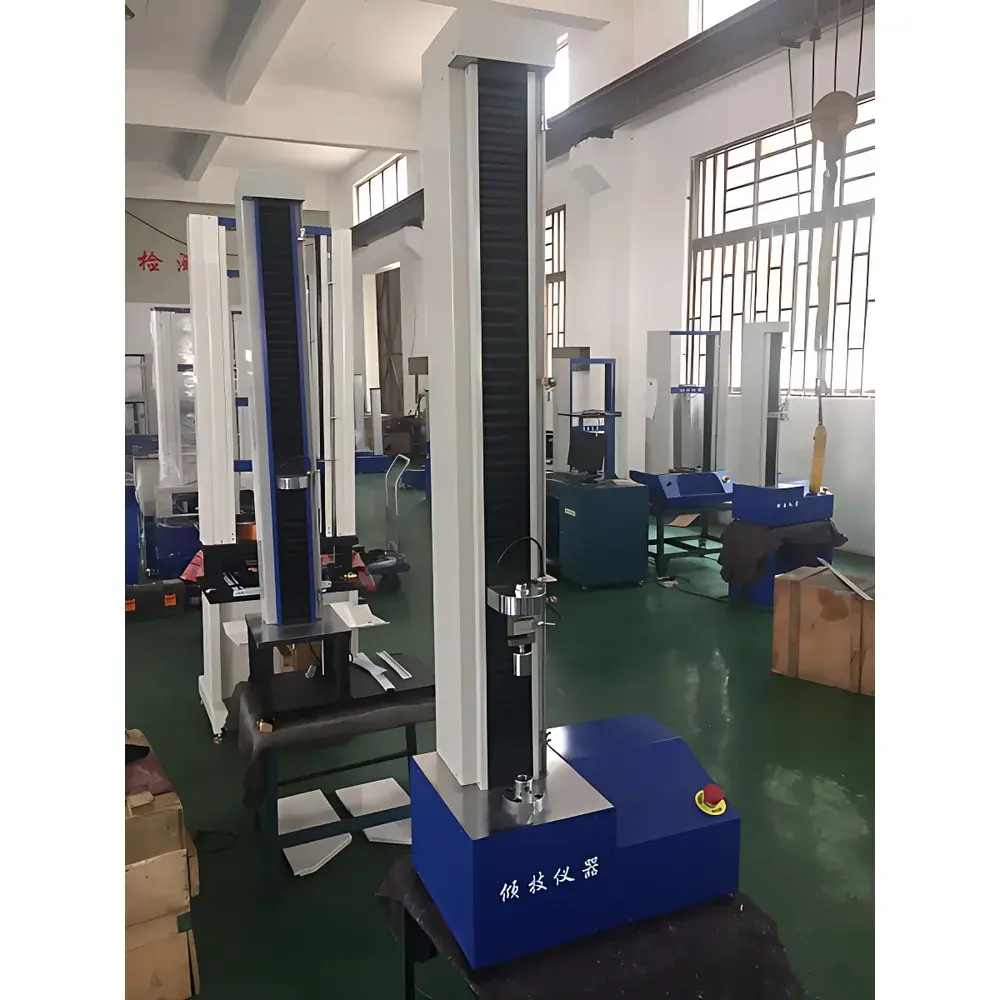
QJ210A Universal Testing Machine for Medical Packaging Materials
| Origin | Shanghai, China |
|---|---|
| Manufacturer Type | Authorized Distributor |
| Origin Category | Domestic (PRC) |
| Model | QJ210A |
| Instrument Type | Electromechanical Universal Testing Machine |
| Load Capacity Range | 5 N to 5,000 N (selectable within 5 kN full scale) |
| Accuracy Class | 0.5 |
| Effective Test Width | 150 mm |
| Max Travel Distance | 800 mm |
| Speed Range | 0.01–500 mm/min (adjustable, ±0.5% speed accuracy) |
| Force Resolution | 500,000 counts (single-range, constant resolution) |
| Force Units | gf, kgf, N, kN, lbf |
| Displacement & Strain Measurement Accuracy | ±0.5% of reading |
| Sensor | High-precision load cell (USA-sourced) |
| Controller | Panasonic all-digital AC servo system |
| Safety Features | Software-based diagnostics, electronic travel limits, overload protection (>110% FS), programmable return-to-start |
| Power Supply | 200 V AC, 400 W |
| Dimensions (L×W×H) | 590 × 355 × 1640 mm |
| Weight | ~85 kg |
Overview
The QJ210A Universal Testing Machine is an electromechanical force-testing platform engineered for precision mechanical characterization of medical packaging materials in regulated quality control and R&D environments. It operates on the principle of controlled uniaxial loading—applying tensile, compressive, flexural, peel, or puncture forces to standardized specimens while continuously recording load, displacement, and strain data. Designed to meet ISO 11607-1/2, ASTM F88 (peel strength), ASTM F903 (seal strength), ASTM D882 (tensile properties of thin plastic films), and USP requirements, the system supports full compliance with GMP documentation practices and GLP audit trails when integrated with validated software configurations.
Key Features
- High-fidelity force measurement: 0.5-class accuracy certified per ISO 7500-1, with a seamless 5 N–5,000 N load range and constant 500,000-count resolution—no internal range switching required.
- Dynamic speed control: Programmable crosshead velocity from 0.01 to 500 mm/min, with real-time feedback ensuring ≤±0.5% deviation from setpoint across the entire range.
- Rigid dual-column frame with 150 mm effective test width and 800 mm vertical travel, optimized for dimensional stability during high-precision seal integrity and burst testing.
- Integrated safety architecture: Dual-mode protection including hardware-based electronic limit switches, software-driven overload cutoff (>110% of selected capacity), and automatic return-to-origin post-test.
- Industrial-grade motion control: Panasonic all-digital AC servo drive ensures repeatable positioning, low-speed torque consistency, and minimal thermal drift during extended-duration creep or relaxation tests.
- Modular fixture interface: Standardized T-slot base accommodates ISO/ASTM-compliant grips (tensile, peel, compression platens, bend fixtures) and supports custom tooling for pouches, blister cards, Tyvek® laminates, and sterile barrier systems.
Sample Compatibility & Compliance
The QJ210A accommodates flat, flexible, and semi-rigid substrates typical of Class I–III medical packaging—including thermoformed trays, heat-sealed pouches, aluminum-laminated foils, medical-grade polyethylene and polypropylene films, and paper-plastic composites. Specimen thickness up to 5 mm is supported without modification. All mechanical test protocols align with regulatory expectations for validation documentation: traceable calibration certificates (NIST-traceable load cells), audit-ready test logs (with operator ID, timestamp, environmental notes), and exportable raw data files compatible with FDA 21 CFR Part 11–compliant review workflows.
Software & Data Management
Control and analysis are executed via dedicated PC-based software (Windows OS, supplied with Lenovo ThinkCentre M-series workstation). The interface enables method-driven test sequencing, real-time curve overlay, multi-curve statistical comparison (mean, SD, CV%), and automated report generation in PDF or Excel format. Raw ASCII data (.txt) exports include time-stamped force, displacement, and extension values at user-defined sampling intervals (down to 10 Hz). Optional integration with LIMS platforms is supported via ODBC drivers. Audit trail functionality records all parameter changes, test starts/stops, and result modifications—satisfying ALCOA+ principles for data integrity.
Applications
- Tensile strength and elongation-at-break of sterilization wraps and surgical drapes (per ISO 9073-3)
- Peel adhesion strength of heat seals on flexible packaging (ASTM F88, ISO 11607-2)
- Burst pressure and creep resistance of pre-filled syringe barrels and IV bags
- Compression modulus of rigid blister cavities and clamshell containers
- Delamination resistance of multilayer laminates under static and dynamic loads
- Validation of packaging process parameters (e.g., seal temperature/pressure correlation studies)
FAQ
What standards does the QJ210A support for medical packaging validation?
It fully supports ISO 11607-1/2, ASTM F88, ASTM F903, ASTM D882, ASTM D638, and USP . Calibration and verification procedures follow ISO/IEC 17025 guidelines.
Can the system be qualified under GMP or FDA-regulated environments?
Yes—when deployed with IQ/OQ documentation packages, 21 CFR Part 11–enabled software, and NIST-traceable calibration records, it meets baseline requirements for equipment qualification in pharmaceutical and medical device manufacturing.
Is customization available for non-standard specimen geometries?
All fixture sets are configurable per customer-supplied drawings; custom jaw profiles, pneumatic clamping, and environmental chamber integration (e.g., humidity-controlled enclosures) are available as engineering options.
What maintenance is required to sustain 0.5-class accuracy?
Annual recalibration by an accredited third-party lab is recommended; routine verification using certified reference load cells and displacement standards should be performed before each shift in high-usage QC labs.
Does the system support remote monitoring or networked operation?
The control PC supports standard Ethernet connectivity and can be integrated into enterprise networks for centralized data archiving—though direct remote control requires additional firewall-compliant security configuration per IT policy.



