
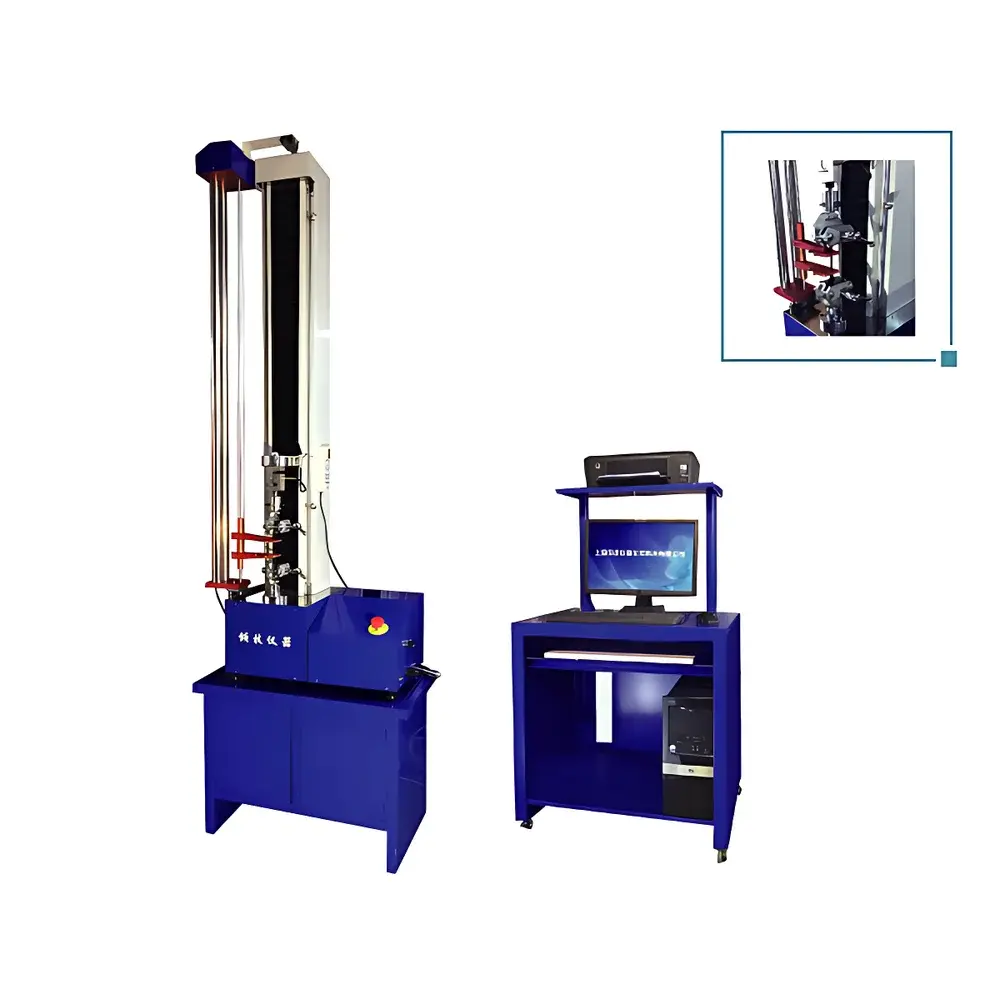
QJ210A Welding Tensile Testing Machine
| Origin | Shanghai, China |
|---|---|
| Manufacturer Type | Authorized Distributor |
| Origin Category | Domestic (China) |
| Model | QJ210A |
| Price | USD 5,600 (FOB Shanghai) |
| Instrument Type | Electromechanical Tensile Testing Machine |
| Max Test Load | 5 kN |
| Adjustable Load Range | 0.1–5 kN (full-scale) |
| Force Accuracy Class | ISO 7500-1 Class 1 |
| Stroke | 150 mm |
| Displacement Resolution | 0.01 mm |
| Effective Test Width | 150 mm |
| Effective Tensile Travel | 800 mm |
| Speed Range | 0.01–500 mm/min (adjustable in real time) |
| Speed Accuracy | ±0.5% of set value |
| Displacement Measurement Accuracy | ±0.5% of reading |
| Deformation Measurement Accuracy | ±0.5% of reading |
| Load Cell | High-precision imported strain-gauge sensor (USA-made) |
| Control System | Panasonic full-digital AC servo controller (Japan) |
| Drive System | Imported servo motor + Taiwan-made precision gear reducer + preloaded ball screw |
| Safety Protection | Dual-mode (software-based overload diagnosis + hardware electronic limit switch) |
| Overload Protection Threshold | 110% of selected load range |
| Fixture Customization | Available per specimen geometry and industry-standard test method requirements |
| Optional Accessories | Lenovo LCD desktop PC with Windows OS |
| Power Supply | 200 V AC, 50/60 Hz, 400 W |
| Dimensions (L×W×H) | 590 × 355 × 1640 mm |
| Net Weight | ~85 kg |
Overview
The QJ210A Welding Tensile Testing Machine is a precision electromechanical system engineered for quantitative mechanical evaluation of welded joints and related metallic or polymer-based assemblies. It operates on the principle of uniaxial force application under controlled displacement or speed, conforming to standardized tensile, peel, shear, puncture, and lap-shear test protocols. Designed for laboratories requiring traceable, repeatable, and compliant mechanical property data, the system integrates a high-fidelity load cell, closed-loop servo control architecture, and real-time digital signal acquisition—enabling accurate measurement of yield strength, ultimate tensile strength, elongation at break, modulus of elasticity, and joint failure mode classification per ASTM E8/E8M, ISO 6892-1, GB/T 228.1, and AWS B4.0.
Key Features
- Full-range force measurement from 0.1 kN to 5 kN with ISO 7500-1 Class 1 accuracy—no manual range switching required
- High-resolution displacement sensing (0.01 mm) and dynamic speed control (0.01–500 mm/min) with ±0.5% speed fidelity across the entire range
- Dual-mode motion control: rapid positioning via fast/slow dual-speed actuation and fine-tuned testing via programmable ramp-hold profiles
- Robust mechanical architecture featuring preloaded ball screws, low-backlash gear reduction (Taiwan-sourced), and maintenance-free servo drive (Panasonic)
- Comprehensive safety integration including automatic overload cutoff (110% threshold), software-based fault diagnostics, and hardware-based electronic end-stop limits
- Modular fixture interface supporting ASTM F1136-compliant weld-joint grips, peel fixtures, and custom-designed tooling per client specimen geometry
Sample Compatibility & Compliance
The QJ210A accommodates flat, round, or irregularly shaped specimens up to 150 mm wide and 800 mm effective travel length—ideal for evaluating butt-welded plates, fillet welds, resistance spot welds, laser-welded thin sheets, and dissimilar-metal joints. Its calibration traceability aligns with ISO/IEC 17025-accredited practices, and test execution supports audit-ready documentation for GLP, GMP, and ISO 9001 environments. All firmware and control logic comply with IEC 61508 functional safety principles for laboratory equipment. The system meets mechanical safety requirements per EN 61000-6-2 (EMC immunity) and EN 61000-6-3 (EMC emission) standards.
Software & Data Management
Bundled with Windows-compatible test control software (v3.2+), the QJ210A delivers real-time plotting of stress–strain, load–displacement, and time–force curves with user-definable analysis points (e.g., yield offset, peak load, fracture energy). Raw data export is supported in CSV, Excel (.xlsx), and XML formats—including metadata such as operator ID, timestamp, environmental conditions (optional external sensor input), and calibration certificate reference. Audit trail functionality logs all parameter modifications, test starts/stops, and result exports—fully compliant with FDA 21 CFR Part 11 requirements when deployed with validated user access controls and electronic signature modules.
Applications
- Mechanical qualification of fusion and solid-state welds per AWS D1.1, ISO 15614-1, and EN ISO 15614-1
- Quality assurance testing of automotive body-in-white resistance spot welds and laser seam welds
- Failure mode analysis of dissimilar metal joints (e.g., Al–steel, Cu–Al) under static and quasi-static loading
- R&D validation of new filler materials, shielding gases, and welding parameters through comparative tensile performance mapping
- Third-party certification testing for pressure vessel, pipeline, and structural steel fabrication compliance
- Educational use in metallurgy and welding engineering curricula for hands-on mechanical behavior instruction
FAQ
What international standards does the QJ210A support out-of-the-box?
The system includes preconfigured test methods for ASTM E8/E8M, ISO 6892-1, GB/T 228.1, JIS Z 2241, and AWS B4.0—with additional standards available via software update.
Can the machine perform cyclic or fatigue testing?
No—the QJ210A is designed exclusively for static and quasi-static monotonic tests. For fatigue applications, consider our QJ212 series with hydraulic servo actuation and waveform generation capability.
Is calibration certification included with delivery?
Yes—a NIST-traceable factory calibration report (including force, displacement, and speed verification) is provided with each unit, valid for 12 months from shipment date.
How is data integrity ensured during long-duration tests?
All acquired data are buffered in non-volatile memory onboard the controller; lossless transmission to PC occurs even during brief network interruptions, with auto-resume functionality upon reconnection.
What maintenance intervals are recommended?
Ball screw lubrication every 6 months; annual verification of load cell linearity and displacement encoder zero drift; no scheduled replacement parts required within first 5 years under normal lab use conditions.



