
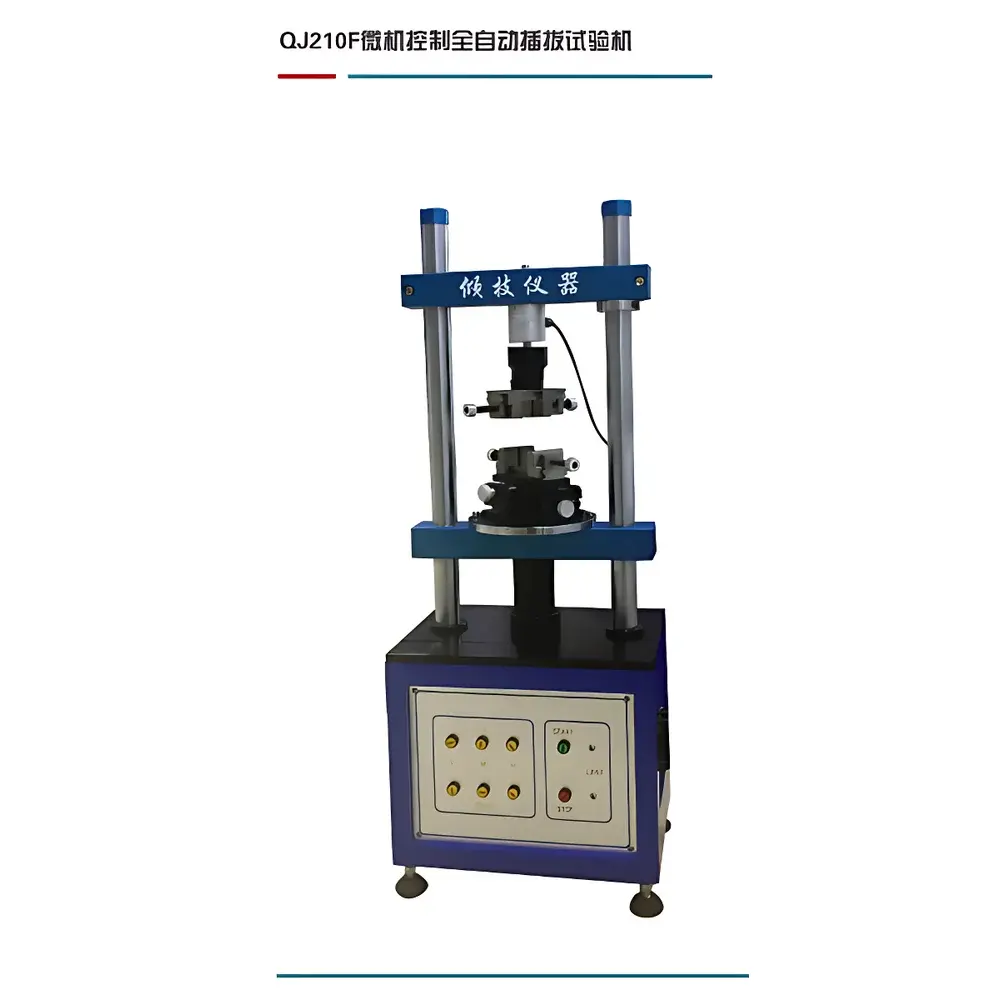
QJ210F Connector Insertion and Extraction Force Tester
| Origin | Shanghai, China |
|---|---|
| Manufacturer Type | Authorized Distributor |
| Origin Category | Domestic (PRC) |
| Model | QJ210F |
| Load Capacity | 200 kgf |
| Force Resolution | 500,000 counts (full-scale, unsegmented) |
| Accuracy Class | Class 1 (per GB/T 16491 / ISO 7500-1) |
| Effective Force Range | 0.2–100% of full scale |
| XY Axis Travel | 0–75 mm |
| Test Speed | 0–500 mm/min (adjustable in 0.1 mm/min increments) |
| Maximum Test Height | 150 mm |
| Displacement Measurement Accuracy | ±1% of reading |
| Micrometer Fine-Adjustment Resolution | 0.01 mm |
| Drive Motor | 200 W, 220 VAC |
| Dimensions (L×W×H) | 400 × 300 × 1000 mm |
| Net Weight | 65 kg |
Overview
The QJ210F Connector Insertion and Extraction Force Tester is a precision electromechanical testing system engineered for quantitative mechanical evaluation of electrical and electronic connectors. It operates on the principle of controlled axial force application—measuring insertion force (IF), extraction force (EF), and retention force profiles during mating and unmating cycles under defined displacement-rate conditions. Designed in accordance with fundamental requirements of IEC 60512-2-1, IEC 60512-2-2, and GB/T 16491 (equivalent to ISO 7500-1 for static force calibration), the system delivers traceable, repeatable mechanical characterization essential for connector qualification, design validation, and production line quality control. Its rigid frame architecture, high-resolution load cell, and closed-loop servo-controlled actuation ensure minimal hysteresis and thermal drift—critical for detecting subtle anomalies such as contact galling, housing deformation, or latch fatigue.
Key Features
- Class 1 force measurement accuracy (per GB/T 16491 and ISO 7500-1), validated across 0.2–100% of 200 kgf full scale without range switching
- Unsegmented 500,000-count analog-to-digital resolution ensures consistent sensitivity at low-force thresholds (e.g., sub-1 N micro-connector testing) and high-load stability
- Motorized XY-stage with 0–75 mm travel enables precise lateral alignment and automatic centering—eliminating angular misalignment-induced parasitic moments during test execution
- Programmable speed control from 0.1 to 500 mm/min, supporting both quasi-static qualification tests and accelerated durability cycling
- Integrated micrometer fine-adjustment (0.01 mm resolution) for sub-millimeter positioning of fixture height and preload engagement point
- Robust aluminum-and-steel frame (400 × 300 × 1000 mm) with 65 kg mass minimizes vibration coupling and supports long-term repeatability in shared lab environments
Sample Compatibility & Compliance
The QJ210F accommodates a broad spectrum of connector types—including board-to-board (B2B), wire-to-board (W2B), RF coaxial, USB-C, HDMI, MIL-DTL-38999 variants, and custom molded housings—via interchangeable jaw fixtures and modular mounting plates. Fixture adaptability extends to terminals with pitch down to 0.3 mm and housing widths up to 80 mm. All test protocols align with international standards governing connector mechanical integrity: IEC 60512-2 (insertion/extraction force), IEC 60512-5 (mechanical operation life), and GB/T 5095.2–1997 (Chinese national standard for electronic equipment connectors). The system’s force and displacement data acquisition meets GLP documentation requirements, supporting audit-ready reporting for ISO 9001-certified manufacturing facilities.
Software & Data Management
Controlled via Windows-based native software with Chinese/English bilingual GUI, the QJ210F platform provides real-time force–displacement curve visualization, multi-cycle lifetime tracking, and automated pass/fail threshold evaluation. Test parameters—including speed profile, dwell time, cycle count, and trigger conditions—are fully scriptable and stored with metadata (operator ID, timestamp, firmware version). Raw data exports to CSV and Excel formats; graphical outputs include overlayable curves, statistical summaries (mean, SD, min/max per cycle), and annotated inspection reports compliant with internal QA templates. Audit trail functionality logs all parameter changes and report generations—supporting basic 21 CFR Part 11 readiness when deployed with network-authenticated user accounts and timestamped digital signatures.
Applications
- Design verification of new connector interfaces prior to mold release or PCB layout finalization
- Production line incoming inspection of connector batches against AQL sampling plans
- Accelerated wear-life assessment (e.g., 500–5,000 mating cycles) to quantify degradation in insertion force trends
- FMEA support for identifying failure modes such as terminal spring relaxation, plastic creep, or housing cracking
- Supplier qualification testing where contractual specifications mandate force envelope compliance (e.g., max IF ≤ 35 N, min EF ≥ 8 N)
- Root cause analysis of field returns involving intermittent contact or excessive mating resistance
FAQ
What standards does the QJ210F comply with for force calibration and test methodology?
It conforms to GB/T 16491 (equivalent to ISO 7500-1) for static force measurement accuracy and implements test procedures aligned with IEC 60512-2-1 and IEC 60512-2-2.
Can the system perform continuous cyclic testing with automatic pass/fail judgment?
Yes—users define upper/lower force limits and displacement thresholds; the software logs each cycle result and halts testing upon first failure or completion of preset iterations.
Is third-party calibration certification available?
Factory calibration is performed using NIST-traceable deadweight standards; optional UKAS-accredited calibration certificates can be arranged through authorized metrology partners.
What maintenance is required to sustain measurement accuracy over time?
Annual verification of load cell linearity and displacement encoder performance is recommended; routine cleaning of guide rails and lubrication of lead screws every 6 months ensures mechanical longevity.
Does the system support custom fixture design for non-standard connectors?
Yes—mounting interface dimensions and CAD models are provided to facilitate OEM fixture development; mechanical drawings and torque specifications for adapter plates are included in the technical documentation package.



