
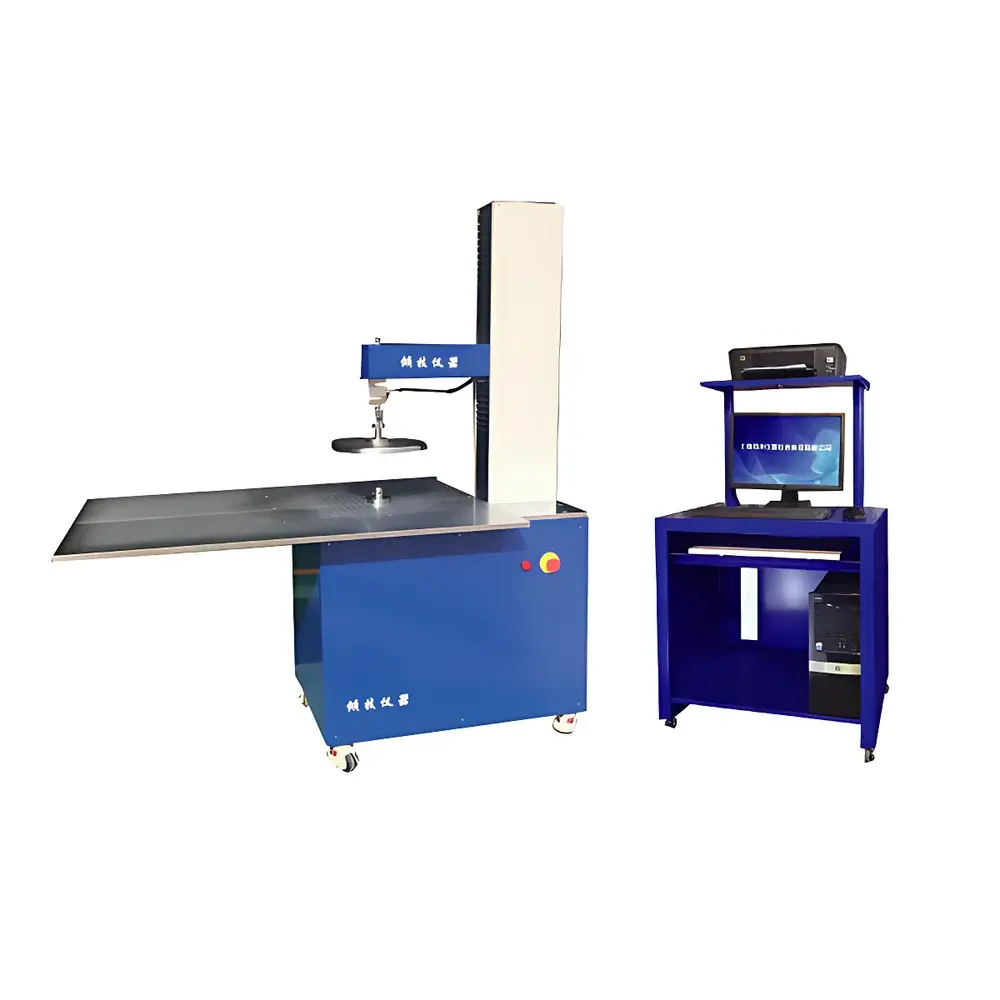
QJ210K Sponge Indentation Hardness Tester by Qingji
| Brand | Qingji |
|---|---|
| Origin | Shanghai, China |
| Model | QJ210K Sponge-Specific |
| Max Test Force | 2 kN |
| Load Rate Range | 0.01–300 mm/min |
| Platen Spacing | 500 mm |
| Platen Dimensions | 300 mm × 300 mm |
| Compliance | GB/T 10807–2006, GB/T 6344–1996, GB/T 20467–2006 |
| Force Sensor Accuracy | ±0.01% FS |
| Force Measurement Class | 0.5 |
| Repeatability | ≤0.5% |
| Displacement Accuracy | ≤0.2% |
| Deformation Accuracy | ≤0.2% |
Overview
The QJ210K Sponge Indentation Hardness Tester is a precision-engineered compression testing system designed exclusively for the mechanical characterization of flexible polymeric foams—particularly open-cell and closed-cell sponge materials used in automotive seating, furniture, bedding, packaging, and medical cushioning applications. It operates on the principle of controlled quasi-static indentation, applying a defined load or displacement profile to a standardized test specimen while continuously recording force and displacement data. The instrument conforms to internationally recognized test methodologies, including ISO 2439 (equivalent to GB/T 10807–2006), which specifies the indentation hardness test for soft cellular polymeric materials using a 25%, 40%, and 65% compression protocol. Its dual-control architecture supports both load-controlled and displacement-controlled test modes, enabling full compliance with ASTM D3574, ISO 1798, and GB/T 20467–2006 for compression set, stress relaxation, and low-cycle fatigue evaluation.
Key Features
- Modular three-closed-loop control system (force, displacement, strain) ensures high reproducibility across repeated indentation cycles.
- High-resolution load cell with ±0.01% full-scale accuracy and 0.5-class metrological certification per JJG 139–2014 (Chinese national verification regulation).
- Adjustable crosshead speed range from 0.01 to 300 mm/min, supporting both slow-rate creep tests and rapid compression recovery assessments.
- Fixed 500 mm vertical platen spacing accommodates thick foam blocks and layered composites without reconfiguration.
- 300 mm × 300 mm rigid steel platens with precision-ground surfaces ensure uniform pressure distribution and minimize edge effects during indentation.
- Integrated LCD controller with real-time graphing and programmable test sequences; fully compatible with PC-based software for advanced data analysis and report generation.
Sample Compatibility & Compliance
The QJ210K is optimized for specimens conforming to standard dimensions specified in GB/T 10807–2006 (e.g., 380 mm × 380 mm × 50 mm or 150 mm × 150 mm × 50 mm), but accepts custom geometries within its 300 mm platen limit. It supports preconditioning per ISO 293 and ISO 291 for temperature/humidity equilibration prior to testing. All test protocols align with regulatory frameworks applicable to foam qualification in regulated industries: validation documentation supports GLP-compliant testing environments, and audit trails are available when paired with optional 21 CFR Part 11–compliant software modules. The system meets mechanical safety requirements per GB/T 2611–2013 (General Requirements for Testing Machines) and electromagnetic compatibility per GB/T 18268.1–2010.
Software & Data Management
The QJ210K interfaces with Qingji’s proprietary TestMaster v4.2 software suite, offering calibrated force-displacement curve acquisition, automatic indentation stage detection (25%/40%/65%), and calculation of key metrics—including initial slope (effective modulus), plateau stress, residual deformation, and hysteresis energy loss. Raw data exports to CSV, XLSX, and XML formats; reports comply with ISO/IEC 17025 documentation standards. Optional database integration enables centralized test record storage with user-access controls, versioned method templates, and electronic signature support for QA/QC workflows. Software updates are provided free of charge for the lifetime of the hardware platform, with backward-compatible firmware revisions ensuring long-term method integrity.
Applications
- Determination of indentation load deflection (ILD) values for upholstery and mattress foam grading.
- Compression set evaluation after 22-hr dwell at 70°C per GB/T 20467–2006 and ISO 1856.
- Stress relaxation profiling over time intervals from 1 min to 24 hr under constant strain.
- Low-cycle fatigue testing (up to 10,000 cycles) to assess structural degradation in automotive seat cushions.
- Quality control benchmarking against supplier specifications or internal material release criteria.
- Research into viscoelastic behavior of bio-based or recycled polyurethane foams under variable humidity conditions.
FAQ
What standards does the QJ210K directly support?
It is configured and validated for GB/T 10807–2006, GB/T 6344–1996, GB/T 20467–2006, ISO 2439, ISO 1798, and ASTM D3574.
Can the system perform cyclic compression testing?
Yes—programmable multi-stage profiles allow up to 100,000 compression-relaxation cycles with adjustable dwell times, peak loads, and ramp rates.
Is calibration traceable to national standards?
Force calibration is traceable to CNAS-accredited laboratories (certificate included); displacement calibration uses laser interferometry verified per JJG 762–2007.
What maintenance is required for long-term accuracy?
Annual verification of load cell linearity and platen parallelism is recommended; no routine lubrication or consumable replacement is necessary due to brushless servo motor design.
Does the system support automated reporting for ISO/IEC 17025 compliance?
Yes—software includes customizable report templates with embedded uncertainty calculations, operator ID logging, and timestamped audit trails.



