
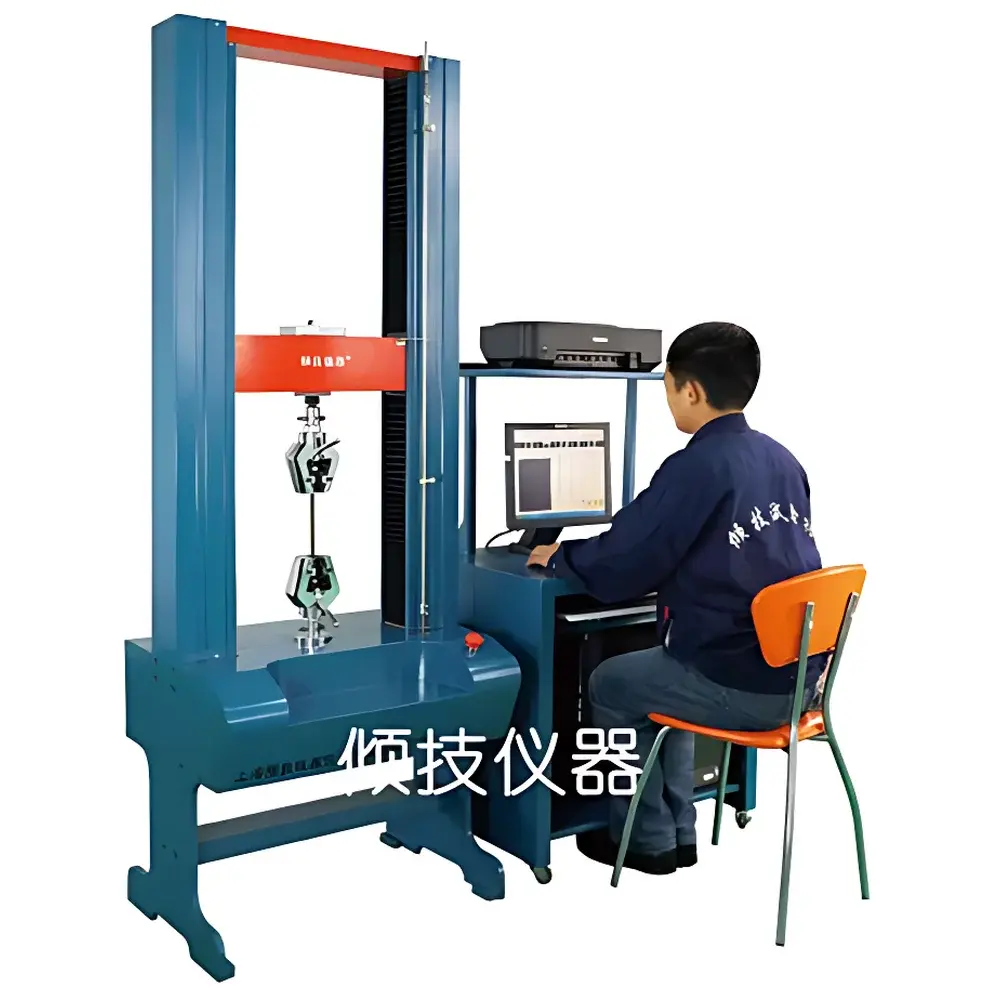
QJ211 Geotextile Tensile Testing Machine – Electronic Universal Testing System
| Origin | Shanghai, China |
|---|---|
| Manufacturer Type | Authorized Distributor |
| Origin Category | Domestic (China) |
| Model | QJ211 |
| Price Range | USD 7,000–14,000 |
| Instrument Type | Electromechanical Universal Testing Machine |
| Max Load Capacity | 30 kN |
| Load Cell Accuracy | 0.01% FS |
| Test Accuracy | < ±0.5% |
| Control Interface | Windows-based PC Control with Real-time Data Acquisition |
| Effective Test Width | ~420 mm |
| Effective Stroke | ~800 mm |
| Speed Range | 0.001–500 mm/min |
| Speed Accuracy | ±0.5% |
| Displacement Measurement Accuracy | ±0.5% |
| Strain/Deformation Measurement Accuracy | ±0.5% |
| Safety Features | Electronic Limit Switches, Emergency Stop Button |
| Net Weight | ~140 kg |
Overview
The QJ211 Geotextile Tensile Testing Machine is an electromechanical universal testing system engineered for high-reproducibility mechanical characterization of geosynthetic materials—including woven and nonwoven geotextiles, geogrids, geomembranes, and related civil engineering textiles. It operates on the principle of controlled uniaxial force application via a precision servo-motor-driven crosshead, enabling accurate measurement of tensile strength, elongation at break, modulus, yield point, and load-elongation behavior per standardized test protocols. Designed to meet the stringent demands of quality assurance in infrastructure projects, landfill liners, road reinforcement, and hydraulic engineering, the system delivers traceable, audit-ready results compliant with global regulatory frameworks governing material certification and construction compliance.
Key Features
- Modular dual-function testing platform supporting tensile, compression, flexural, peel, tear, shear, puncture, and low-cycle fatigue tests through interchangeable fixture sets
- High-resolution 30 kN load cell with 0.01% full-scale accuracy and digital signal conditioning for minimal thermal drift and long-term stability
- Real-time dynamic display of force, displacement, strain, and time-based curves on integrated 7-inch LCD interface with configurable parameter input
- Windows-based control software with ISO/IEC 17025-aligned data acquisition architecture—supports automatic calibration logging, user-defined test sequences, and multi-channel synchronized sampling
- Robust structural frame with reinforced aluminum alloy columns and precision-ground ball screws ensuring minimal deflection (< 0.02 mm under full load) and consistent crosshead alignment
- Comprehensive safety suite including programmable electronic limit switches, hardware-triggered emergency stop circuitry, and overload protection with auto-hold-and-report functionality
Sample Compatibility & Compliance
The QJ211 accommodates standard geotextile specimens per ASTM D4595 (tensile strength of geotextiles), ISO 10319 (wide-width tensile test), GB/T 15788 (Chinese national standard for geotextile tensile performance), and JTG E50 (Highway Engineering Test Specifications). Fixture options include pneumatic wedge grips (for high-friction fabrics), roller clamps (for slippage-sensitive nonwovens), and specialized puncture anvils meeting ASTM D4833 requirements. All test methods are pre-configured in software with built-in pass/fail criteria aligned with EN 13249, EN 13250, EN 13251, and EN 13252 for CE-marked geosynthetic qualification. The system supports GLP-compliant operation with user-level access control, electronic signature capture, and FDA 21 CFR Part 11–ready audit trails when deployed in regulated QA/QC environments.
Software & Data Management
The embedded Windows 10 IoT Edition software provides full lifecycle test management: from specimen ID assignment and environmental condition logging (temperature/humidity metadata tagging) to real-time curve overlay, statistical batch analysis (mean, SD, CV%), and automated report generation in PDF/Excel formats. Raw data files (.tdf) retain full resolution (1 kHz sampling rate) and are exportable without loss for third-party statistical validation or finite element model correlation. Software modules support multi-user role permissions (admin/operator/auditor), version-controlled method templates, and encrypted local database storage compliant with ISO/IEC 27001 information security benchmarks. Optional cloud synchronization enables remote monitoring and centralized lab network integration via secure TLS 1.2 API endpoints.
Applications
- Quality conformance testing of geotextiles supplied for municipal solid waste landfill capping systems per EPA SW-846 Method 9090
- Mechanical verification of erosion control blankets (ECBs) and turf reinforcement mats (TRMs) under ASTM D6768
- Tensile property benchmarking for railway sub-ballast separation layers in accordance with UIC 717 OR
- Long-term creep behavior assessment of HDPE-coated geogrids under sustained loading per ISO 13431
- Material qualification for marine sediment containment barriers used in dredged material disposal projects
- Research-grade stress-strain analysis in university geotechnical laboratories conducting ASTM D6637 interlaboratory round-robin studies
FAQ
Does the QJ211 support ASTM D4595 and ISO 10319 out-of-the-box?
Yes—preloaded test methods include full parameterization for both standards, with automatic calculation of breaking strength (kN/m), elongation (%), and secant modulus at 5% strain.
Can the system be integrated into an existing LIMS environment?
Yes—via ODBC-compliant database export or RESTful API interface; custom field mapping and HL7/FHIR schema adaptation available upon request.
Is calibration traceability provided to national metrology institutes?
Each unit ships with a NIST-traceable calibration certificate (valid for 12 months) and includes internal self-diagnostic routines for daily verification checks.
What maintenance intervals are recommended for sustained accuracy?
Load cell and encoder verification every 6 months; mechanical lubrication and belt tension check every 12 months; full system recalibration annually or after 10,000 test cycles.
Are fixtures for wide-width tensile testing included as standard equipment?
A 200 mm wide pneumatic grip set is supplied standard; optional 300 mm and 500 mm width configurations are available for ISO 10319-compliant testing of heavy-duty geogrids.



