
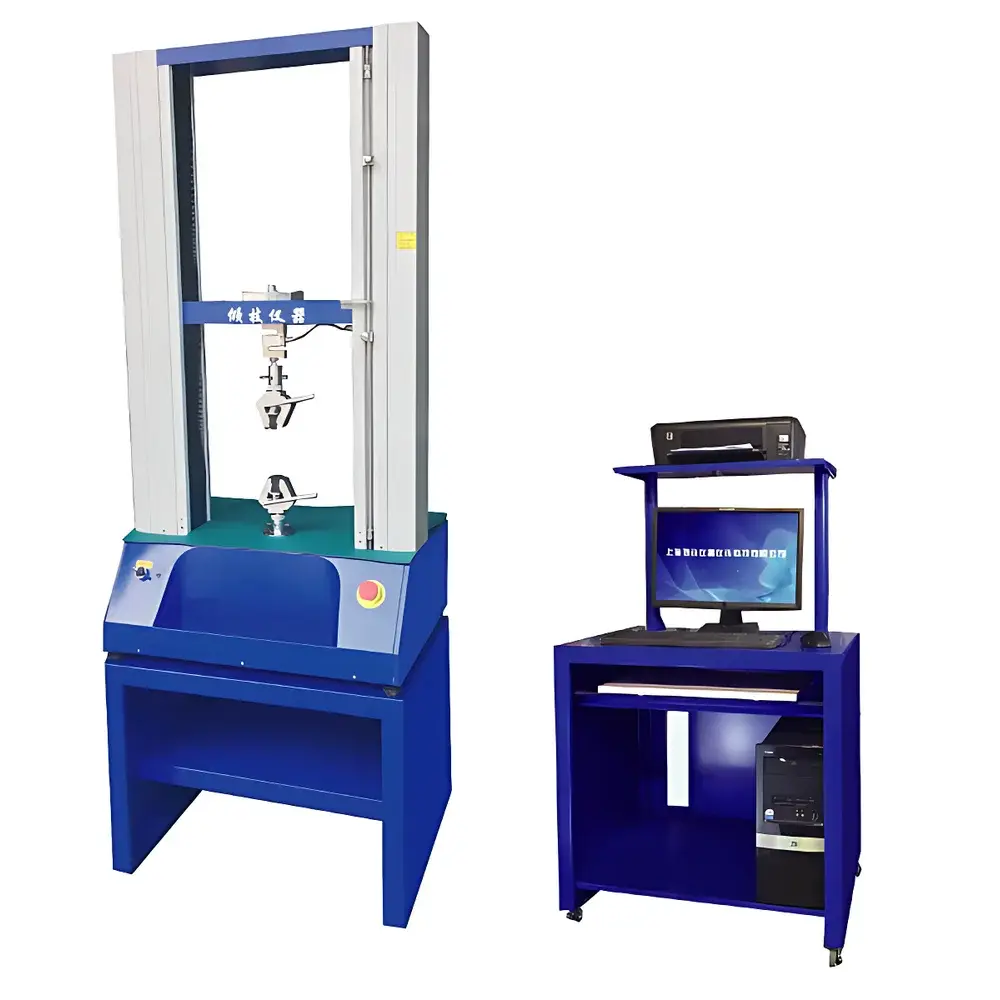
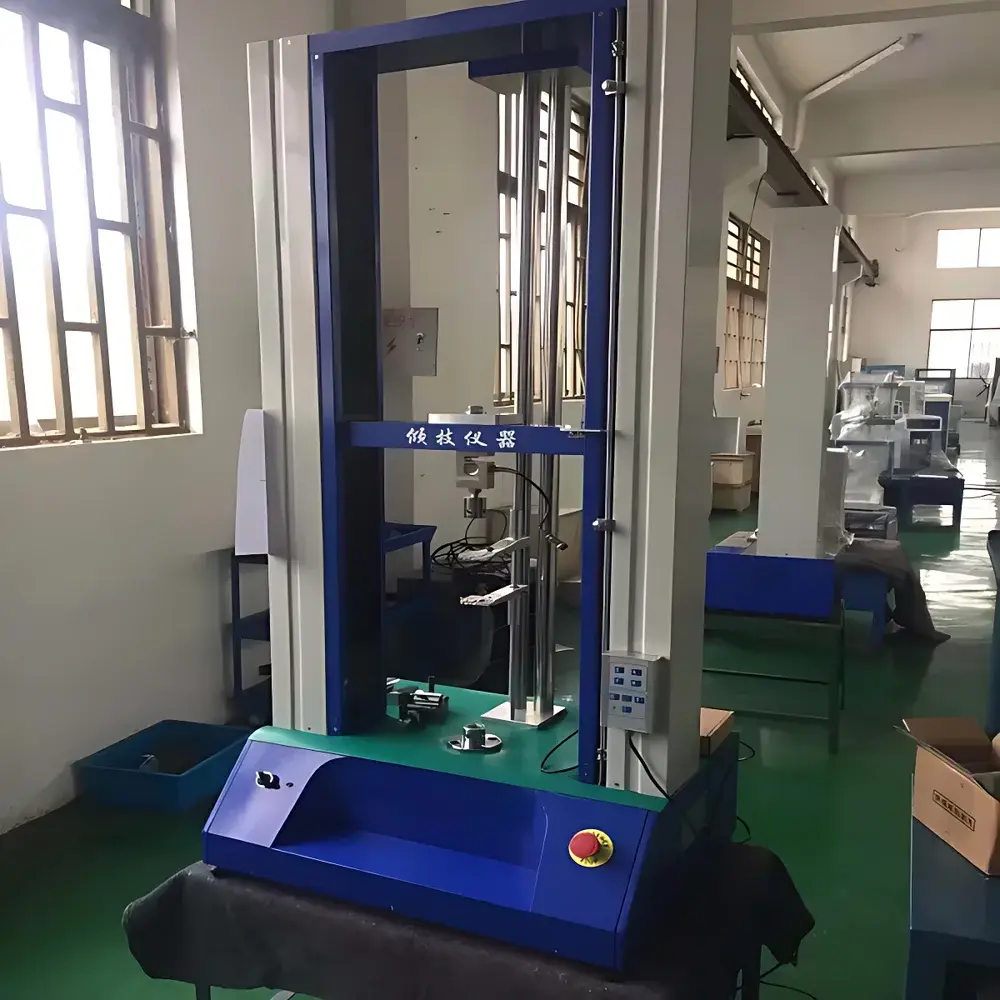
QJ211 Mineral Insulated Cable Bending Tester
| Origin | Shanghai, China |
|---|---|
| Manufacturer Type | Authorized Distributor |
| Origin Category | Domestic (PRC) |
| Model | QJ211 |
| Price | USD 9,400 (FOB Shanghai) |
| Instrument Type | Electromechanical Universal Testing Machine |
| Max Load Capacity | 30 kN |
| Load Cell Accuracy | ±0.5% FS |
| Measurement Accuracy | < ±0.5% |
| Control System | Fully Digital Display Interface |
| Effective Test Width | ~420 mm |
| Maximum Stroke | ~800 mm |
| Test Speed Range | 0.01–500 mm/min |
| Speed Accuracy | ±0.5% |
| Displacement Accuracy | ±0.5% |
| Deformation Measurement Accuracy | ±0.5% |
| Safety Features | Electronic Travel Limit Protection, Emergency Stop Button |
| Unit Weight | ~2650 kg |
Overview
The QJ211 Mineral Insulated Cable Bending Tester is an electromechanical universal testing system engineered specifically for the mechanical evaluation of mineral-insulated (MI) cables—copper-sheathed, magnesium oxide-filled conductors widely deployed in fire-resistant, high-temperature, and nuclear-grade applications. Unlike generic tensile testers, the QJ211 integrates structural rigidity, precision motion control, and cable-specific fixture geometry to replicate real-world bending fatigue conditions defined in IEC 60702-1, BS 6387, and UL 1569. Its core measurement principle follows ASTM E8/E8M-compliant uniaxial force-displacement transduction, utilizing a high-stiffness load frame, calibrated S-type load cell, and closed-loop servo control to deliver repeatable bending moment quantification across variable bend radii and cycle counts. Designed for laboratory-based quality assurance and type approval testing, the system supports static and quasi-static loading protocols essential for verifying sheath integrity, conductor slippage resistance, and insulation compaction stability under repeated flexure.
Key Features
- Robust dual-column steel frame with reinforced base plate, optimized for torsional stability during high-moment cable bending tests
- 30 kN capacity load cell traceable to NIM (National Institute of Metrology, China), certified to ISO/IEC 17025 calibration standards
- Digital servo motor drive enabling precise speed control from 0.01 mm/min (for creep and relaxation studies) to 500 mm/min (for rapid failure assessment)
- Integrated digital display console with real-time dynamic plotting of load, displacement, and time—no external PC required for basic operation
- Cable-specific bending fixtures including fixed-radius mandrels (diameters from 5D to 20D per conductor outer diameter), pivot arms with angular encoders, and clamping jaws with serrated copper-faced inserts to prevent slippage
- Comprehensive safety architecture: dual-channel electronic stroke limit switches, hardware-triggered emergency stop circuit, and mechanical overload cut-off at 110% of rated capacity
Sample Compatibility & Compliance
The QJ211 accommodates MI cable specimens up to 40 mm outer diameter and 800 mm effective test length. It supports single-core and multi-core configurations (e.g., 1×1.5 mm² to 4×25 mm²), with optional custom mandrel sets for non-standard bend geometries. All test procedures align with internationally recognized standards including IEC 60702-1 (Clause 10: Flexing Test), BS 6387 (Category CWZ fire endurance + mechanical flexing), and UL 1569 Section 8 (Bend and Impact Resistance). The system’s measurement uncertainty budget complies with ISO/IEC 17025 requirements for accredited laboratories, and raw data output meets GLP documentation criteria for audit readiness.
Software & Data Management
While the base configuration operates via embedded microcontroller interface, optional PC-based software (QTest v3.2) enables advanced data handling: automated test sequence scripting, multi-curve overlay analysis, statistical process control (SPC) charting, and export to CSV, PDF, or XML formats. Audit trail functionality records operator ID, timestamp, calibration status, and parameter changes—supporting compliance with FDA 21 CFR Part 11 when configured with user authentication and electronic signature modules. Data files include embedded metadata referencing applicable test standard clauses and specimen identification codes.
Applications
- Validation of MI cable bending endurance for nuclear power plant instrumentation circuits (IEEE 383 qualified)
- Qualification testing of fire-resistive cable systems in high-rise building infrastructure per EN 50200
- R&D evaluation of novel MgO powder densification methods under cyclic flexure
- Production line QA for sheath adhesion strength and conductor centering stability
- Third-party certification testing per CSA C22.2 No. 131 and AS/NZS 3017
- Failure mode analysis of cold-worked copper sheaths after repeated bending at sub-zero temperatures
FAQ
Does the QJ211 support fully automated cyclic bending tests?
Yes—when paired with QTest software and optional pneumatic actuator upgrade, it executes programmable multi-cycle sequences with dwell periods, direction reversal logic, and pass/fail threshold monitoring.
Can it test armored MI cables with stainless steel or Inconel sheaths?
Yes—the 30 kN frame and hardened mandrel options accommodate higher yield strength metallic sheaths; recommended maximum OD is reduced to 32 mm for alloys exceeding 350 MPa UTS.
Is calibration documentation provided with shipment?
Each unit ships with a factory calibration certificate (traceable to NIM), including as-tested values for load, displacement, and speed across three points per range, plus uncertainty statements per GUM (JCGM 100:2008).
Related Products



