
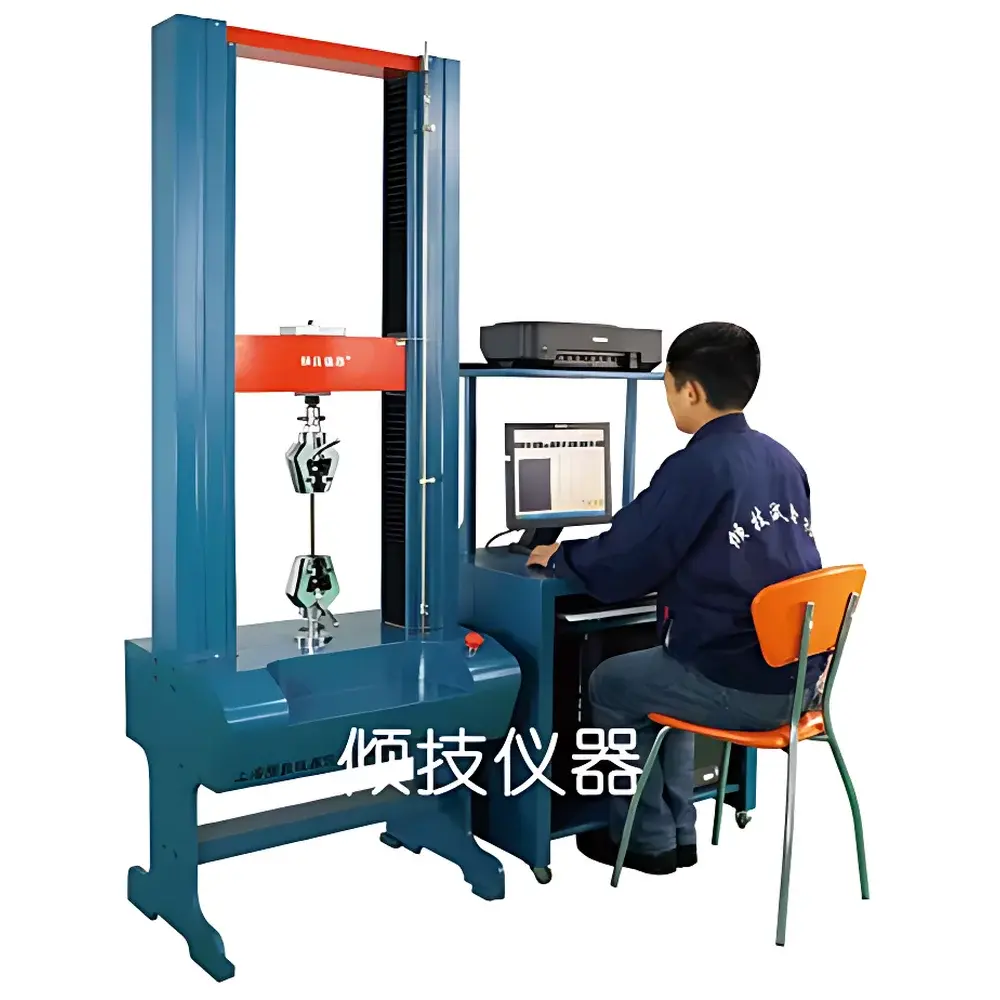
QJ211 Universal Testing Machine by Qingji
| Brand | Qingji |
|---|---|
| Model | QJ211 |
| Type | Electromechanical Universal Testing Machine |
| Maximum Load Capacity | 30 kN |
| Load Accuracy | ±0.5% of reading |
| Effective Test Width | 420 mm |
| Effective Test Height (without fixtures) | 800 mm |
| Crosshead Speed Range | 0.001–500 mm/min |
| Speed Accuracy | ±0.5% of set value |
| Displacement Measurement Accuracy | ±0.5% of reading |
| Strain/Deformation Measurement Accuracy | ±0.5% of reading |
| Force Resolution | 300,000 counts (full-scale, single-range, no auto-ranging) |
| Overload Protection | Activates at >110% of full scale |
| Motor Power | 750 W |
| Dimensions (W×D×H) | 700 × 420 × 1600 mm |
| Weight | 145 kg |
| Compliance | ISO 7500-1, ASTM E4, ASTM E8/E21, GB/T 228.1 |
Overview
The QJ211 Universal Testing Machine by Qingji is an electromechanical static testing system engineered for precision mechanical property characterization of metallic, polymeric, composite, and elastomeric materials. It operates on the principle of controlled uniaxial force application—via a high-stiffness load frame, servo-controlled AC motor, and precision ball-screw actuation—to measure tensile strength, yield point, elongation at break, compressive modulus, flexural performance, tear resistance, and cyclic fatigue behavior under standardized loading conditions. Designed in accordance with international metrological requirements, the system meets ISO 7500-1 (Class 0.5 accuracy), ASTM E4 (verification of force-measuring systems), and ASTM E8/E21 (tensile testing of metals and high-temperature alloys). Its rigid structural architecture minimizes deflection under load, ensuring high reproducibility across repeated tests and long-term stability during routine QC/QA operations in manufacturing labs and R&D facilities.
Key Features
- High-accuracy dual-channel closed-loop control: Simultaneous real-time regulation of load, displacement, and strain via digital PID algorithms.
- Full-scale force resolution of 300,000 counts without range switching—maintaining consistent resolution from 0.001% to 100% of 30 kN capacity.
- Adjustable crosshead speed from 0.001 to 500 mm/min, with traceable calibration against NIST-traceable standards; speed accuracy maintained within ±0.5% of setpoint.
- Integrated electronic limit switches and software-based overload protection (triggered at 110% of full scale) ensure operational safety and equipment integrity.
- Motorized crosshead with dual-speed jog control (fast/slow) and programmable return-to-start functionality—enabling rapid setup and post-test recovery.
- Modular fixture interface compliant with ISO 26203 and ASTM E1012 standards, supporting standardized grips for tensile bars, sheet specimens, wire, film, and custom geometries.
Sample Compatibility & Compliance
The QJ211 accommodates specimens up to 420 mm wide and 800 mm tall (excluding grip height), making it suitable for standard test coupons per ASTM D638 (plastics), ASTM D412 (elastomers), ISO 6892-1 (metals), and ISO 178 (flexural testing). Optional extensometers—including clip-on, video, and non-contact laser types—enable direct strain measurement per ISO 9513 (class 1 or 0.5). All hardware and firmware comply with electromagnetic compatibility (EMC) directives (IEC 61326-1) and low-voltage safety standards (IEC 61000-6-2/6-4). The system supports audit-ready operation under GLP/GMP environments when paired with validated software modules meeting FDA 21 CFR Part 11 requirements for electronic records and signatures.
Software & Data Management
Control and analysis are executed via Windows-based proprietary software featuring real-time dynamic curve visualization (load vs. displacement, stress vs. strain, cyclic hysteresis loops). Data acquisition occurs at ≥1 kHz sampling rate, with timestamped metadata embedded per test. Users may perform post-test operations including curve overlay, differential analysis, automatic yield point detection (0.2% offset method), modulus calculation (tangent/secant), and statistical reporting (mean, SD, CV%). Export formats include CSV, XLSX, PDF, and XML—compatible with LIMS integration and third-party analytics platforms. Raw data files are digitally signed and version-locked to prevent unauthorized modification, fulfilling traceability requirements for ISO/IEC 17025-accredited laboratories.
Applications
- Tensile and compressive testing of structural alloys, stainless steels, aluminum extrusions, and titanium grades per ASTM E8/E9.
- Mechanical evaluation of thermoplastics, thermosets, and fiber-reinforced composites per ISO 527 and ASTM D3039.
- Fatigue life assessment under low-amplitude, high-cycle conditions using programmable sinusoidal or block-loading profiles.
- Adhesion strength testing of coated substrates, laminates, and bonded joints via peel or shear configurations.
- Quality conformance verification for medical device components (e.g., suture threads, catheter tubing) aligned with ISO 10993-12 and USP .
- Educational use in materials science curricula for hands-on instruction in Hooke’s law, necking behavior, fracture mechanics, and viscoelastic modeling.
FAQ
What standards does the QJ211 comply with for force calibration?
The system conforms to ISO 7500-1 Class 0.5 and ASTM E4 for verification of force-measuring instruments; annual recalibration is recommended using certified reference load cells.
Can the machine be integrated into an existing laboratory network?
Yes—it supports TCP/IP communication, OPC UA server configuration, and RESTful API endpoints for seamless integration with MES, SCADA, or enterprise QA databases.
Is third-party validation support available for 21 CFR Part 11 compliance?
Qingji provides IQ/OQ documentation templates and on-site validation assistance through authorized partners accredited to ISO/IEC 17025.
What maintenance intervals are recommended for optimal performance?
Lubrication of the ball screw and inspection of load cell mounting bolts are advised every 6 months; annual verification of encoder linearity and amplifier gain drift is required.
Are custom fixtures supplied with installation or separately quoted?
Standard wedge-action tensile grips are included; application-specific fixtures (e.g., compression platens, bend jigs, pneumatic clamps) are quoted separately based on dimensional and material specifications.



