
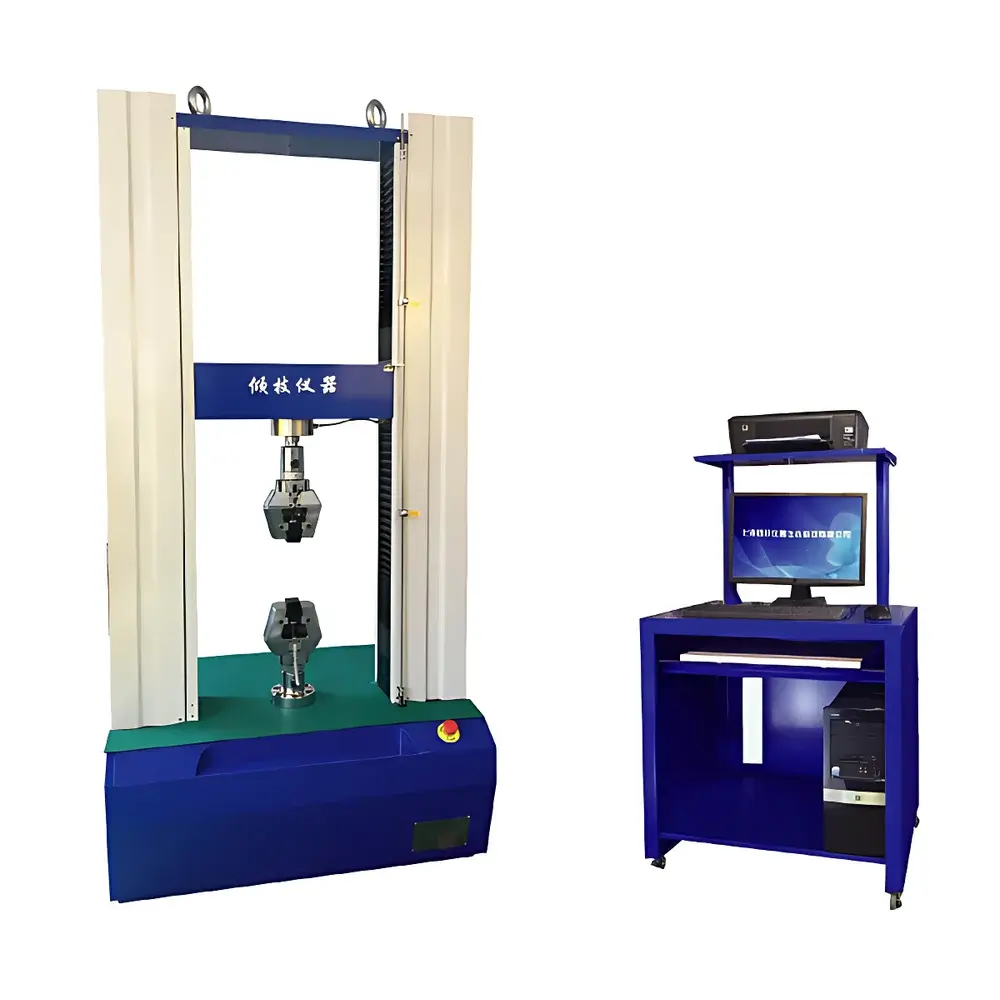
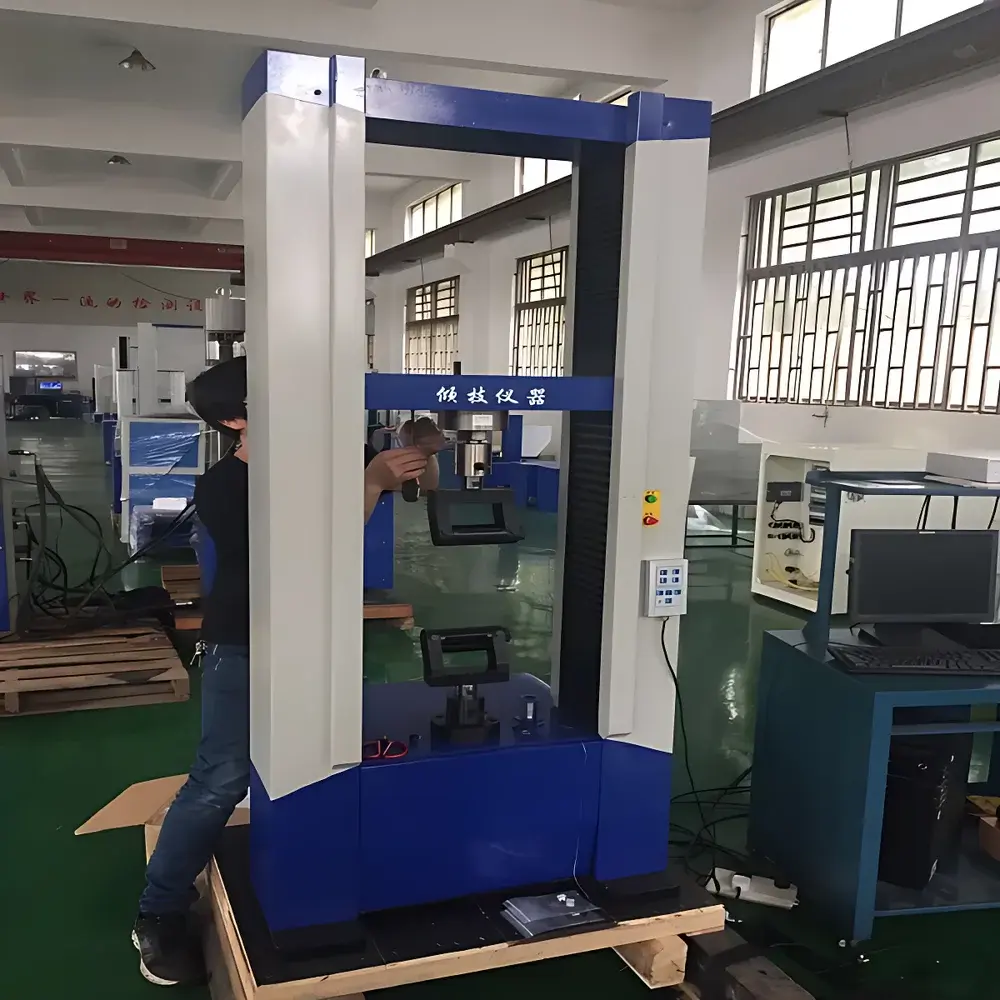
QJ211 Universal Testing Machine for Resin Flexural Strength and Multimode Mechanical Characterization
| Origin | Shanghai, China |
|---|---|
| Manufacturer Type | Authorized Distributor |
| Origin Category | Domestic (China) |
| Model | QJ211 |
| Price | USD 9,500 (FOB Shanghai) |
| Max Torque | ±90° |
| Torque Measurement Range | 0–9999 units |
| Torque Resolution Rate | 60 readings/min |
| Torsional Angle Range | ±15° ±1° (bidirectional) |
| Motor Power | 150 W |
| Load Capacity | 30 kN |
| Force Accuracy | ±0.5% of reading |
| Effective Test Width | 420 mm |
| Vertical Test Space | 800 mm (excluding fixtures) |
| Speed Range | 0.001–500 mm/min |
| Speed Accuracy | ±0.5% of set value |
| Displacement Accuracy | ±0.5% of reading |
| Deformation Measurement Accuracy | ±0.5% of reading |
| Drive Motor | 750 W AC servo motor |
| Dimensions (W×D×H) | 700 × 420 × 1600 mm |
| Weight | 145 kg |
Overview
The QJ211 Universal Testing Machine is an electromechanical static testing system engineered for high-reproducibility mechanical characterization of thermosetting and thermoplastic resins, composites, and polymer-based structural materials. While commonly referenced for flexural strength evaluation per ASTM D790 and ISO 178, its modular architecture supports full multimode mechanical testing—including tensile (ASTM D638), compression (ASTM D695), shear (ASTM D5379), tear (ASTM D624), and torsional deformation (ASTM D5279)—within a single platform. The system employs closed-loop servo control with a 750 W AC servo motor and precision ball-screw actuation, delivering stable force application across the full 30 kN load capacity. Force transduction utilizes a high-stability load cell calibrated to ISO 7500-1 Class 0.5, ensuring traceable accuracy of ±0.5% of reading throughout the 0–20 kN effective measurement range. All motion and data acquisition are synchronized via a real-time embedded controller interfaced with Windows-based software, enabling deterministic test sequencing and sub-millisecond timestamping.
Key Features
- Modular fixture interface supporting standardized grips for flexure (3-point/4-point), tensile, compression, peel, and torsion—custom fixtures available per ISO 26203 and customer-defined geometry.
- High-resolution displacement sensing with optical encoder feedback, achieving ±0.5% accuracy over 800 mm vertical travel (fixture-excluded).
- Programmable speed control from 0.001 to 500 mm/min, with rate stability maintained within ±0.5% of setpoint under dynamic loading conditions.
- Dual-mode operation: manual jog control for fixture alignment and automated test execution with programmable hold, ramp, and cycle profiles.
- Integrated safety architecture including electronic limit switches, overload cutoff (>110% of full scale), and emergency stop compliant with IEC 60204-1.
- Robust frame construction (145 kg mass) with rigid C-frame design minimizing deflection during high-load flexural tests on brittle resin specimens.
Sample Compatibility & Compliance
The QJ211 accommodates standard resin test specimens per ASTM D790 (rectangular bars: 127 × 12.7 × 3.2 mm) and ISO 178 (80 × 10 × 4 mm), as well as non-standard geometries up to 420 mm wide and 800 mm tall. It supports both unreinforced thermosets (e.g., epoxy, phenolic) and fiber-reinforced composites (e.g., carbon/epoxy laminates). All calibration procedures align with ISO/IEC 17025 requirements for testing laboratories. Force and displacement measurements are traceable to national standards (CNAS-accredited calibration certificates available). The system meets electromagnetic compatibility (EMC) requirements per EN 61326-1 and safety directives under CE Machinery Directive 2006/42/EC.
Software & Data Management
The bundled Windows-native software provides real-time graphical display of force–displacement, stress–strain, torque–angle, and time-series curves. Users may perform post-test operations including curve overlay, differential analysis, tangent modulus calculation, yield point detection (0.2% offset method), and fracture energy integration. Raw data exports to CSV, Excel, and XML formats support LIMS integration. Audit trails record operator ID, test parameters, calibration events, and result modifications—fully compliant with FDA 21 CFR Part 11 when configured with user authentication and electronic signature modules. Software updates and firmware patches are delivered via secure HTTPS portal with version-controlled release notes.
Applications
- Flexural property validation of casting resins used in electrical insulation and encapsulation.
- Mechanical screening of UV-curable acrylates and dental composite resins per ISO 4049.
- Quality control of prepreg layup systems in aerospace-grade carbon-fiber manufacturing.
- Comparative aging studies (thermal/UV/humidity exposure) tracking modulus degradation in polyurethane binders.
- R&D-level investigation of toughening mechanisms in nanofilled epoxy matrices via controlled three-point bending with acoustic emission coupling.
- ISO 10365-compliant fatigue testing of resin joints under cyclic bending loads (R = 0.1, 10⁴–10⁶ cycles).
FAQ
Does the QJ211 comply with ASTM D790 for flexural testing of rigid plastics?
Yes—the system meets all hardware and procedural requirements specified in ASTM D790-23, including support span-to-depth ratio control, crosshead speed tolerance, and deflection measurement resolution.
Can the machine perform simultaneous force and torsion measurements?
No—it operates in uniaxial force or rotational torque mode; dual-axis concurrent measurement requires a dedicated biaxial testing system.
Is GLP-compliant data archiving supported out of the box?
Basic audit logging is included; full GLP compliance (electronic signatures, role-based access, 21 CFR Part 11 validation package) requires optional software module activation and site-specific IQ/OQ documentation.
What is the recommended recalibration interval for the load cell?
Annual recalibration is advised per ISO/IEC 17025; however, frequency should be adjusted based on usage intensity and internal quality protocols.
Are replacement parts and service support available outside China?
Yes—global distributor network provides spare load cells, grips, and servo drives with lead times under 4 weeks; remote diagnostics and on-site technician dispatch available under extended service agreements.



