
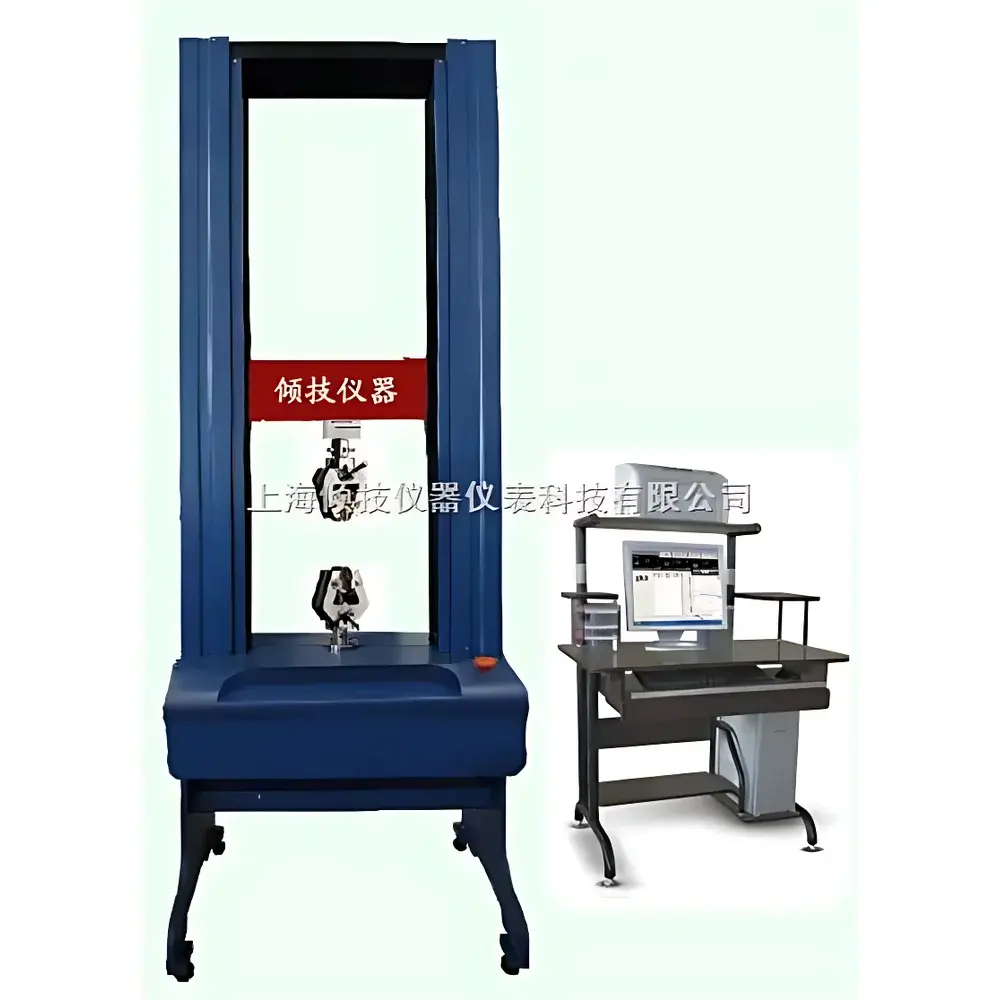
QJ211 Universal Testing Machine for Wood Parallel-to-Grain Shear Strength
| Brand | Qinsy |
|---|---|
| Origin | Shanghai, China |
| Model | QJ211 |
| Maximum Load Capacity | 30 kN |
| Load Cell Accuracy | ±0.5% |
| Measurement Accuracy | < ±0.5% |
| Control System | Full Digital Display |
| Effective Test Width | ~420 mm |
| Effective Stroke | ~800 mm |
| Test Speed Range | 0.01–500 mm/min |
| Speed Accuracy | ±0.5% |
| Stroke Accuracy | ±0.5% |
| Displacement Accuracy | ±0.5% |
| Safety Features | Electronic Limit Switches, Emergency Stop Button |
| Unit Weight | ~2650 kg |
Overview
The QJ211 Universal Testing Machine is an electromechanical force-testing system engineered for precise mechanical characterization of wood and other structural biomaterials under static and quasi-static loading conditions. Specifically configured for parallel-to-grain shear strength evaluation—per ASTM D143, ISO 3130, and EN 338—the instrument applies controlled uniaxial tension, compression, bending, shear, peel, tear, and puncture loads to standardized specimens. Its dual-column rigid frame and high-stiffness crosshead assembly ensure minimal deflection during high-load testing (up to 30 kN), enabling reproducible stress–strain curve acquisition. The machine operates on closed-loop servo-controlled displacement actuation, with real-time load and displacement feedback from a calibrated S-type load cell and linear encoder. All test parameters—including rate, hold time, and trigger thresholds—are programmable via the integrated digital controller, supporting both manual operation and pre-defined test protocols.
Key Features
- High-capacity load frame rated for 30 kN maximum force, with optional calibration ranges covering 1%, 2%, 5%, 10%, 20%, 50%, and 100% of full scale
- Load cell accuracy compliant with ISO 7500-1 Class 0.5, ensuring traceable force measurement across the entire dynamic range
- Test speed continuously adjustable from 0.01 to 500 mm/min, with speed stability maintained within ±0.5% of setpoint per ISO 5893
- Digital display control interface with dynamic real-time plotting of load vs. displacement, enabling immediate identification of yield point, peak load, and failure mode
- Robust safety architecture including dual-channel electronic limit switches, hardware-based emergency stop circuitry, and stroke safeguard logic to prevent over-travel damage
- Structural rigidity optimized for low compliance (< 0.05 mm/kN), minimizing frame deformation effects during high-force shear tests on dense hardwood specimens
Sample Compatibility & Compliance
The QJ211 accommodates standard wood test specimens defined in ASTM D143 (small clear specimens), ISO 3130 (density and moisture content–adjusted dimensions), and GB/T 1931–2009 (Chinese national standard for wood physical and mechanical testing). Specimen geometries include 20 mm × 20 mm × 300 mm prisms for longitudinal shear, as well as custom-designed double-lap shear fixtures conforming to ASTM D905. The system supports interchangeable grips and fixtures—such as wedge-action tensile grips, compression platens, three-point bending assemblies, and dedicated parallel-to-grain shear jigs—enabling seamless transition between test modes without recalibration. All test procedures and data reporting comply with GLP principles; raw test files retain audit trails of operator ID, timestamp, environmental conditions (if externally logged), and calibration status—supporting FDA 21 CFR Part 11 readiness when paired with validated software extensions.
Software & Data Management
While the base configuration features embedded microcontroller-based digital control with local LCD display, the QJ211 is compatible with optional PC-based data acquisition software (sold separately) that enables advanced post-test analysis, statistical reporting, and export to CSV, Excel, or PDF formats. Software modules support automatic calculation of shear strength (MPa), modulus of elasticity in shear (G), proportional limit, and energy absorption up to failure. Data integrity safeguards include write-once file generation, user-level access controls, and electronic signature capture for critical test records. Calibration certificates are digitally linked to each load cell serial number and remain embedded in exported datasets, fulfilling traceability requirements per ISO/IEC 17025 and CNAS accreditation criteria.
Applications
- Determination of parallel-to-grain shear strength in solid timber, laminated veneer lumber (LVL), and cross-laminated timber (CLT) panels
- Quality assurance testing of adhesive bonds in finger-jointed wood elements per ASTM D5266
- Mechanical screening of modified wood species (e.g., acetylated or thermally treated) for shear performance degradation
- Research-grade evaluation of orthotropic behavior in anisotropic wood composites under combined loading configurations
- Validation of finite element models used in structural timber design software (e.g., RFEM, Timber Design add-ons)
- Compliance verification for CE-marked construction products under EN 14080 and EN 1194
FAQ
What standards does the QJ211 support for wood shear testing?
ASTM D143, ISO 3130, EN 338, GB/T 1931–2009, and JIS Z 2101.
Can the machine perform both tensile and shear tests on the same specimen setup?
No—shear testing requires dedicated fixtures (e.g., double-lap or rail shear configurations); tensile tests use axial grips. Fixture interchange is tool-free and takes under 5 minutes.
Is third-party calibration certification included with delivery?
A factory calibration report traceable to NIM (China National Institute of Metrology) is provided; ISO/IEC 17025-accredited field calibration is available upon request.
What maintenance intervals are recommended for long-term accuracy?
Load cell verification every 12 months; lubrication of lead screws and alignment check of crosshead guides every 6 months; routine inspection of emergency stop functionality before each test session.
Does the system meet electromagnetic compatibility (EMC) requirements for laboratory environments?
Yes—compliant with IEC 61326-1:2013 for industrial laboratory use, including immunity to electrostatic discharge (ESD), radiated RF fields, and fast transient bursts.



