
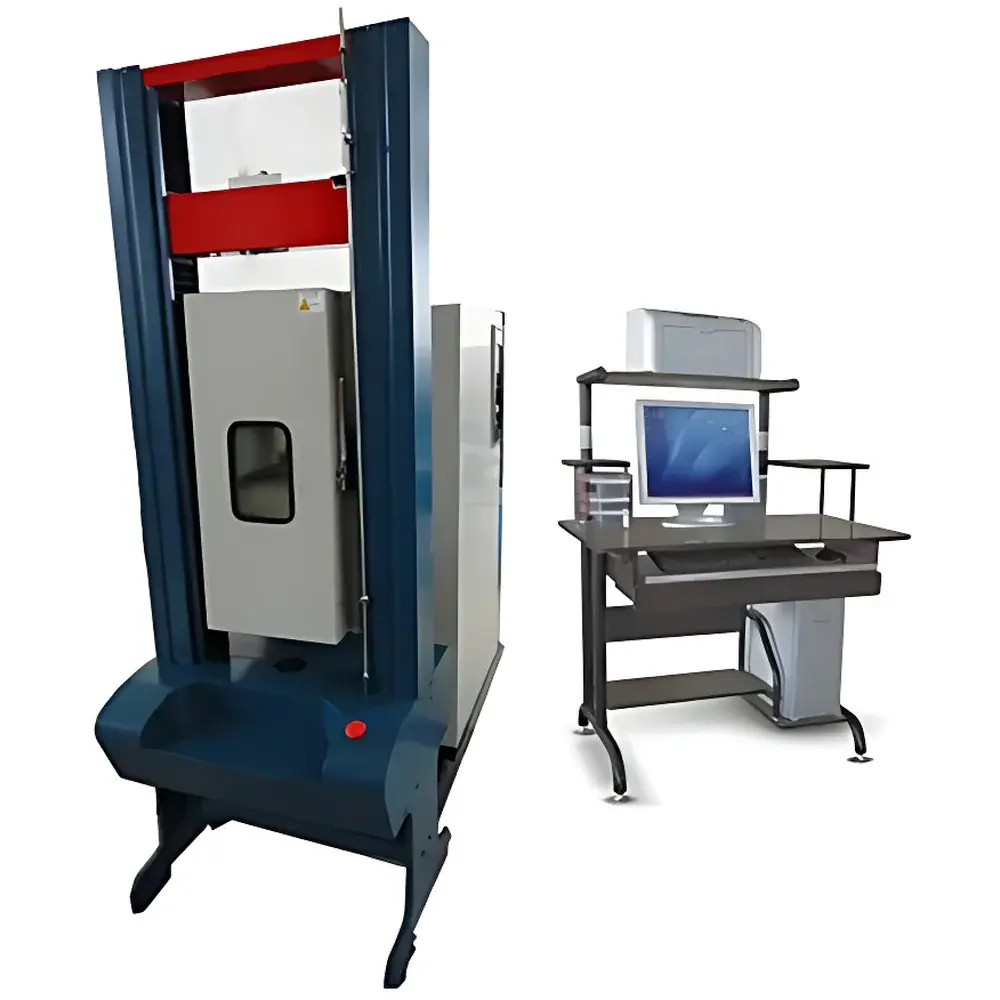
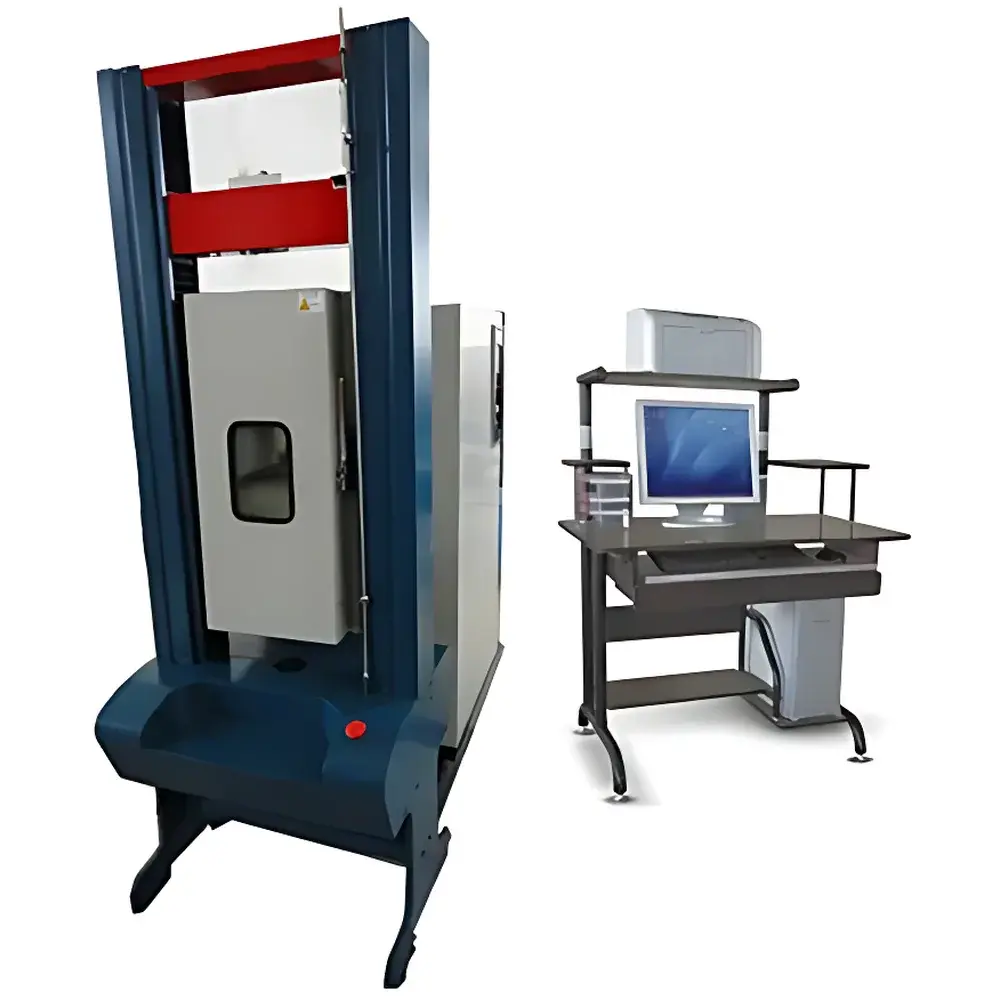
QJ211B Closed-Loop Tensile Testing Machine
| Origin | Shanghai, China |
|---|---|
| Manufacturer Type | Authorized Distributor |
| Origin Category | Domestic (PRC) |
| Model | QJ211B |
| Instrument Type | Electromechanical Tensile Tester |
| Max Test Load | 30 kN |
| Load Measurement Range | Full Scale (FS) |
| Load Accuracy | ±1% FS |
| Travel Range | 1 mm |
| Displacement Resolution | 1 mm |
| Temperature Range | –60 °C to +300 °C (within uniform zone) |
| Temperature Ramp Rate | ≥5 °C/min |
| Temperature Controller Resolution | 0.1 °C |
| Load Cell Accuracy | ±0.01% FS |
| Overall System Test Accuracy | ≤±0.5% FS |
| Effective Width | 420 mm |
| Effective Test Length | ~800 mm (extendable) |
| Test Speed Range | 0.001–500 mm/min (standard) |
| Control Mode | Dual-mode — PC-based closed-loop control + digital panel operation |
Overview
The QJ211B Closed-Loop Tensile Testing Machine is an electromechanical universal testing system engineered for high-fidelity mechanical property characterization of metallic, polymeric, composite, elastomeric, and textile materials under controlled thermal conditions. It operates on a servo-controlled load frame with real-time feedback via high-stability load cells and precision linear encoders, enabling true closed-loop displacement, load, and strain control per ASTM E4, ISO 7500-1, and GB/T 228.1 standards. The system integrates seamlessly with optional environmental chambers—capable of maintaining stable temperatures from –60 °C to +300 °C within the uniform test zone—allowing users to conduct tensile, peel, tear, compression, flexural, shear, puncture, and low-cycle fatigue tests across defined thermal profiles. When ambient-temperature testing is required, the chamber may be physically detached to maximize workspace and simplify setup for routine QA/QC or R&D applications.
Key Features
- Robust dual-mode control architecture: full PC-based closed-loop operation with redundant digital panel interface for manual override and rapid diagnostics
- High-resolution force measurement: 30 kN capacity load cell calibrated to ±0.01% full-scale accuracy, traceable to national metrology standards
- Precision motion control: servo-driven crosshead with adjustable speed range (0.001–500 mm/min), programmable acceleration/deceleration profiles, and position repeatability ≤±0.02 mm
- Thermally integrated design: chamber-mounting interface compliant with ISO 11357 and ASTM D618; uniformity ±1.5 °C across active test volume at steady state
- Comprehensive safety architecture: dual-stage overload protection (software-limited torque cutoff + hardware mechanical stop), emergency stop button meeting IEC 60204-1, and programmable travel limits with hardware interlock
- Modular extensibility: supports optional video extensometers, pneumatic grips, hydraulic wedge clamps, and high-temperature furnaces up to 1000 °C (via third-party integration)
Sample Compatibility & Compliance
The QJ211B accommodates standard specimen geometries per ASTM E8/E8M (tensile bars), ASTM D882 (thin films), ISO 527-2 (plastics), and GB/T 1040.1–1040.5 (Chinese national standards). Grip options include screw-action, pneumatic, and hydraulic configurations, supporting flat, round, and irregular cross-sections up to 420 mm wide and 800 mm effective gauge length (extendable upon request). All firmware and data acquisition modules comply with GLP/GMP documentation requirements, including audit-trail-enabled user authentication, electronic signature support, and timestamped raw data logging. The system meets electromagnetic compatibility (EMC) per EN 61326-1 and safety certification per EN 61000-6-2/6-4.
Software & Data Management
Control and analysis are performed using proprietary Windows-based software compliant with FDA 21 CFR Part 11 (electronic records and signatures). The platform provides real-time graphical display of stress–strain, load–displacement, and time-based curves; automated calculation of yield strength, ultimate tensile strength, elongation at break, modulus, and Poisson’s ratio; and export to CSV, PDF, and XML formats. All test parameters—including temperature setpoints, ramp rates, hold durations, and control loops—are stored with metadata (operator ID, timestamp, instrument serial number) in an encrypted SQLite database. Backups are configurable via network share or external SSD, and historical data retrieval supports multi-criteria filtering by material type, standard, date range, or test ID.
Applications
- Quality assurance of structural alloys, aerospace composites, and medical-grade polymers under thermal cycling
- Validation of adhesive bond strength (peel, lap shear) per ASTM D1876 and ISO 4577
- Mechanical aging studies of elastomers and thermoplastic vulcanizates (TPVs) at elevated temperatures
- Low-cycle fatigue characterization of battery electrode foils and flexible printed circuit substrates
- Regulatory submission testing for ISO 10993 biocompatibility assessments requiring mechanical integrity verification
- Research into creep behavior and viscoelastic relaxation of shape-memory polymers between –40 °C and +120 °C
FAQ
What international standards does the QJ211B support out-of-the-box?
The system includes preloaded test methods for ASTM E8, ISO 6892-1, GB/T 228.1, JIS Z 2241, and DIN 50125, with calibration certificates traceable to CNAS-accredited laboratories.
Can the system operate without the environmental chamber?
Yes—the chamber mounts via standardized flange interfaces and can be removed to increase vertical clearance and simplify ambient-temperature testing workflows.
Is the software validated for regulated environments?
Yes—software validation documentation (IQ/OQ/PQ protocols), Part 11 compliance reports, and change control logs are provided with each installation.
What maintenance is required during the first year of operation?
Routine calibration verification every 6 months is recommended; load cell recalibration and encoder alignment are included in the standard one-year warranty service plan.
Are third-party extensometers supported?
The system features analog and digital input channels compatible with ASTM E83-compliant video and clip-on extensometers from major OEMs (e.g., MTS, Instron, ZwickRoell).



