
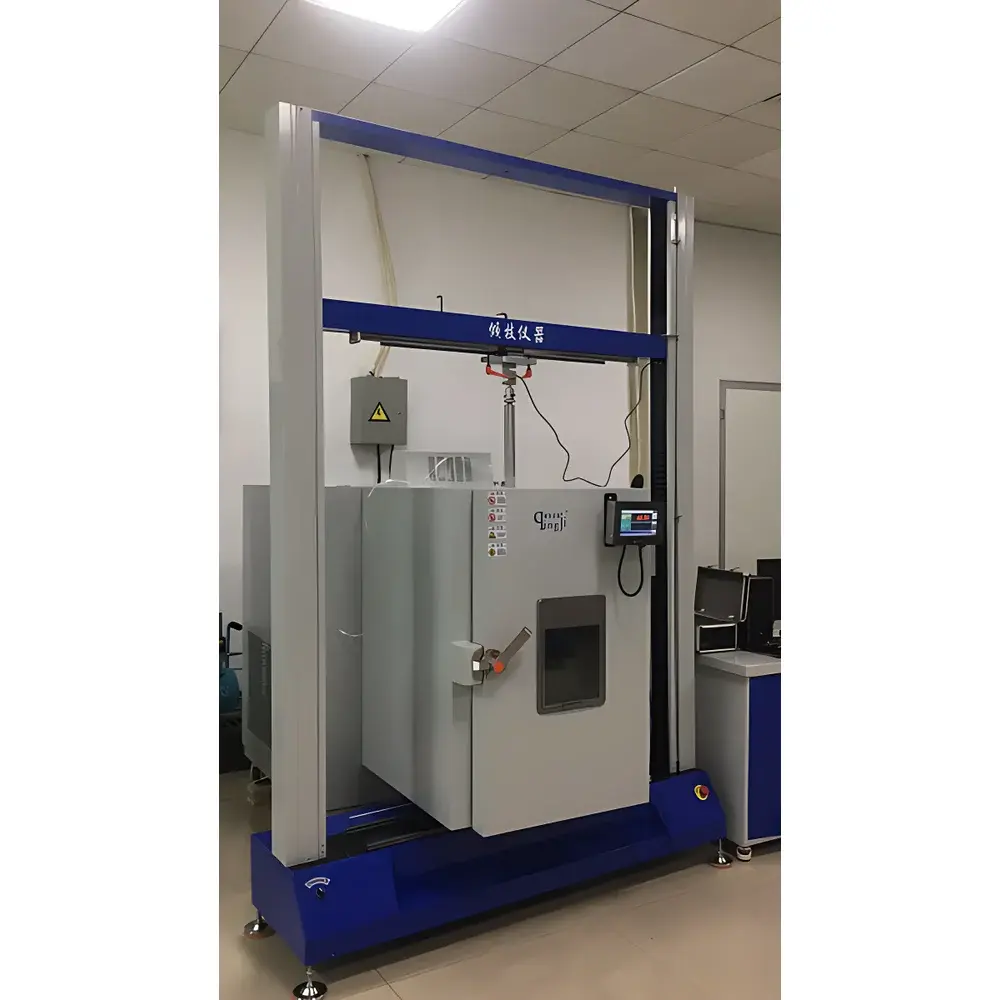
QJ211B High-Low Temperature Electronic Universal Testing Machine
| Key | Origin: Shanghai, China |
|---|---|
| Manufacturer Type | Authorized Distributor |
| Country of Origin | China |
| Model | QJ211B |
| Max Test Load | 30 kN |
| Load Range | 0–30 kN (adjustable) |
| Load Accuracy | ±1% or ±0.5% FS |
| Stroke | 420 mm |
| Displacement Resolution | 0.001 mm |
| Temperature Range | –7 °C to +350 °C (isothermal capability at 350 °C) |
| Heating/Cooling Rate | ≥5 °C/min |
| Temp. Controller Resolution | 0.1 °C |
| Crosshead Speed | 0.01–500 mm/min (optional up to 1000 mm/min) |
| Speed Accuracy | ±0.5% |
| Displacement Measurement Accuracy | ±0.5% FS |
| Strain Measurement Accuracy | ±0.5% FS |
| Safety Features | Electronic travel limit protection, emergency stop button |
| Weight | 265 kg |
Overview
The QJ211B High-Low Temperature Electronic Universal Testing Machine is an integrated electromechanical system engineered for precision mechanical property evaluation of metallic, polymeric, composite, and architectural materials—particularly thermally sensitive specimens such as insulating aluminum profiles—under controlled thermal environments. It operates on the principle of servo-controlled uniaxial force application, compliant with fundamental standards of ISO 7500-1 (static calibration of force-measuring systems) and ASTM E4 (load verification of testing machines). The system couples a high-rigidity dual-column frame with a programmable temperature chamber (–7 °C to +350 °C), enabling real-time tensile, compression, flexural, shear, peel, tear, torsion, and low-cycle fatigue testing across defined thermal states. Unlike ambient-only testers, the QJ211B supports isothermal hold, ramp-and-hold, and step-temperature protocols—critical for simulating service conditions in building envelope components, aerospace alloys, and polymer-based thermal barriers.
Key Features
- Modular thermal chamber design: Removable high-temperature furnace assembly allows rapid reconfiguration for ambient-only testing, maximizing lab flexibility and workspace utilization.
- High-fidelity load measurement: Dual-range load cell with 0.01% linearity and optional ±0.5% full-scale accuracy, traceable to national metrological standards.
- Precision motion control: Servo-motor-driven crosshead with closed-loop feedback, delivering speed stability within ±0.5% across the full 0.01–500 mm/min range (extendable to 1000 mm/min upon request).
- Sub-micron displacement resolution: Encoder-based position sensing with 0.001 mm resolution and ±0.5% FS repeatability—essential for small-strain modulus determination and yield point detection.
- Thermal performance validation: Chamber calibrated per ASTM E220 and ISO 17025-compliant procedures; temperature uniformity ≤±2 °C across 100 mm³ test volume at 350 °C.
- Dual-mode operation: Supports both PC-based automated testing (via Windows-native software) and manual digital panel control—ensuring operational continuity during software maintenance or training phases.
- Comprehensive safety architecture: Redundant hardware interlocks including electronic stroke limits, emergency stop circuitry meeting IEC 60204-1, and over-travel mechanical buffers.
Sample Compatibility & Compliance
The QJ211B accommodates standard specimen geometries per ISO 6892-1 (tensile), ISO 14125 (flexure), ASTM D638 (plastics), and EN 13830 (curtain wall aluminum profiles). Its 420 mm effective width and ~800 mm vertical test space (expandable) support custom fixtures for peel (ASTM D903), shear (ISO 14130), and torsional loading. Thermal chamber integration complies with ASTM D5229/D5229M for elevated-temperature mechanical testing and meets essential requirements of GB/T 28289–2012 (insulating aluminum profiles). Data acquisition and reporting are structured to support GLP/GMP-aligned workflows, including audit trails, user access levels, and electronic signature readiness per FDA 21 CFR Part 11 when paired with validated software modules.
Software & Data Management
The system ships with proprietary Windows-based control and analysis software supporting multi-channel synchronized acquisition (load, displacement, temperature, strain via extensometer input). Raw data is stored in vendor-neutral CSV and XML formats; stress–strain curves, modulus calculations (secant, tangent, chord), and statistical summaries (mean, SD, CV%) are auto-generated per ISO 527-2 and ASTM D3039. Software includes built-in report templates compliant with ISO/IEC 17025 documentation requirements, with optional PDF export featuring embedded metadata (operator ID, calibration date, environmental logs). All test sequences are fully scriptable and repeatable—enabling standardized qualification protocols for material release or supplier audits.
Applications
- Mechanical characterization of thermally broken aluminum window and curtain wall profiles per EN 13830 and GB/T 28289.
- Evaluation of polymer matrix composites under simulated service temperatures (e.g., automotive under-hood components).
- Creep and stress relaxation testing of elastomeric gaskets and sealants between –10 °C and +120 °C.
- Validation of brazed or welded joints in heat-exchanger tubing across thermal cycling profiles.
- Quality assurance of structural adhesives used in aerospace bonding applications (ASTM D1002, D3163).
- Research into temperature-dependent yield behavior of shape-memory alloys and high-entropy metals.
FAQ
What temperature uniformity can be expected inside the chamber at 350 °C?
At 350 °C isothermal condition, temperature deviation across the central 100 mm × 100 mm × 100 mm test volume is ≤±2 °C, verified per ASTM E220 Annex A4.
Is the load cell calibrated independently of the thermal chamber?
Yes—load cell calibration is performed at ambient temperature prior to chamber installation; thermal drift compensation is applied algorithmically during high-temperature tests using embedded thermistor feedback.
Can the system interface with third-party extensometers?
The controller provides analog ±10 V and digital LVDT/TTL inputs compatible with industry-standard contact and non-contact extensometers (e.g., MTS 632, Zwick Roell XLC series).
Does the software support automated compliance with ISO 17025 record-keeping?
Yes—the software generates timestamped, tamper-evident test logs with operator authentication, instrument calibration status, environmental parameters, and raw data checksums—all required for ISO/IEC 17025 accreditation.
What maintenance intervals are recommended for long-term accuracy retention?
Biannual verification of load cell linearity and displacement encoder resolution is advised; annual thermal chamber sensor recalibration against NIST-traceable references is recommended for critical applications.



