
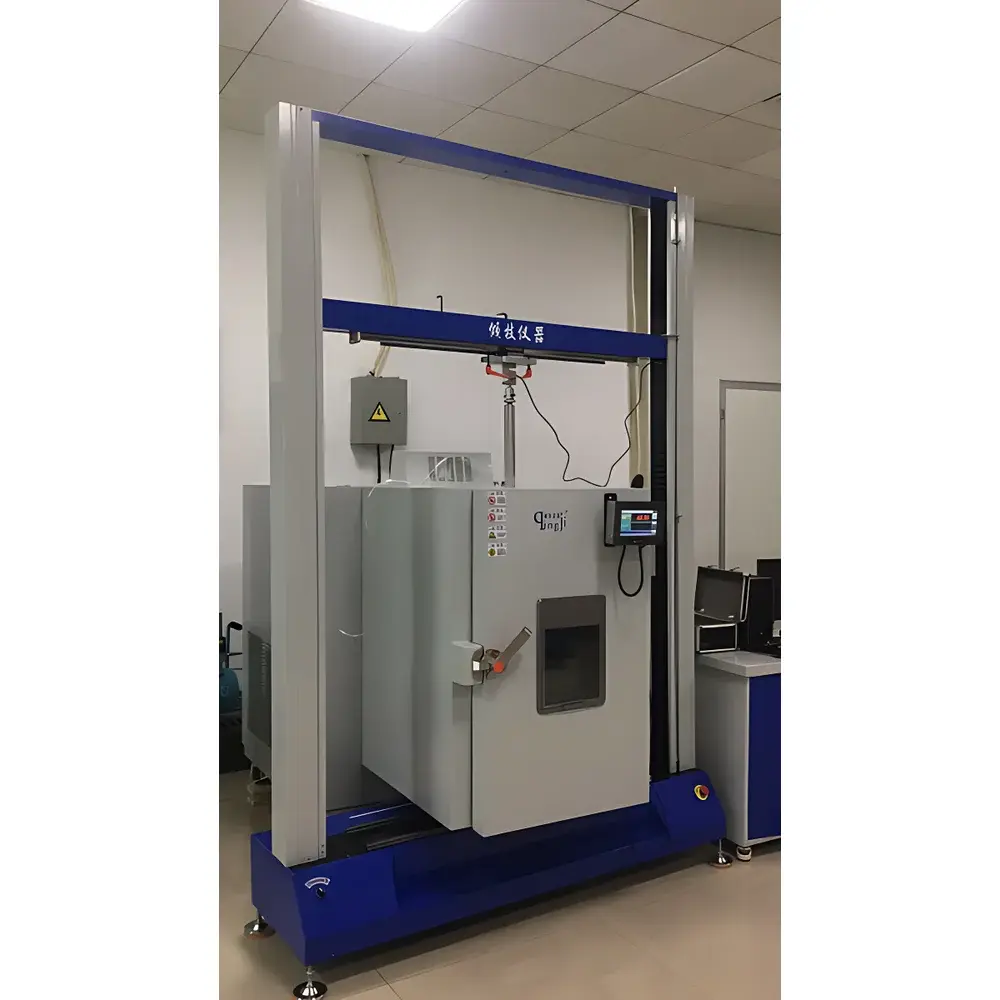
QJ211B High-Low Temperature Universal Testing Machine
| Origin | Shanghai, China |
|---|---|
| Manufacturer Type | Authorized Distributor |
| Origin Category | Domestic (PRC) |
| Model | QJ211B |
| Instrument Type | Electromechanical Universal Testing Machine |
| Load Capacity | 0–30 kN |
| Temperature Range | −70 °C to +350 °C (isothermal at 350 °C) |
| Heating/Cooling Rate | ≥5 °C/min |
| Temperature Controller Resolution | 0.1 °C |
| Effective Test Width | 420 mm |
| Effective Stroke | ~800 mm (extendable) |
| Test Speed Range | 0.001–500 mm/min (up to 1000 mm travel) |
| Speed Accuracy | ±0.5% |
| Load Cell Accuracy | 0.01% FS |
| Measurement Accuracy (Load/Displacement/Strain) | ±0.5% |
| Safety Features | Electronic travel limit switches, emergency stop circuit |
| Machine Weight | 135 kg |
Overview
The QJ211B High-Low Temperature Universal Testing Machine is an electromechanical materials testing system engineered for precise mechanical characterization of solids and composites under controlled thermal environments. It integrates a servo-controlled dual-column frame with a modular high-low temperature chamber—capable of sustained operation from −70 °C to +350 °C—to enable quasi-static and dynamic mechanical testing across extreme thermal conditions. The system operates on the principle of controlled displacement actuation with closed-loop load and position feedback, adhering to fundamental standards of force metrology (ISO 7500-1, ASTM E4). Its architecture supports uniaxial tensile, compressive, flexural, shear, peel, tear, puncture, and low-cycle fatigue tests—making it suitable for R&D labs, quality control departments, and certification bodies evaluating polymer blends, elastomers, aerospace composites, battery separator films, and high-performance ceramics.
Key Features
- Modular thermal chamber design: Removable chamber enables rapid reconfiguration for ambient-temperature testing, optimizing lab space utilization and workflow flexibility.
- High-fidelity load measurement: Precision load cell with 0.01% full-scale accuracy traceable to national standards; integrated digital signal conditioning eliminates analog drift.
- Thermal stability & control: PID-driven temperature regulation with 0.1 °C resolution and ≤±1.5 °C uniformity across chamber working volume at 350 °C isothermal hold.
- Dual-mode operation: Full PC-based control via proprietary test software with optional manual jog interface for setup verification and safety-critical alignment.
- Mechanical robustness: Heavy-duty cast-iron base and reinforced crosshead ensure minimal frame deflection (<0.02 mm/kN), critical for accurate modulus and yield point determination.
- Comprehensive safety architecture: Redundant electronic limit switches, hardware-triggered emergency stop, and software-enforced soft limits prevent overtravel and overload events.
Sample Compatibility & Compliance
The QJ211B accommodates standardized specimens per ISO 527, ASTM D638, ASTM D790, ISO 178, ISO 1133, and GB/T 1040 series—including dog-bone, rectangular, cylindrical, and thin-film geometries up to 420 mm wide and 800 mm gage length. Its thermal chamber accepts fixtures with cryogenic or high-temperature grips (e.g., hydraulic wedge, pneumatic clamps, or custom-designed jaws) without compromising thermal integrity. The system meets essential requirements of ISO 17025-accredited laboratories: all calibration certificates include uncertainty budgets per ISO/IEC 17025:2017 Annex A. It supports audit-ready documentation for GLP and GMP environments, including configurable electronic signatures and 21 CFR Part 11-compliant audit trails when paired with validated software modules.
Software & Data Management
The embedded Windows-based control platform provides real-time acquisition of load, displacement, strain (via extensometer input), and chamber temperature at up to 1 kHz sampling rate. Test methods are preconfigured per ASTM, ISO, and GB standards—including multi-step ramp-hold cycles, cyclic loading protocols, and creep/stress-relaxation sequences. Raw data exports in ASCII CSV and universal .tdms formats ensure compatibility with MATLAB, Python (NumPy/Pandas), and third-party statistical analysis tools. All test records are time-stamped, digitally signed, and stored with metadata (operator ID, environmental logs, calibration status), enabling full traceability required by regulatory submissions and internal quality audits.
Applications
- Evaluation of thermomechanical transitions in polymeric materials (e.g., glass transition temperature Tg, cold crystallization, heat distortion behavior).
- Characterization of interfacial adhesion strength in multilayer packaging films under sub-zero storage conditions.
- Mechanical aging studies of lithium-ion battery electrode coatings subjected to thermal cycling between −40 °C and +85 °C.
- Validation of composite material performance in aerospace primary structures per ASTM D3039 and MIL-STD-1797A.
- Creep compliance and stress relaxation modeling of biomedical hydrogels at physiological and hypothermic temperatures.
FAQ
Can the temperature chamber be used independently of the testing frame?
Yes—the chamber is mechanically and electrically decoupled and can be operated as a standalone environmental unit for non-mechanical thermal exposure tests.
Is the system compatible with extensometers for strain measurement?
Yes—both contact-type clip-on and non-contact video extensometers (with optional mounting brackets) are supported via analog voltage input and digital trigger synchronization.
What calibration documentation is provided upon delivery?
A factory calibration report with NIST-traceable load cell and encoder verification, temperature uniformity mapping at three setpoints (−40 °C, 23 °C, 200 °C), and uncertainty budgets per ISO/IEC 17025 is included.
Does the system support automated test sequence execution?
Yes—batch testing with programmable specimen identification, method selection, and pass/fail criteria based on user-defined thresholds is fully implemented.
What maintenance intervals are recommended for long-term accuracy retention?
Biannual verification of load cell linearity and temperature chamber uniformity is advised; annual recalibration is recommended for ISO 17025 compliance.



