
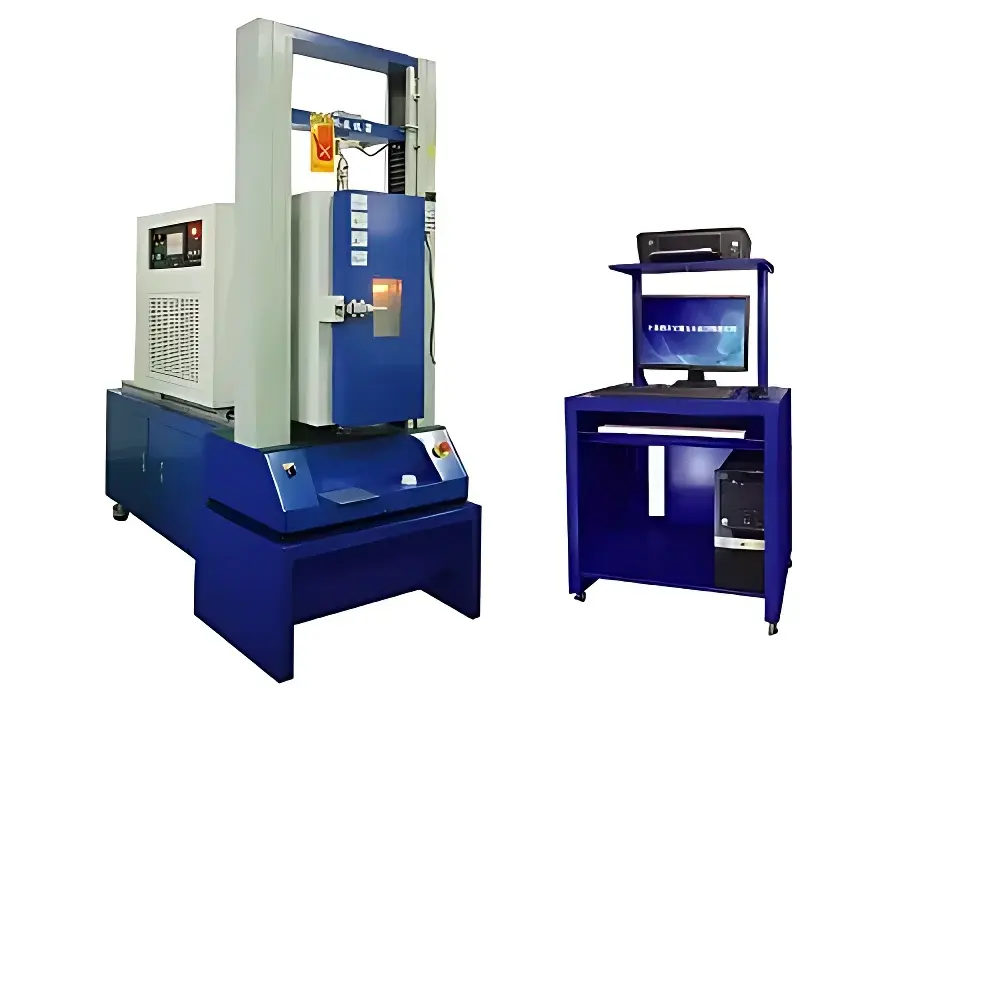
QJ211B High-Temperature & Low-Temperature Universal Material Testing Machine
| Origin | Shanghai, China |
|---|---|
| Manufacturer Type | Authorized Distributor |
| Origin Category | Domestic (PRC) |
| Model | QJ211B |
| Price | USD 16,800 (FOB Shanghai) |
| Instrument Type | Electromechanical Tensile Testing System |
| Max Test Load | 30 kN |
| Load Range | 0–30 kN (fully adjustable) |
| Force Accuracy Class | ISO 7500-1 Class 1 |
| Crosshead Travel | 420 mm |
| Displacement Resolution | ±0.5% of reading |
Overview
The QJ211B High-Temperature & Low-Temperature Universal Material Testing Machine is an electromechanical tensile testing system engineered for precision mechanical characterization of metallic, polymeric, composite, and ceramic materials across extreme thermal conditions. It integrates a high-stability servo-controlled actuation system with a modular environmental chamber capable of continuous operation from –7 °C to +350 °C (isothermal hold at 350 °C), enabling static and quasi-static mechanical testing—including tensile, compression, flexural, peel, tear, shear, puncture, and low-cycle fatigue—under thermally controlled environments. The system complies with fundamental mechanical testing principles defined in ISO 6892-1 (tensile testing of metals), ISO 527-1/2 (plastics), ASTM E8/E21 (metallic materials at elevated temperatures), and ASTM D638/D790 (polymer tensile/flexural behavior). Its dual-mode control architecture supports both full PC-based operation via dedicated test software and manual digital panel control, ensuring operational continuity during software maintenance or validation lock-downs.
Key Features
- Thermally integrated environmental chamber with rapid ramp rate ≥5 °C/min and temperature stability of ±1 °C at 350 °C (1-hour dwell); chamber removable for ambient-only testing to maximize workspace and simplify calibration workflows
- High-rigidity dual-column frame with 265 kg mass and reinforced base plate, minimizing frame deflection under load and ensuring long-term alignment integrity
- Load cell accuracy certified to ISO 7500-1 Class 1, with resolution down to 0.01% of full scale and linearity error <±0.5% FS
- Crosshead travel of 420 mm (extendable up to ~800 mm upon request), supporting standardized specimen geometries per ASTM E8, ISO 6892, and GB/T 228.1
- Adjustable test speed range: 0.01–500 mm/min (standard), extendable to 1000 mm/min for dynamic compliance assessment; speed accuracy maintained within ±0.5% of setpoint
- Dual-safety architecture: hardware-based electronic limit switches plus emergency stop circuit compliant with IEC 60204-1; all safety interlocks logged in audit trail
- Displacement and strain measurement accuracy: ±0.5% of reading over full stroke; optional extensometer interface supports ASTM E83 Class B1/B2 compliance
Sample Compatibility & Compliance
The QJ211B accommodates flat, round, and custom-shaped specimens up to 420 mm effective width and 800 mm gauge length. Standard grips include wedge-action pneumatic and mechanical clamps (0.1–20 mm thickness range), with optional hydraulic, torsional, or high-temperature ceramic-faced fixtures available. The system supports full traceability for GLP/GMP-regulated environments: test parameters, raw force/displacement data, environmental chamber logs, and operator actions are timestamped and stored with immutable metadata. Software export formats comply with ASTM E1434 (digital data exchange) and support 21 CFR Part 11-compliant electronic signatures when deployed with validated user access controls and audit trail modules.
Software & Data Management
Control and analysis are performed using the proprietary QTestSuite v4.x platform, compatible with Windows 10/11 (64-bit) and validated per GAMP 5 guidelines. The software provides real-time plotting of stress–strain, load–displacement, and temperature–time curves; automated calculation of yield strength (Rp0.2), ultimate tensile strength (UTS), modulus (E), elongation at break, and fracture energy. All raw data are saved in ASCII CSV and binary .qtd formats; XML-based report templates support customizable formatting per ISO/IEC 17025 requirements. Data backups, version-controlled method files, and encrypted database archiving ensure long-term integrity and regulatory readiness.
Applications
- Evaluation of polymer melt strength and thermo-mechanical degradation at 200–350 °C for extrusion and injection molding process development
- Characterization of aerospace alloy creep resistance and ductility loss near solidus temperature
- Quality control of battery separator films under sub-zero conditions (–5 °C to 25 °C) per UL 2591 and IEC 62619
- Mechanical screening of biomedical polymers (e.g., PEEK, PEKK) across physiological to sterilization temperatures
- Validation of adhesive bond performance in automotive composites under thermal cycling (–40 °C ↔ 120 °C)
- Research into shape-memory alloy hysteresis and recovery strain under constrained heating protocols
FAQ
Does the QJ211B meet ISO 17025 calibration traceability requirements?
Yes—the load cell, displacement transducer, and temperature sensors are supplied with NIST-traceable calibration certificates; on-site recalibration services include uncertainty budgets per ISO/IEC 17025 Annex A.
Can the system perform tests per ASTM E21 for elevated-temperature tensile testing?
Yes—when equipped with a high-temperature furnace option (up to 1000 °C) and axial extensometer, it satisfies all mechanical and environmental control requirements of ASTM E21 Annex A.
Is remote diagnostics and firmware update supported?
Yes—via secure TLS-encrypted Ethernet connection; all updates undergo SHA-256 signature verification and require administrator-level authentication.
What is the recommended preventive maintenance schedule?
Biannual inspection of drive belt tension, lubrication of lead screws, and verification of thermal chamber seal integrity; annual load cell recalibration advised for GLP environments.
Are third-party software integrations (e.g., LabVIEW, MATLAB) available?
Yes—TCP/IP and DLL-based API libraries are provided for programmatic control and real-time data streaming, fully documented in the Developer Integration Manual (Rev. 4.2).



