
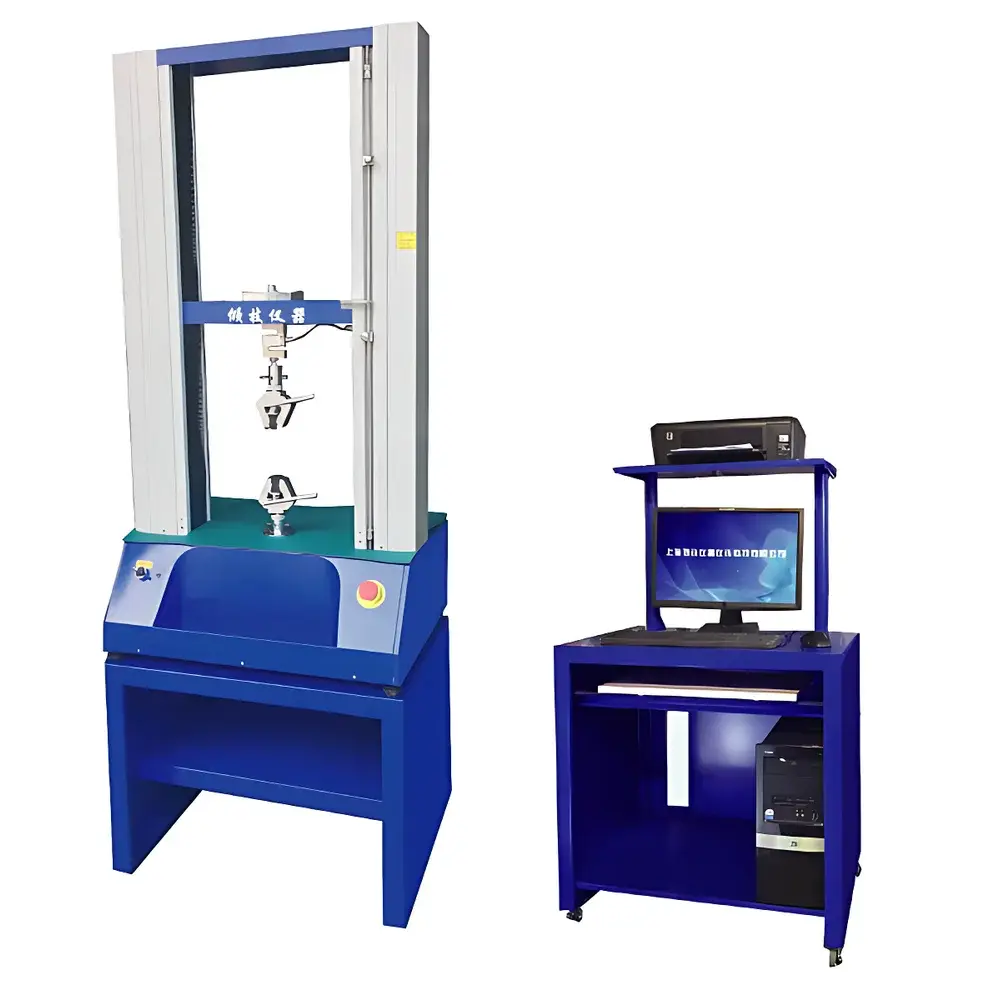
QJ211S-20KN Qinsun Universal Testing Machine
| Key | Load Capacity: 0–20 kN |
|---|---|
| Accuracy Class | 0.5 |
| Force Resolution | 500,000 counts (full-scale, no range switching) |
| Effective Test Width | 460 mm |
| Effective Stroke | 1500 mm (excluding fixtures) |
| Speed Range | 0.001–1000 mm/min |
| Speed Accuracy | ±0.5% of reading |
| Displacement Accuracy | ≤0.2% of reading |
| Strain Measurement Accuracy | ≤0.2% of reading |
| Noise Level | ≤76 dB(A) |
| Continuous Operation Time | ≥2000 h |
| Motor Power | 0.75 kW |
| Dimensions (W×D×H) | ≈670×600×2220 mm |
| Weight | ≈195 kg |
Overview
The QJ211S-20KN Qinsun Universal Testing Machine is a precision-engineered electromechanical system designed for static mechanical property evaluation of metallic and polymeric materials under uniaxial tensile, compressive, flexural, and cyclic loading conditions. Based on servo-controlled electromechanical actuation and high-fidelity closed-loop feedback architecture, the system complies with fundamental principles defined in ISO 7500-1 (static calibration of force-measuring systems), ASTM E4 (load verification of testing machines), and ISO 5893 (tensile testing machine verification). It delivers traceable force measurement across its full 0–20 kN capacity with class 0.5 accuracy per ISO 7500-1, enabling reliable determination of yield strength (Rp0.2), ultimate tensile strength (Rm), elongation at break (A%), Young’s modulus (E), and secant modulus—critical parameters for quality control, material certification, and R&D validation in wire, cable, spring, rebar, and fastener manufacturing.
Key Features
- High-stability load frame with rigid cast-iron base and reinforced steel crosshead structure, engineered for minimal deflection during high-load testing.
- 32-bit ARM-based microprocessor control system operating at 56 MIPS, supporting real-time data acquisition at up to 1 kHz sampling rate without aliasing or latency.
- Single-range, high-resolution force transducer (500,000 internal counts), eliminating range-switching artifacts and ensuring consistent resolution across 0.02%–100% of full scale.
- Bi-directional, brushless AC servo motor drive with 0.75 kW continuous rating and integrated regenerative braking—enabling precise speed control from 0.001 to 1000 mm/min (±0.5% accuracy).
- Dual-mode positioning: rapid coarse adjustment and fine incremental (point-to-point) movement for optimal fixture alignment and specimen preloading.
- Comprehensive hardware safety layer including electronic travel limits, overload cutoff (110% FS), emergency stop circuitry compliant with IEC 60204-1, and automatic return-to-home function post-test.
- Low-noise mechanical design (<76 dB(A) at 1 m distance) suitable for integration into shared laboratory environments and QA labs adjacent to office spaces.
Sample Compatibility & Compliance
The QJ211S accommodates standard test specimens per ASTM E8/E8M (metals), ASTM D638/D638M (plastics), ISO 6892-1 (metallic materials), ISO 527-1 (plastics), and GB/T 228.1 (Chinese national standard). Its 460 mm effective test width and 1500 mm vertical stroke support extended-length samples such as coiled springs, multi-strand cables, and structural reinforcement bars. Fixture adaptability includes wedge-action grips for wires and rods, compression platens (100 mm diameter), and three-point bending fixtures (span adjustable from 20–200 mm). All mechanical and electrical subsystems conform to CE marking requirements (2014/30/EU EMC Directive and 2006/42/EC Machinery Directive), and software operation supports audit trails aligned with GLP and GMP documentation practices.
Software & Data Management
The proprietary Qinsun TestMaster software provides ISO/IEC 17025-aligned test configuration, execution, and reporting workflows. It supports automated parameter derivation—including Rp0.2, Rm, A50mm, E-modulus, and tangent modulus—as well as custom calculation modules for stiffness, hysteresis, and fatigue cycle counting. Raw data export is available in CSV, XML, and universal .tdms formats; reports are generated in PDF with embedded digital signatures and timestamped metadata. The software architecture incorporates role-based access control, change history logging, and optional 21 CFR Part 11 compliance modules (electronic signatures, audit trail encryption, and user permission hierarchies) for regulated pharmaceutical and medical device testing environments.
Applications
- Tensile characterization of copper/aluminum conductors, steel cords, and stainless-steel wires per IEC 60853 and ASTM B33.
- Compression testing of elastomeric isolators, rubber bushings, and polymer foam blocks per ASTM D3574.
- Spring performance validation—including static load-deflection curves, relaxation behavior, and dynamic fatigue life (up to 10⁶ cycles using optional pneumatic cycling module).
- Mechanical qualification of welded joints, brazed assemblies, and adhesive bonds per AWS D1.1 and ISO 14272.
- Quality assurance of cold-formed fasteners, rivets, and threaded components per ISO 898-1 and ASTM F606.
- Educational use in university materials science laboratories for hands-on instruction in stress–strain theory and fracture mechanics fundamentals.
FAQ
What international standards does this UTM support out-of-the-box?
It natively supports test method templates and report formatting for ASTM E8, ISO 6892-1, GB/T 228.1, JIS Z2241, and DIN 50145, with customizable parameter mapping for non-standard protocols.
Is third-party calibration certification included with delivery?
Yes—a UKAS-accredited certificate of force calibration (traceable to NIM China) is provided upon shipment, covering all five verification points per ISO 7500-1 Annex B.
Can the system be integrated into an existing MES or LIMS environment?
Yes, via OPC UA server interface or RESTful API endpoints for bi-directional data exchange, including test initiation, status polling, and result ingestion.
What maintenance intervals are recommended for long-term reliability?
Preventive maintenance is advised every 1,500 operational hours or annually—whichever occurs first—with documented procedures for lubrication, transducer zero-check, and encoder alignment verification.
Does the controller support closed-loop strain control using extensometer feedback?
Yes, the system accepts analog inputs from clip-on or video extensometers (LVDT or CCD-based), enabling true closed-loop strain-rate control per ISO 6892-1 Annex C.
Related Products



