
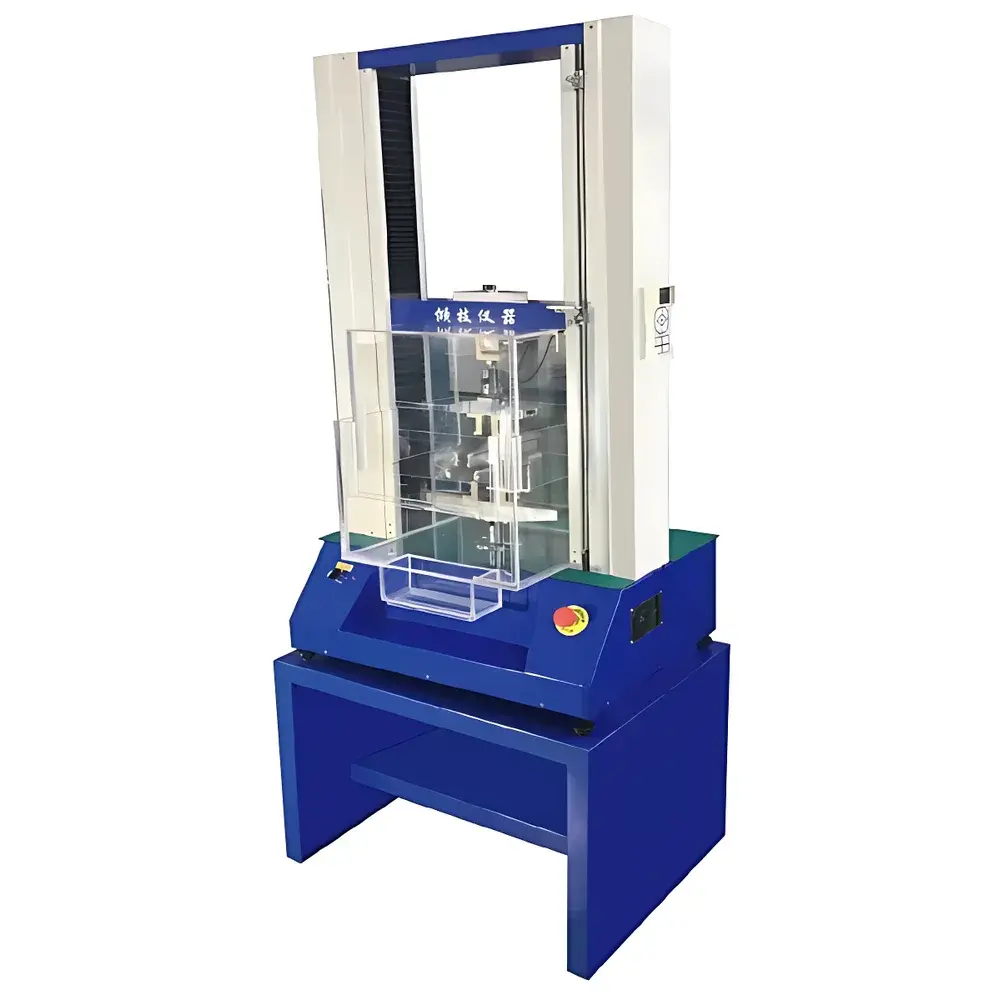
QJ211S-5KN Qingji Microcomputer-Controlled Three-Point and Four-Point Bending Testing Machine
| Brand | Qingji |
|---|---|
| Origin | Shanghai, China |
| Manufacturer Type | Authorized Distributor |
| Origin Category | Domestic (China) |
| Model | QJ211S-5KN |
| Load Capacity | 5 kN |
| Load Accuracy | ±0.5% FS |
| Effective Test Width | 400 mm |
| Effective Stroke | 500 mm |
| Test Speed Range | 0.01–500 mm/min |
| Speed Accuracy | ±0.5% of indicated value |
| Displacement Resolution | 0.025 µm |
| Force Resolution | 500,000 counts (full-scale, no range switching) |
| Position Measurement Accuracy | ±0.5% of reading |
| Deformation Measurement Accuracy | ±0.5% of reading |
| Overload Protection | Activates at >110% of rated load |
| Motor | 400 W, 220 V AC |
| Dimensions (L×W×H) | 500 × 450 × 1650 mm |
| Weight | 165 kg |
Overview
The Qingji QJ211S-5KN Microcomputer-Controlled Three-Point and Four-Point Bending Testing Machine is a precision electromechanical system engineered for standardized mechanical characterization of brittle and semi-brittle materials under flexural loading. Based on the principles of beam bending theory—governed by Euler–Bernoulli assumptions—the instrument applies controlled quasi-static loads to specimens supported in either three-point (single-span, central loading) or four-point (dual-span, uniform moment region) configurations. This enables quantitative determination of flexural strength (MOR), flexural modulus (elastic modulus in bending), yield deflection, fracture toughness indicators, and load–deflection linearity across a wide range of advanced ceramics, optical glasses, sapphire substrates, tempered smartphone cover plates, and thin-film-coated rigid substrates. The machine complies with core mechanical testing standards including ASTM C1161 (flexural strength of advanced ceramics), ISO 178 (plastics – determination of flexural properties), GB/T 232 (metallic materials – bend test), JIS R1601 (fine ceramics), and DIN EN 843-1 (advanced technical ceramics). Its closed-loop servo control architecture ensures high reproducibility and traceable force/displacement fidelity required for QC labs, R&D validation, and regulatory submission packages.
Key Features
- High-resolution dual-closed-loop control: Simultaneous real-time regulation of load (force) and crosshead displacement with independent feedback channels.
- 0.5-class accuracy certified per ISO 7500-1: Meets Class 0.5 requirements for static force measurement uncertainty (±0.5% of full scale).
- Full-range force resolution: 500,000 internal data points without auto-ranging—ensures consistent sensitivity from 0.4% to 100% of 5 kN capacity.
- Precision displacement sensing: Optical encoder-based position feedback with 0.025 µm resolution and ±0.5% linearity over 500 mm effective stroke.
- Programmable speed control: Adjustable test velocity from 0.01 to 500 mm/min, with speed stability maintained within ±0.5% of setpoint.
- Integrated safety architecture: Dual-mode electronic limit switches, overload cutoff (>110% FS), emergency stop circuitry, and motor-driven soft return functionality.
- Ergonomic test bed: 400 mm clear span width accommodates standard ceramic tile, glass sheet, and wafer-sized specimens; motorized rapid/slow height adjustment with jog capability.
Sample Compatibility & Compliance
The QJ211S-5KN supports standardized specimen geometries per ASTM C1161 (rectangular bars: 3.2 × 4 × 45–50 mm), ISO 178 (80 × 10 × 4 mm plastic strips), and GB/T 9341 (similar dimensions for polymer composites). It is routinely deployed for quality conformance testing of Gorilla Glass® variants, ALON™ transparent armor, lithium-aluminosilicate (LAS) glass-ceramics, and zirconia-toughened alumina (ZTA) substrates. All hardware and firmware comply with CE machinery directive (2006/42/EC) and electromagnetic compatibility (EMC) standards IEC 61326-1. Data acquisition meets GLP audit requirements through timestamped, non-editable raw data logs and configurable user access levels.
Software & Data Management
Equipped with Qingji’s proprietary QTest v4.2 software suite, the system delivers ISO/IEC 17025-aligned data handling: automatic calculation of flexural stress (σf = 3PL/2bd² for 3-pt; σf = PL/bd² for 4-pt), strain (ε = 6D/t²), modulus (Ef = L³m/4bd³), and fracture energy integrals. Raw force–displacement curves are exported in CSV and XML formats compatible with MATLAB®, Python (NumPy/Pandas), and JMP®. Audit trails record operator ID, calibration date, environmental conditions (optional sensor input), and parameter changes—supporting FDA 21 CFR Part 11 compliance when deployed with Windows domain authentication and digital signature modules.
Applications
- Flexural strength validation of display cover glass in consumer electronics manufacturing lines.
- Batch release testing of dental zirconia crowns per ISO 6872.
- R&D evaluation of thermal barrier coating adhesion on turbine blade substrates using controlled delamination onset detection.
- Mechanical screening of additive-manufactured ceramic lattice structures under monotonic bending.
- Quality assurance of solar panel front-sheet glass subjected to hail impact simulation pre-test conditioning.
- Teaching laboratories for materials science curricula covering brittle fracture mechanics and elastic–plastic transition behavior.
FAQ
What standards does this bending tester support out-of-the-box?
ASTM C1161, C133, C1424; ISO 178, 14125, 6872; GB/T 232, 9341, 1040.7; JIS R1601, R1602; DIN EN 843-1.
Can the system perform both three-point and four-point bending without hardware modification?
Yes—the support and loading fixtures are fully interchangeable via standardized T-slot mounting rails; no recalibration is required between configurations.
Is third-party calibration certification available?
Yes—Qingji provides optional NIST-traceable calibration certificates issued by CNAS-accredited laboratories (ISO/IEC 17025), valid for 12 months.
Does the software support automated report generation compliant with ISO 17025?
Yes—customizable templates include uncertainty budgets, equipment traceability, environmental metadata, and electronic signatures; reports export as PDF/A-2b for long-term archival.
What maintenance intervals are recommended for routine operation?
Biannual verification of force transducer linearity and encoder resolution; annual full-system metrological recalibration recommended for GMP environments.



