
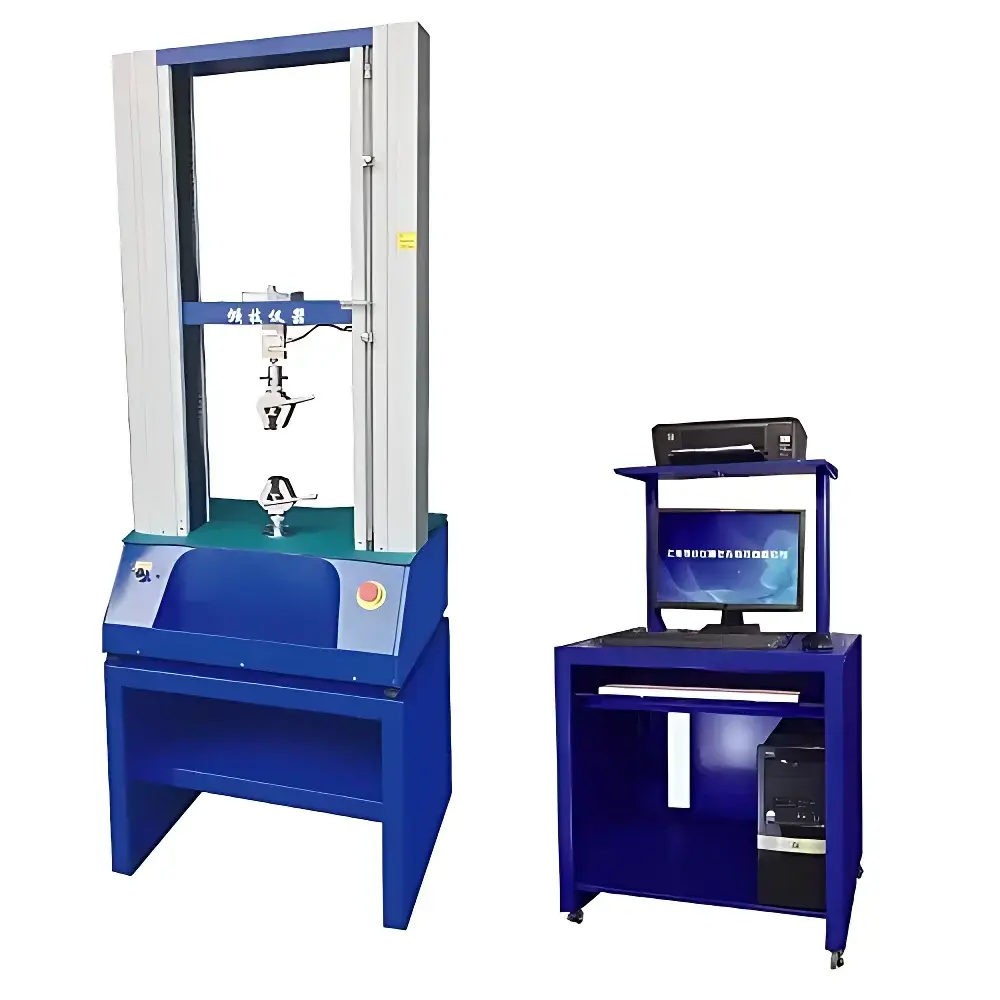
QJ211S Biomedical Material Mechanical Testing System
| Origin | Shanghai, China |
|---|---|
| Manufacturer Type | Authorized Distributor |
| Origin Category | Domestic (PRC) |
| Model | QJ211S |
| Price | USD 6,300 (FOB Shanghai) |
| Max Load Capacity | 10 kN |
| Force Accuracy Class | 0.5 |
| Effective Test Width | 320 mm |
| Effective Vertical Travel | 500 mm |
| Speed Range | 0.01–50,000 mm/min (standard configuration: 300 mm/min) |
| Speed Accuracy | ±0.5% of reading |
| Displacement Accuracy | ±0.5% of reading |
| Strain Measurement Accuracy | ±0.5% of reading |
| Force Resolution | 500,000 counts (full-scale, no auto-ranging required) |
| Motor Power | 400 W |
| Net Weight | 145 kg |
Overview
The QJ211S Biomedical Material Mechanical Testing System is a precision universal testing platform engineered for static and quasi-static mechanical characterization of soft and semi-rigid biological materials—including hydrogels, decellularized tissues, scaffolds, surgical meshes, suture materials, and polymer-based implants—within a 10 kN force range. It operates on the principle of controlled displacement or load-controlled actuation using a high-stiffness dual-column frame and servo-motor-driven crosshead, enabling compliance with fundamental mechanics-of-materials test protocols such as tensile, compression, flexural, puncture, peel, and cyclic bending. Designed for R&D laboratories, quality control units in medical device manufacturing, and academic biomechanics research groups, the system delivers traceable, repeatable data under ISO 17025-aligned operational conditions. Its modular architecture supports seamless integration of ASTM F2100, ISO 10993-12, YY/T 0681.13, and GB/T 1040.1-compliant test methods without hardware modification.
Key Features
- High-resolution force measurement with 500,000-count A/D conversion and full-scale linearity maintained across 0.2%–100% of 10 kN—no range switching required.
- Wide dynamic speed range (0.01–50,000 mm/min), programmable in real time; standard calibration verified per ISO 5893 for velocity accuracy (±0.5% of setpoint).
- Dual-mode motion control: closed-loop displacement control and load control, both compliant with ASTM E4 and ISO 7500-1 calibration traceability requirements.
- Integrated electronic limit protection, mechanical end-stop redundancy, and over-load shutdown at 110% of maximum rated capacity (11 kN).
- Motorized crosshead with independent fast/slow jog modes and programmable return-to-start functionality—enabling rapid sample setup and post-test recovery.
- Windows-based proprietary software with real-time plotting, multi-curve overlay, point-wise data interrogation, and export to CSV, Excel, or PDF formats.
- Modular fixture interface compatible with ISO/ASTM-standard grips, three-point bend fixtures, puncture probes (e.g., 1.6 mm blunt-tip), and custom-designed clamping solutions for fragile or hydrated specimens.
Sample Compatibility & Compliance
The QJ211S accommodates specimens ranging from thin films (<0.1 mm thickness) to bulk tissue analogues (up to 50 mm height), with adjustable grip spacing and low-force sensitivity suitable for preconditioning protocols and viscoelastic relaxation studies. All mechanical outputs—including stress-strain curves, modulus derivation (Young’s, secant, tangent), yield point identification, and failure energy calculation—are generated in accordance with internationally recognized standards including ASTM D638 (tensile), ASTM D790 (flexure), ISO 6892-1 (metallic analogs), YY/T 0149 (medical device biocompatibility mechanical testing), and GB/T 228.1. The system meets GLP documentation requirements via audit-trail-enabled software logging (user ID, timestamp, parameter changes, raw data checksums), and supports FDA 21 CFR Part 11 readiness when deployed with validated Windows OS configurations and networked user authentication.
Software & Data Management
The embedded Windows application provides full test method scripting, automated sequence execution (e.g., preconditioning → ramp → hold → unloading), and real-time statistical feedback (mean, SD, CV%) across replicate tests. Raw force-displacement data are stored in binary format with metadata headers (operator, date, sample ID, environmental notes). Curve analysis tools include automatic peak detection, linear region selection for modulus computation, hysteresis loop quantification, and strain-rate-dependent parameter extraction. Exported datasets retain SI-unit consistency (N, mm, MPa, %) and comply with laboratory information management system (LIMS) ingestion protocols. Software updates—including new standard templates and enhanced reporting modules—are provided free of charge for the lifetime of the instrument, subject to hardware compatibility verification.
Applications
- Mechanical validation of 3D-bioprinted constructs under uniaxial tension/compression
- Failure mode analysis of absorbable sutures and hernia repair meshes
- Time-dependent creep and stress-relaxation profiling of collagen-based hydrogels
- Interfacial adhesion strength assessment of tissue-engineered skin grafts
- Compression modulus mapping of cartilage-mimetic scaffolds (ISO 13314)
- Puncture resistance evaluation of wound dressings and barrier films (ASTM F1306)
- Quality conformance testing for ISO 13485-certified medical device manufacturers
FAQ
Is the QJ211S compliant with FDA 21 CFR Part 11 for electronic records?
Yes—when configured with domain-authenticated Windows accounts, disabled local admin privileges, and enabled audit trail logging, the system satisfies core Part 11 requirements for signature attribution, data integrity, and change control.
Can the system perform cyclic loading tests?
Yes—the software supports programmable multi-step waveforms (sine, triangle, square) with user-defined frequency, amplitude, and dwell intervals, enabling fatigue and hysteresis analysis.
What calibration documentation is supplied?
Each unit ships with a factory-issued calibration certificate traceable to NIM (China National Institute of Metrology), covering force (10 kN load cell), displacement (linear encoder), and speed (rotary encoder), valid for 12 months.
Are custom fixtures available for non-standard specimen geometries?
Yes—our engineering team provides CAD-supported design and CNC fabrication of application-specific grips, platens, and environmental chambers (e.g., saline submersion rigs) under NDA.
Does the warranty cover software updates and technical support?
Yes—the standard 12-month comprehensive warranty includes remote diagnostics, firmware patches, and unlimited email/phone support; extended service plans include on-site annual verification and metrological recalibration.



