
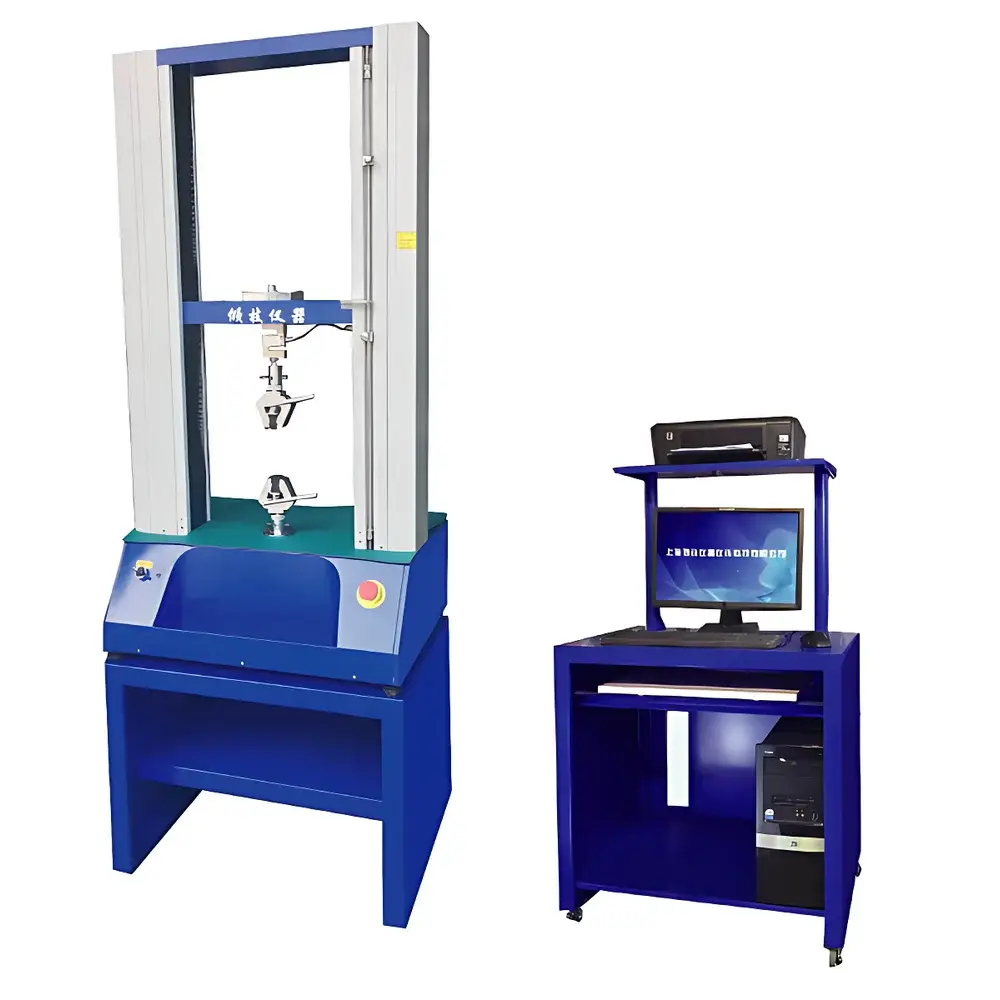
QJ211S Desktop Universal Testing Machine with Microcomputer Control and Adjustable Crosshead Speed
| [Origin | Shanghai, China |
|---|---|
| Type | Electromechanical Universal Testing Machine |
| Max Load Capacity | 10 kN |
| Load Accuracy Class | 0.5 |
| Force Resolution | 500,000 counts (full-scale, no range switching) |
| Effective Test Width | 320 mm |
| Effective Vertical Travel | 500 mm |
| Speed Range | 0.01–500 mm/min (standard configuration: up to 300 mm/min) |
| Speed Accuracy | ±0.5% of indicated value |
| Displacement Accuracy | ±0.5% of indicated value |
| Strain Measurement Accuracy | ±0.5% of indicated value |
| Motor Power | 400 W |
| Net Weight | 145 kg |
| Compliance | ASTM E4, E8, E21, ISO 6892-1, GB/T 228.1, JIS Z 2241, DIN 50125] |
Overview
The QJ211S Desktop Universal Testing Machine is an electromechanical static testing system engineered for high-reproducibility tensile, compression, flexure, puncture, peel, and bend testing of metallic, polymeric, composite, and biological specimens within a 10 kN load capacity. It operates on the principle of controlled crosshead displacement driven by a precision AC servo motor and planetary gear reducer, enabling accurate force–displacement–strain data acquisition under closed-loop feedback control. Designed for R&D laboratories, QC departments, and academic institutions, the system meets the mechanical testing requirements of materials science, biomedical engineering, packaging validation, and regulatory-compliant product development. Its modular architecture supports interchangeable load cells, extensometers, environmental chambers, and custom fixtures—ensuring adaptability across diverse specimen geometries and mechanical behavior regimes.
Key Features
- Microcomputer-controlled operation with Windows-based software for real-time graphical display of stress–strain, load–extension, and time-based curves.
- Adjustable crosshead speed ranging from 0.01 mm/min to 500 mm/min (extendable to 50,000 mm/min per optional calibration), with speed accuracy maintained at ±0.5% of setpoint.
- High-resolution force measurement: 500,000 internal counts over full scale; no manual or automatic range switching required—ensures consistent resolution across 0.2% to 100% of full-scale load (10 kN).
- Dual-speed motorized crosshead actuation: fast approach (for positioning) and fine-tuning (for test execution), with programmable acceleration/deceleration profiles.
- Integrated electronic limit protection and mechanical end-stop safeguards prevent overtravel damage during operation or failure events.
- Automatic return-to-start functionality post-fracture or test completion, configurable via software or manual override.
- Real-time curve traversal, overlay, zoom, and point-wise data extraction—including instantaneous load, displacement, and calculated strain values.
- Full digital signal conditioning with temperature-compensated strain gauge amplification and anti-aliasing filtering to minimize noise in low-force regimes.
Sample Compatibility & Compliance
The QJ211S accommodates specimens up to 320 mm wide and 500 mm tall between grips, supporting standardized dog-bone, sheet, film, filament, and tissue samples. Optional fixtures include wedge-action tensile grips, pneumatic clamps, three/four-point bending assemblies, puncture probes, and peel testers—all compliant with ISO 527, ASTM D638/D790/D882/D3763, GB/T 228.1–2021, YY/T 0681.12 (medical packaging), and ISO 11607-2. The system supports audit-ready data integrity through timestamped test logs, user-access controls, and exportable XML/CSV reports. While not inherently 21 CFR Part 11 compliant out-of-the-box, it can be validated for GLP/GMP environments when deployed with documented SOPs, electronic signature protocols, and periodic performance verification per ASTM E74 and ISO/IEC 17025 guidelines.
Software & Data Management
The proprietary Windows application provides intuitive test method setup—including force-controlled, displacement-controlled, and strain-controlled modes—with preloaded templates for ASTM, ISO, and GB standards. All raw data are stored in binary format with metadata (operator ID, date/time, calibration status, environmental notes). Export options include PDF reports with embedded graphs, Excel-compatible CSV files, and image snapshots of live curves. Software features include automatic zeroing at test initiation, auto-scaling of axes, customizable pass/fail criteria with audible alerts, and batch processing for multi-specimen comparisons. Audit trails record all parameter changes, data edits, and report generations—enabling traceability for internal quality reviews or external accreditation audits.
Applications
- Tensile characterization of thermoplastics, elastomers, hydrogels, and soft tissues (e.g., tendon, skin, vascular grafts).
- Compression testing of foams, pharmaceutical tablets, and orthopedic biomaterials.
- Flexural modulus and strength evaluation of composites and laminates per ASTM D790.
- Puncture resistance of medical device packaging (ISO 11607-2) and protective films.
- Peel adhesion testing of pressure-sensitive tapes and wound dressings (ASTM D903).
- Creep and stress-relaxation profiling under constant load or displacement conditions (with extended runtime configuration).
- Educational use in materials science curricula for hands-on demonstration of Hooke’s law, yield point, ultimate tensile strength, and fracture toughness principles.
FAQ
What is the maximum load capacity and accuracy class of the QJ211S?
The QJ211S has a maximum rated load of 10 kN and conforms to ISO 7500-1 / ASTM E4 Class 0.5 accuracy requirements for force measurement.
Can the system perform tests beyond tensile and compression?
Yes—it supports flexure, puncture, peel, and bend testing using optional fixtures calibrated per relevant international standards.
Is the software compatible with modern Windows OS versions?
The current release supports Windows 10 and 11 (64-bit); legacy compatibility with Windows 7 is maintained for migration-critical installations.
Does the machine support extensometer integration?
Yes—both clip-on and non-contact video extensometers can be interfaced via analog/digital I/O ports for high-fidelity strain measurement independent of crosshead motion.
What maintenance is required to sustain metrological performance?
Annual verification against traceable standards is recommended; routine checks include grip alignment, load cell zero stability, and encoder calibration—documented in the included maintenance log template.



