
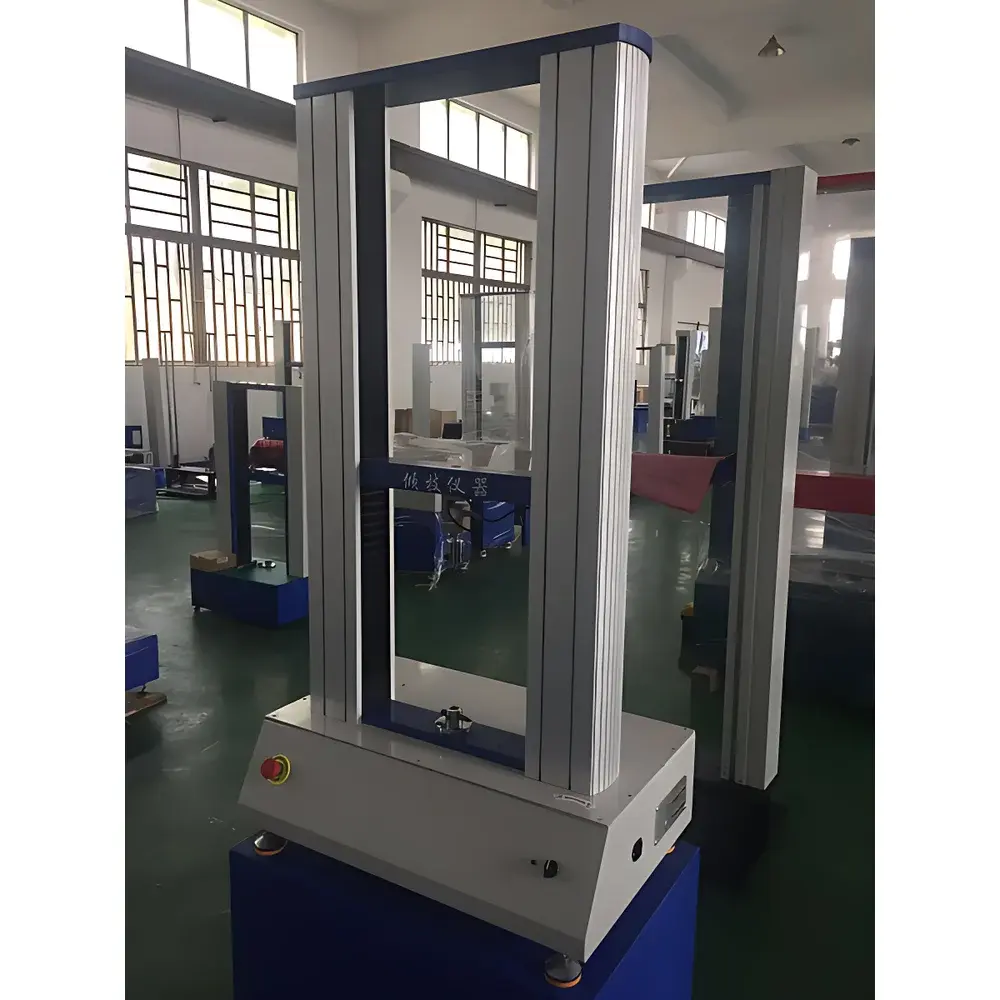
QJ211S Graphite Flexural Strength Testing Machine
| Origin | Shanghai, China |
|---|---|
| Manufacturer Type | Authorized Distributor |
| Regional Origin | Domestic (China) |
| Model | QJ211S |
| Price | USD 6,300 (FOB Shanghai) |
| Load Capacity | 10 kN |
| Force Accuracy Class | 0.5 |
| Effective Test Width | 320 mm |
| Effective Vertical Travel | 500 mm |
| Speed Range | 0.01–500 mm/min (standard configuration: 300 mm/min) |
| Speed Accuracy | ±0.5% of indicated value |
| Displacement Accuracy | ±0.5% of indicated value |
| Strain Measurement Accuracy | ±0.5% of indicated value |
| Motor Power | 400 W |
| Net Weight | 145 kg |
Overview
The QJ211S Graphite Flexural Strength Testing Machine is a high-precision universal testing system engineered for the mechanical characterization of brittle and semi-brittle carbon-based materials—particularly isotropic and anisotropic graphite grades used in nuclear, aerospace, EDM, and high-temperature furnace applications. It operates on the principle of three-point or four-point bending per ASTM C651, ISO 24579, and GB/T 17200, delivering repeatable flexural strength (MOR), modulus of elasticity (MOE), and fracture behavior data under controlled displacement or load control. Its rigid dual-column frame, precision-ground ball screws, and high-resolution force transduction architecture ensure minimal compliance and excellent signal fidelity across low-force (<100 N) and high-force (up to 10 kN) regimes—critical for capturing the nonlinear stress–strain response typical of graphitic ceramics. Designed for laboratory environments requiring GLP-compliant documentation and traceable calibration, the system meets essential metrological requirements defined in ISO/IEC 17025 for mechanical testing laboratories.
Key Features
- Full-range force resolution of 500,000 counts without internal range switching—ensuring consistent resolution from 0.2% to 100% of full scale (10 kN)
- Dual-speed crosshead actuation with programmable fast approach (for setup) and precise test-speed control (0.01–500 mm/min), compliant with ASTM D790 and ISO 178 rate specifications
- Integrated electronic limit switches and mechanical hard stops provide redundant overload protection—automatically halting motion at >110% of rated load
- Motorized crosshead return with both manual override and post-test auto-return functionality, minimizing operator intervention between specimens
- Modular sensor interface supporting interchangeable load cells (e.g., 100 N, 1 kN, 10 kN) to maintain optimal signal-to-noise ratio across diverse sample geometries and strength classes
- Real-time dynamic display of force–displacement, stress–strain, and time-based curves during testing; all raw data captured at ≥100 Hz sampling rate
- Onboard calibration verification protocol enabling traceable force recalibration using certified reference standards per ISO 7500-1
Sample Compatibility & Compliance
The QJ211S accommodates standard graphite test bars per GB/T 17200 (rectangular cross-section: 6 mm × 6 mm × 40 mm or 10 mm × 10 mm × 50 mm), ASTM C651 (cylindrical rods), and ISO 24579 (flexural specimens up to 320 mm span width). Fixture options include adjustable three-point bending supports with hardened steel rollers (R5 mm radius), four-point bending fixtures with parallel loading pins, and custom jaw sets for compression or tensile testing of machined graphite coupons. The system complies with national and international standards including GB/T 1040.2 (plastics), GB/T 13022 (film tensile), GB/T 16491 (universal testing machines), and ISO 527-2. All measurement functions support audit-ready metadata logging required for FDA 21 CFR Part 11–aligned workflows when paired with validated software modules.
Software & Data Management
The embedded Windows-based control and analysis suite provides full I/O synchronization, real-time curve overlay, and automated report generation in PDF/XLS formats. Each test record includes timestamped environmental metadata (operator ID, ambient temperature/humidity if integrated sensors are present), instrument configuration snapshot, raw channel data (force, displacement, extensometer if attached), and calculated parameters (flexural strength σf, elastic modulus Ef, deflection at break). Data files conform to ASTM E1434 and ISO/IEC 17025 traceability requirements—supporting electronic signatures, version-controlled templates, and configurable audit trails. Optional software upgrades enable advanced statistical process control (SPC) charts, Weibull modulus calculation for strength distribution analysis, and export to LIMS via ASTM E1578-compliant XML schema.
Applications
This system serves as a primary qualification tool for graphite manufacturers validating batch consistency in extruded, molded, or vibration-isostatically pressed (VIP) grades. It supports R&D labs evaluating oxidation-resistant coatings, thermal shock resistance via cyclic flexural testing, and irradiation-induced embrittlement studies (in collaboration with nuclear research facilities). Universities utilize it for teaching fundamental mechanics of materials concepts—including fracture initiation, crack propagation thresholds, and microstructure–property correlations via SEM-EDS correlation workflows. Quality control departments in EDM electrode producers rely on its repeatability (CV < 1.2% for MOR on identical specimens) to enforce incoming material specifications against ISO 8545-3 and DIN 6919.
FAQ
Does the QJ211S comply with ASTM C651 for graphite flexural testing?
Yes—the machine’s load train accuracy (Class 0.5), displacement resolution, and fixture geometry meet all dimensional and performance criteria specified in ASTM C651-22 for room-temperature flexural strength evaluation.
Can the system be calibrated to national metrology institute (NMI) standards?
Yes—force calibration is traceable to NIM (China National Institute of Metrology) via accredited third-party providers; certificate includes uncertainty budget per ISO/IEC 17025 Annex A.
Is remote diagnostics and firmware update supported?
Yes—secure SSH-enabled remote access allows authorized engineers to perform health checks, parameter optimization, and over-the-air firmware updates without onsite visits.
What is the recommended maintenance schedule?
Biannual inspection of ball screw lubrication, guide rail alignment, and load cell zero drift verification is advised; full metrological recalibration every 12 months or after 5,000 test cycles.
Are custom grips or environmental chambers available?
Yes—custom-designed graphite-specific fixtures (e.g., low-friction ceramic-coated supports) and optional 23–200 °C environmental chambers with PID-controlled air circulation are available under OEM agreement.



