
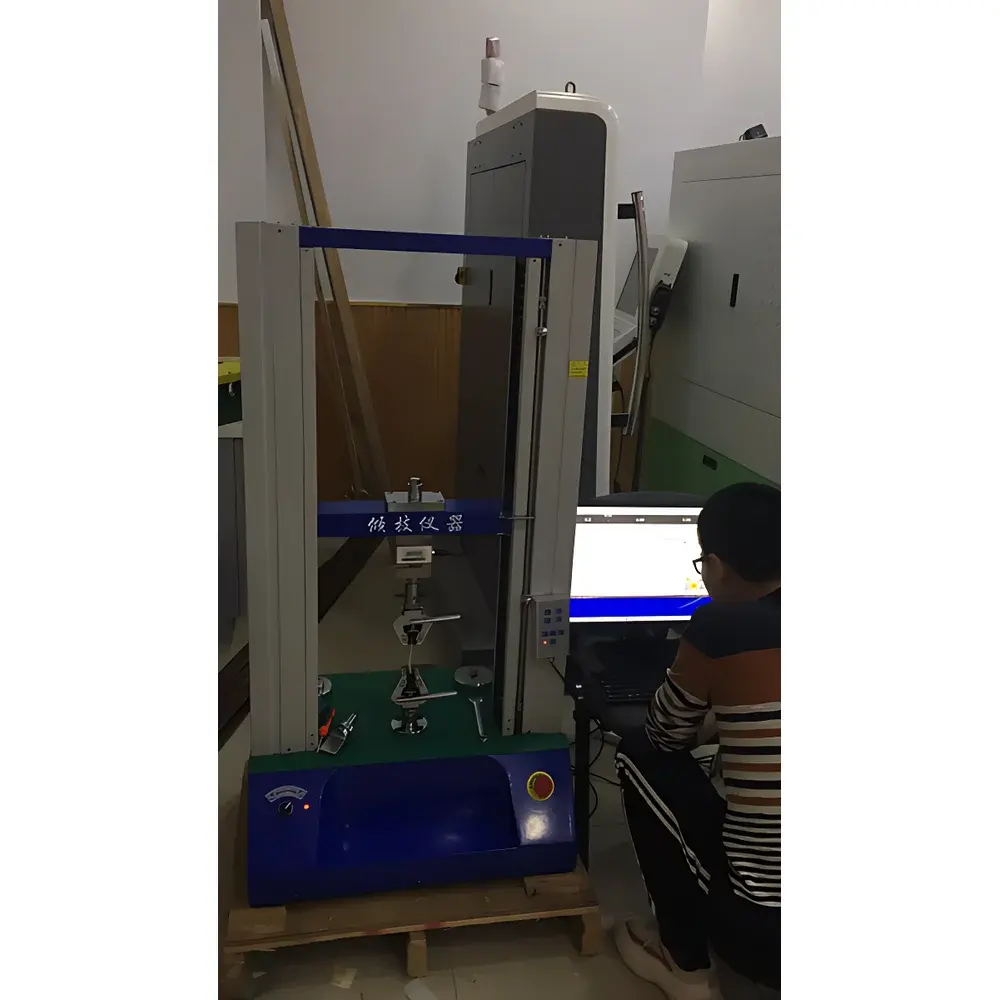
QJ211S Microcomputer-Controlled Electromechanical Tensile-Torsion Testing Machine
| Origin | Shanghai, China |
|---|---|
| Manufacturer Type | Authorized Distributor |
| Origin Category | Domestic (PRC) |
| Model | QJ211S |
| Price | USD 7,700 (FOB Shanghai) |
| Instrument Type | Electromechanical Universal Testing Machine |
| Max. Tensile Force | 30 kN |
| Max. Torque | ±100 N·m |
| Force Measurement Range | 0.2–100% of Full Scale (FS) |
| Force Accuracy | ±0.5% of reading |
| Force Resolution | 1/500,000 of full-scale load |
| Crosshead Travel | 800 mm |
| Displacement Resolution | ±0.5% of indicated value |
| Tensile Speed Range | 0.001–500 mm/min |
| Torsional Speed Range | 0.1–720 °/min |
| Angular Position Range | 0° to ±999° |
| Load Cell Class | ISO 7500-1 Class 0.5 |
| Control System | Real-time closed-loop microprocessor-based servo control |
Overview
The QJ211S Microcomputer-Controlled Electromechanical Tensile-Torsion Testing Machine is a dual-axis universal testing system engineered for high-fidelity mechanical characterization of structural and functional materials under combined axial and torsional loading. It operates on a precision electromechanical drive architecture with synchronized closed-loop control of both linear displacement (via ball-screw-driven crosshead) and angular rotation (via servo-motor-coupled torque actuator), enabling true biaxial stress-state simulation in accordance with ASTM E2209, ISO 14577-2, and GB/T 228.1–2021 standards. Unlike conventional uniaxial tensile testers, the QJ211S integrates real-time force-torque-displacement-angle synchronization, allowing users to execute standardized tension, compression, bending, peel, shear, torsion, and combined tension-torsion protocols — critical for evaluating anisotropic behavior in composites, wire rope fatigue, threaded fastener integrity, biomedical implant coatings, and elastomeric couplings.
Key Features
- Integrated dual-actuation system: independently controllable high-resolution linear actuator (30 kN capacity) and coaxial rotary actuator (±100 N·m torque) with phase-synchronized motion profiles
- Class 0.5 load cell per ISO 7500-1, calibrated traceable to NIM (National Institute of Metrology, China), delivering force accuracy of ±0.5% of reading across 0.2–100% FS
- Real-time digital servo control with sampling rate ≥1 kHz, supporting dynamic ramp-hold-step loading sequences and programmable multi-segment test routines
- High-stiffness cast-iron frame with four-column guided crosshead, ensuring axial alignment deviation 2.5 × 10⁶ N·m/rad
- Optical encoder-based displacement measurement (800 mm travel) and absolute rotary encoder for angular position (±999° range, resolution <0.01°)
- Compliance with electromagnetic compatibility (EMC) per IEC 61326-1 and safety requirements per GB/T 2611–2021 (equivalent to ISO 7500-1 Annex B)
Sample Compatibility & Compliance
The QJ211S accommodates specimens ranging from miniature metallic wires (Ø0.1 mm) to structural polymer bars (up to 50 mm × 50 mm cross-section) using interchangeable grips (pneumatic, wedge, hydraulic, and custom-threaded fixtures). Its modular design supports ASTM D638 (tensile plastics), ASTM D143 (wood), ISO 6892-1 (metallic materials), ISO 527-2 (polymer films), and ISO 14130 (short-beam shear for composites). All hardware and firmware comply with GLP documentation requirements, including audit-trail-enabled test log generation, electronic signature support, and user-access-level management (admin/operator/viewer). Data output conforms to ASTM E1434 and ISO/IEC 17025 traceability frameworks.
Software & Data Management
The bundled TestMaster Pro v4.2 software provides ISO 17025-compliant test method definition, real-time curve overlay (force vs. displacement, torque vs. angle, shear stress vs. strain), automatic yield point detection per ASTM E8/E2209, and customizable report templates exportable as PDF, Excel, or XML. Raw data files are stored in HDF5 format with embedded metadata (operator ID, calibration timestamp, environmental conditions, instrument serial number). The system supports FDA 21 CFR Part 11 compliance via optional digital certificate integration, role-based access control, and immutable audit logs recording all parameter modifications, test executions, and data exports.
Applications
- Mechanical qualification of orthopedic screws and spinal rods under simultaneous axial preload and torsional fatigue
- Interfacial adhesion strength assessment of thermally sprayed coatings via torsional peel testing
- Constitutive modeling of shape-memory alloys using coupled tension-torsion hysteresis loops
- Quality control of automotive CV joint boots under cyclic torsion-compression loading
- Standardized evaluation of textile fiber twist retention and yarn tensile degradation
- Research-grade validation of finite element models for bolted joint behavior under combined loading
FAQ
Does the QJ211S support fully automated test sequences with conditional branching (e.g., stop on fracture, hold at yield)?
Yes — TestMaster Pro enables logic-based scripting (IF/THEN/ELSE) for adaptive test control, including event-triggered pauses, load-unload cycles, and real-time pass/fail decision gates based on user-defined thresholds.
Is third-party calibration certification included with delivery?
A factory calibration certificate traceable to NIM is provided; optional UKAS-accredited calibration (ISO/IEC 17025) is available upon request prior to shipment.
Can the system be integrated into a laboratory LIMS environment?
Yes — via OPC UA server interface and RESTful API, supporting bidirectional data exchange with major LIMS platforms (e.g., LabVantage, Thermo Fisher SampleManager) for automated sample ID injection and result ingestion.
What maintenance intervals are recommended for long-term metrological stability?
Load cell and encoder verification every 12 months; ball screw lubrication and grip jaw inspection every 6 months; full mechanical alignment check annually per GB/T 2611–2021 Section 8.3.



