
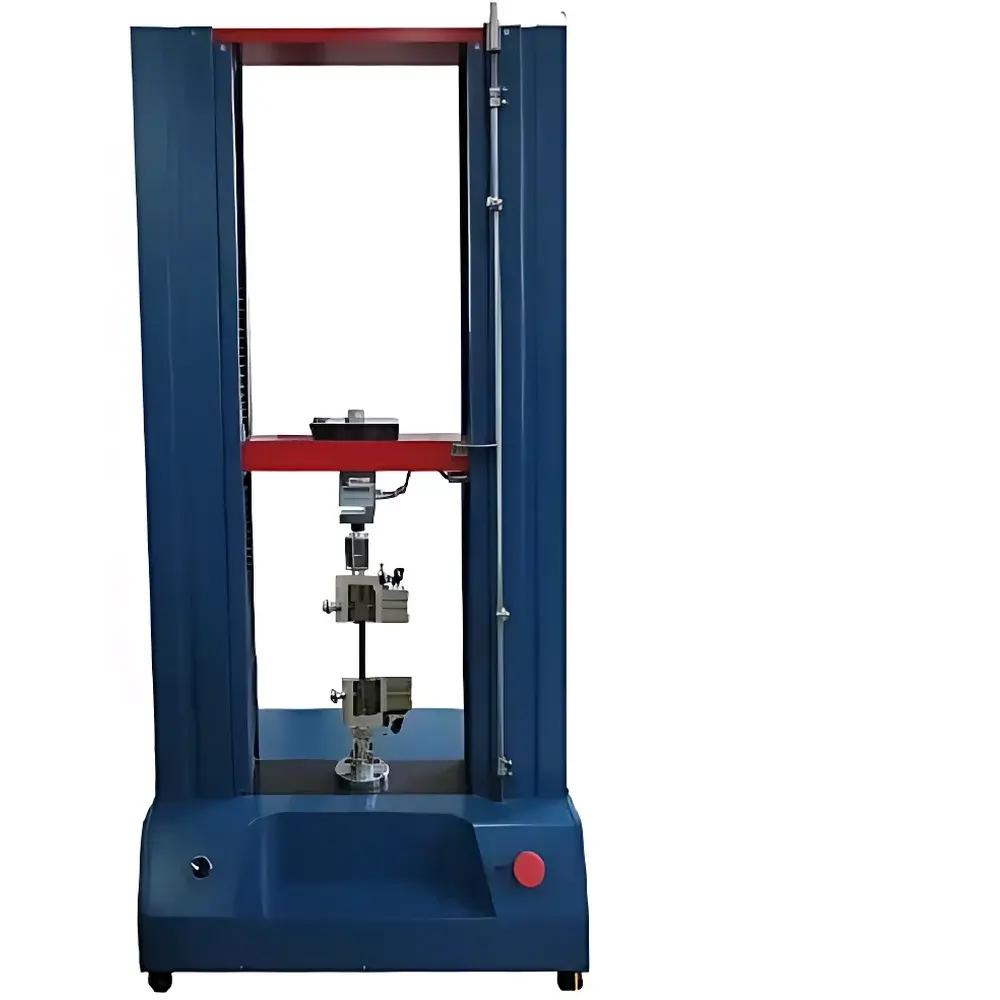
QJ211S Three-Point Bending Tester – Universal Testing Machine
| Origin | Shanghai, China |
|---|---|
| Manufacturer Type | Authorized Distributor |
| Origin Category | Domestic (PRC) |
| Model | QJ211S |
| Price Range | USD 1,400–7,000 |
| Instrument Type | Electromechanical Universal Testing Machine |
| Max Load Capacity | 10 kN |
| Load Cell Accuracy | ±0.01% FS |
| Measurement Accuracy | ±0.5% |
| Test Speed Range | 0.001–500 mm/min |
| Speed Accuracy | ±0.5% |
| Stroke Accuracy | ±0.5% |
| Displacement Accuracy | ±0.5% |
| Effective Test Width | 420 mm |
| Effective Stroke | 800 mm |
| Safety Features | Electronic travel limit protection, emergency stop button |
| Unit Weight | ~140 kg |
Overview
The QJ211S Three-Point Bending Tester is an electromechanical universal testing machine engineered for high-reproducibility mechanical characterization of rigid and semi-rigid materials under controlled flexural loading conditions. Based on the classical Euler–Bernoulli beam theory, the system applies a concentrated load at the midspan of a horizontally supported specimen—resting on two parallel knife-edge supports—to quantify flexural modulus, bending strength, fracture toughness, and load-deflection behavior. Designed to comply with standardized test geometries defined in ASTM D790, ISO 178, JIS K7203, and DIN EN ISO 14125, the instrument delivers traceable, repeatable data across research laboratories, quality control departments, and R&D centers in ceramics, composites, polymer laminates, thin-film substrates, and tempered glass industries—including smartphone cover glass validation per IEC 60529 and MIL-STD-810G Annex G.
Key Features
- Modular three-point bending fixture assembly with precision-ground support rollers and adjustable center-loading nose—ensuring consistent span-to-depth ratio (e.g., 16:1 or 32:1) per ISO 178 requirements.
- High-resolution load cell (±0.01% full scale) coupled with closed-loop servo control for stable force ramping and dwell hold during quasi-static bending tests.
- Real-time synchronized acquisition of load, displacement, and strain (via optional extensometer or digital image correlation interface), all displayed dynamically on integrated LCD panel and mirrored to Windows-based software.
- Full-electronic safety architecture including programmable stroke limits, hardware-triggered emergency stop, and automatic load cutoff upon specimen failure detection.
- Robust dual-column frame with reinforced crosshead guidance and low-friction ball-screw drive, minimizing parasitic bending moments and ensuring axial alignment within ±0.1° over full stroke (800 mm).
- Compliant with GLP/GMP documentation workflows: audit-trail-enabled test method storage, user-level access control, and electronic signature support per FDA 21 CFR Part 11 when configured with validated software modules.
Sample Compatibility & Compliance
The QJ211S accommodates specimens up to 420 mm wide and 800 mm long, supporting standard rectangular bars (e.g., 10 × 4 mm, 12.7 × 3.2 mm), thin plates (≥0.5 mm thickness), brittle ceramics (Al₂O₃, ZrO₂), fiber-reinforced polymers, and chemically strengthened aluminosilicate glass (e.g., Gorilla Glass). Fixture adaptability extends to four-point bending configurations for uniform moment distribution and reduced shear interference—enabling compliance with ASTM C1161 for advanced ceramics or ISO 14125 for fiber composites. All test procedures adhere to international calibration traceability standards (ISO/IEC 17025) and are compatible with third-party verification against national metrology institutes (e.g., CNAS-accredited labs in China, UKAS in the UK).
Software & Data Management
Control and analysis are executed via Windows-native software compliant with IEC 62304 Class B medical device software guidelines. The platform supports customizable test templates, multi-curve overlay, derivative calculation (dF/dδ), automatic yield point detection per ASTM E111, and export to CSV, XML, or PDF formats with embedded metadata (operator ID, timestamp, environmental conditions). Raw data files retain unprocessed sensor timestamps at ≥1 kHz sampling rate, enabling post-hoc reanalysis without loss of fidelity. Version-controlled method libraries allow secure deployment across distributed lab networks, while encrypted database backups ensure data integrity per ISO 27001 information security protocols.
Applications
- Flexural property certification of structural adhesives per ASTM D1002 and ISO 4587.
- Quality assurance of display cover glass (e.g., ion-exchanged alkali-aluminosilicate) under three-point bend fatigue cycling (50–1000 cycles at 1–10 Hz).
- Mechanical screening of additive-manufactured metal and polymer parts for anisotropic stiffness variation across build layers.
- Validation of biodegradable polymer scaffolds (PLA, PCL) for orthopedic implant applications per ISO 13314.
- Interlaminar shear strength assessment of prepreg composites using modified short-beam shear geometry.
- Creep and stress-relaxation profiling under constant flexural load (ISO 899-1/2) with temperature-controlled environmental chamber integration.
FAQ
Does the QJ211S support both three-point and four-point bending configurations?
Yes—standard three-point fixtures are included; four-point bending kits (with dual loading noses and adjustable outer/inner spans) are available as optional accessories calibrated per ASTM D6272.
Can test data be exported in formats compliant with LIMS integration?
Yes—CSV, XML, and structured PDF exports include all raw channel data, metadata headers, and digital signatures required for LIMS ingestion and regulatory submission.
Is the system suitable for accredited testing laboratories?
When operated with certified calibration certificates (traceable to NIM or NIST), documented SOPs, and validated software, the QJ211S meets ISO/IEC 17025 technical requirements for routine mechanical testing.
What environmental conditions are recommended for optimal accuracy?
Ambient temperature stability within ±2°C (20–25°C), relative humidity 30–60% RH, and vibration-isolated benchtop mounting are advised per ISO 2041.
How is traceability maintained for load cell calibration?
Each unit ships with a factory calibration certificate referencing primary standards; annual recalibration by an ISO/IEC 17025-accredited provider is recommended to maintain measurement uncertainty budgets.



